







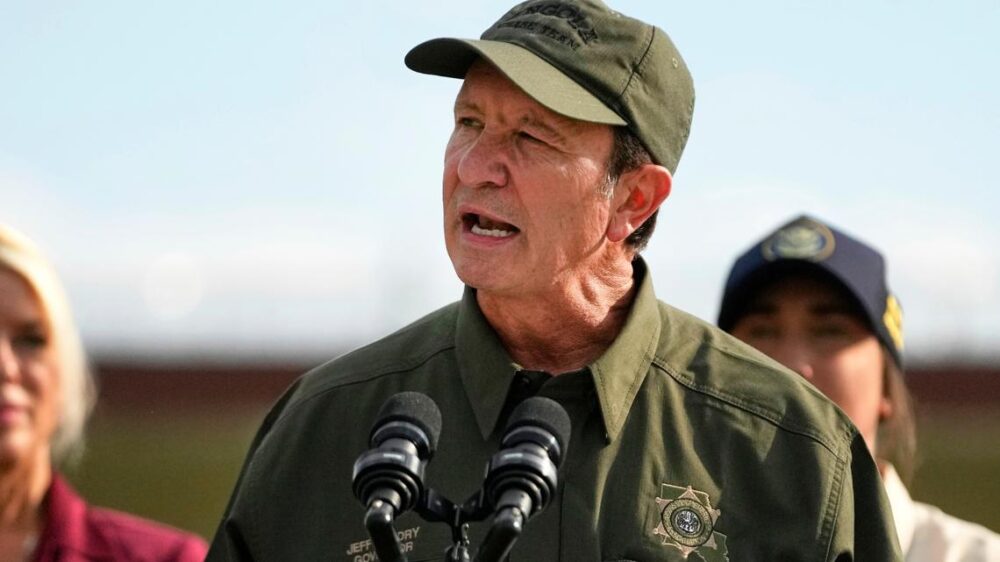
Fresh diplomatic tensions have erupted between the United States and Denmark after U.S. President Donald Trump announced the appointment of Louisiana Governor Jeff Landry as Washington’s special envoy to Greenland, reviving fears in Europe over American ambitions toward the strategically vital Arctic territory.
Leaders in both Denmark and Greenland responded forcefully on Monday, insisting that the United States has no claim over the semi-autonomous island and demanding respect for their territorial integrity under international law.
“We have said it before. Now, we say it again,” Danish Prime Minister Mette Frederiksen and Greenland’s Prime Minister Jens-Frederik Nielsen said in a rare joint statement. “National borders and the sovereignty of states are rooted in international law. They are fundamental principles. You cannot annex another country — not even with an argument about international security.”
“Greenland belongs to the Greenlanders, and the U.S. shall not take over Greenland,” the statement added. “We expect respect for our joint territorial integrity.”
Trump’s announcement on Sunday, made via his social media platform Truth Social, immediately reignited a long-simmering dispute over Washington’s interest in Greenland, a vast, mineral-rich Arctic island that is part of the Kingdom of Denmark and a fellow NATO ally. Trump praised Landry as uniquely suited for the role, writing that the Louisiana governor “understands how essential Greenland is to our National Security” and would “strongly advance our country’s interests for the safety, security, and survival of our allies — and indeed, the world.”
Landry, a Republican who has served as governor since early 2024, embraced the appointment enthusiastically. In a social media post, he described the role as a “volunteer position” and called it “an honor to serve,” adding pointedly that he would work to “make Greenland a part of the U.S.” He stressed that the appointment would not affect his duties as governor of Louisiana.
Those remarks intensified alarm in Copenhagen. Danish Foreign Minister Lars Løkke Rasmussen told Danish broadcasters TV2 and DR that he would summon the U.S. ambassador to Denmark, Ken Howery, for an explanation. According to a Danish government official, who spoke on condition of anonymity, the Trump administration gave no advance warning of the envoy appointment.
The controversy marks the latest chapter in Trump’s long-running fixation on Greenland. During his presidential transition and the early months of his second term, Trump repeatedly called for U.S. jurisdiction over the island and has refused to rule out using military or economic pressure to secure control. In March, U.S. Vice President JD Vance visited a remote American military base in Greenland, accusing Denmark of under-investing in the territory’s defense.
While the issue faded from headlines for several months, it resurfaced sharply in August when Danish officials summoned senior U.S. diplomats following reports that individuals linked to Trump had carried out covert influence operations in Greenland.
Speaking to reporters on Monday at his Mar-a-Lago resort in Florida, Trump doubled down on his position. “We need Greenland for national security,” he said. “And if you take a look at Greenland, you look up and down the coast — you have Russian and Chinese ships all over the place.”
The White House sought to frame the move as strategic rather than confrontational. Deputy press secretary Anna Kelly said the administration created the envoy role because Greenland is viewed as “a strategically important location in the Arctic for maintaining peace through strength.” Trump later added that Landry himself had approached him about taking on the position, calling the governor “a deal-maker type guy.”
In Nuuk, Greenland’s capital, Prime Minister Nielsen struck a calm but firm tone. In a separate statement, he said Greenland had once again woken up to a dramatic announcement from the U.S. president but stressed that it changed nothing on the ground. “We are happy to cooperate with other countries, including the United States,” Nielsen said, “but this must always take place with respect for us and for our values and wishes.”
The dispute has also drawn wider European attention. Denmark is a member of both European Union and NATO, and European leaders were quick to rally behind Copenhagen. European Commission President Ursula von der Leyen said Arctic security is a “key priority” for the bloc and reaffirmed that “territorial integrity and sovereignty are fundamental principles of international law.”
“We stand in full solidarity with Denmark and the people of Greenland,” she wrote on social media.
The Danish Defense Intelligence Service has warned in a recent annual report that the United States is increasingly using its economic and military power to “assert its will” globally, including toward allies. Against that backdrop, analysts say Trump’s envoy appointment risks further straining transatlantic relations at a time when Arctic security is already complicated by rising competition involving Russia and China.
As the diplomatic fallout continues, Denmark and Greenland have made their position unmistakably clear: cooperation with Washington is welcome, but any suggestion of annexation is a red line they will not tolerate.