








Gulf countries expressed outrage on Saturday in the face of military attacks from the Islamic Republic of Iran, a rare show of unity in pushing back against Tehran in the wake of United States and Israeli strikes against the country.
The Middle East entered a volatile new phase of conflict on Saturday as several Gulf monarchies reported direct military provocations from Iranian forces. This escalation follows a major military operation launched by the United States and Israel earlier in the day, which aimed to destabilize the governing regime in Tehran. In response to these external pressures, the Iranian military appears to have pivoted its focus toward neighboring states that host Western military assets, leading to a significant breakdown in regional stability and a sharp increase in the risk of a broader continental war.
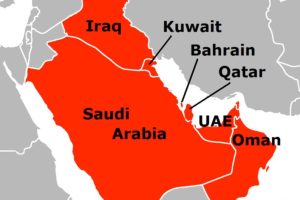
Saudi Arabia, Qatar, the United Arab Emirates, Bahrain, and Kuwait all reported being targeted by Iranian drones or missiles during the multi-wave assault. Additionally, sites within Jordan were identified as targets, marking a broad geographical spread of hostilities. Each of the impacted nations maintains a strategic relationship with Washington, hosting various United States military bases or support personnel. The decision by Tehran to strike these sovereign territories suggests a strategy intended to pressure the United States by threatening its regional partners and the critical infrastructure they provide for American operations.
Analytical perspectives from Washington emphasize that the Iranian leadership is attempting to demonstrate resilience despite the heavy strikes from Israeli and American forces. Jonathan Schanzer, executive director of the Foundation for Defense of Democracies, noted that the regime in Tehran has not capitulated to the initial pressure. Instead, the current atmosphere is characterized by a test of wills, with Iran utilizing its remaining ballistic and aerial capabilities to show that it can still project power across its borders. The targeting of Gulf states is seen as a calculated move to raise the costs of the ongoing military campaign for all parties involved.
In a significant diplomatic shift, the Gulf nations have moved toward a unified front that contrasts with the internal competition often seen in regional politics. Saudi Arabia announced its intention to provide direct assistance to neighboring countries in repelling Iranian attacks. The Saudi Ministry of Foreign Affairs issued a formal statement affirming the Kingdom’s full solidarity with its neighbors and its commitment to mobilizing all national capabilities to assist them. This proactive stance marks a departure from more cautious diplomatic positions and indicates that Riyadh views the current threat as an existential challenge to the established regional order.
The United Arab Emirates mirrored this sentiment, releasing a statement that described regional security as indivisible. The Emirati government argued that an infringement on the sovereignty of any one Gulf state constitutes a direct threat to the stability of the entire Middle East. Observers note that the UAE and Saudi Arabia, which have experienced periods of diplomatic friction in recent months, are now speaking with a synchronized voice. This newfound alignment is largely attributed to the shared threat of Iranian drone and missile strikes, which have bypassed traditional defense layers to impact various sites across the Arabian Peninsula.
The Saudi government further emphasized that the Iranian attacks were entirely unjustified, particularly given that the Kingdom had previously assured Tehran that its airspace and territory would not be used as a launchpad for the United States or Israel. Despite these prior diplomatic assurances, Iranian munitions were launched toward Saudi targets, leading to a sense of betrayal in Riyadh. This development complicates any future efforts at de-escalation, as the trust established during recent rapprochement efforts between the two regional powers has been severely compromised.
In Bahrain, the situation was particularly acute as the Iranian military managed to strike a service center located near the United States Fifth Fleet naval base. While the Bahraini government confirmed that its defense systems successfully intercepted a portion of the incoming threats, the breach of its airspace prompted a stern response. The Kingdom of Bahrain stated that it retains the full right to respond to these external attacks and will take all necessary measures to safeguard its national sovereignty. These actions are expected to be coordinated closely with its Western allies and regional partners.
Qatar also found itself in the crosshairs of the Iranian response, despite its long-standing role as a mediator between Tehran and the West. Reports indicated that Qatari defense forces intercepted several Iranian ballistic missiles that were on a flight path toward the Al-Udeid airbase. This facility is of critical importance to the United States as it hosts the U.S. Central Command forward headquarters. The targeting of Doha represents a significant escalation, as Qatar has historically maintained a more nuanced relationship with the Iranian regime compared to its neighbors.
The Qatari government issued a warning that while it reserves the right to retaliate, it remains deeply concerned about the potential for a total regional collapse. Officials in Doha have called for an immediate cessation of hostilities, warning that the current trajectory will lead to a wider regional war that could devastate global energy markets and regional security for decades. The dual approach of preparing for defense while pleading for a ceasefire highlights the precarious position of smaller Gulf states that are caught between the military objectives of the United States and the retaliatory strikes of Iran.
The technical nature of the attacks suggests that Iran is utilizing its vast stockpile of short- and medium-range missiles, along with loitering munitions, to saturate regional air defenses. While the United States and its allies have deployed sophisticated Patriot and Terminal High Altitude Area Defense systems across the region, the sheer volume of the Iranian launch suggests an attempt to find gaps in the defensive umbrella. The successful strike in Bahrain indicates that while interceptions are frequent, the defense is not impenetrable, leaving vital military and economic infrastructure at risk.
As the situation develops, the international community is closely watching the coordination between the Gulf Cooperation Council members and the United States military. The deployment of additional American naval and air assets to the Persian Gulf is expected to bolster the defensive capabilities of the targeted nations. However, the political fallout of these strikes is already being felt, as the narrative of a contained conflict between the United States and Iran has been replaced by the reality of a multi-front regional war involving several sovereign states.
The unity currently displayed by the Gulf states may serve as a permanent shift in the regional security architecture. If these nations continue to integrate their air defense systems and diplomatic messaging, the long-term strategic calculation for Iran could change. For now, the focus remains on the immediate tactical environment as more reports of incoming aerial threats continue to emerge from the various capitals across the Gulf. The coming days will be decisive in determining whether the conflict can be contained or if the retaliatory cycle will expand further into the Levant and the Horn of Africa.