









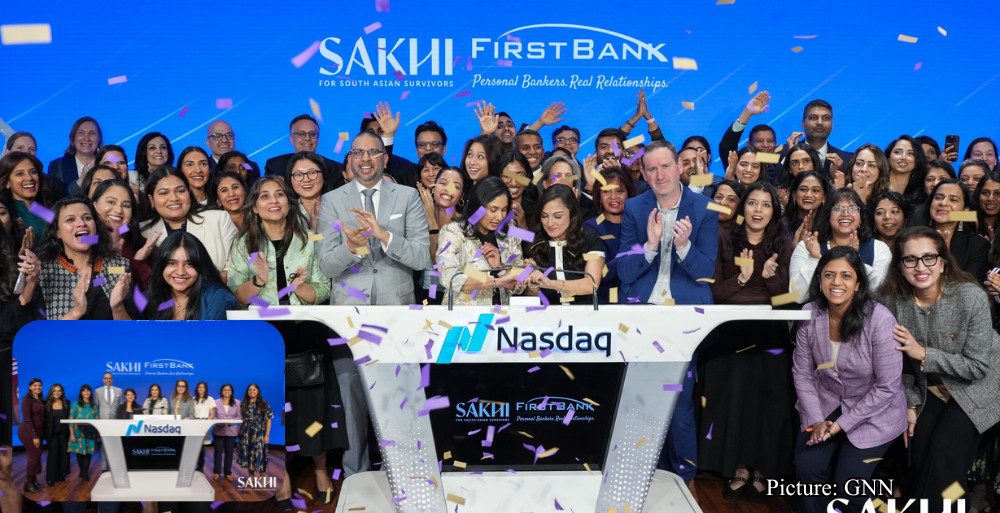
Sakhi for South Asian Survivors, one of the nation’s oldest organizations dedicated to ending domestic violence in the South Asian diaspora, rang the Nasdaq Closing Bell on March 10 to commemorate Women’s History Month. The historic ceremony highlights the growing intersection of social justice advocacy and corporate visibility, signaling a milestone for a movement three decades in the making.
The rhythmic clicking of the stock ticker at the Nasdaq MarketSite in Times Square gave way to a different kind of resonance on March 10. In a moment that transcended the typical celebratory atmosphere of financial milestones, Sakhi for South Asian Survivors took to the podium to ring the Closing Bell. The event served as a high-profile recognition of the organization’s 37-year crusade against gender-based violence, positioned strategically within the global observance of Women’s History Month and following just days after International Women’s Day.
For an organization that began as a volunteer-led collective in 1989, the opportunity to command the stage at one of the world’s premier financial exchanges represents a tectonic shift in how the corporate world engages with grassroots advocacy. Sakhi, which serves survivors from India, Pakistan, Bangladesh, Sri Lanka, Nepal, and the broader South Asian and Indo-Caribbean diaspora, has long operated on the front lines of a crisis that is often shrouded in cultural stigma and institutional neglect.
Kavita Mehra, the executive director of Sakhi, stood at the center of the platform, surrounded by a coalition of survivors, board members, and staff. Her presence there was a deliberate statement on the necessity of gender justice and the empowerment of marginalized voices. In her address to the gathered crowd and the millions watching the broadcast, Mehra emphasized that the ceremony was an affirmation of a movement that has historically been pushed to the periphery of American social services.
“Yesterday marked an extraordinary milestone for Sakhi for South Asian Survivors,” the organization noted in an official statement following the event. “The moment carried even deeper meaning coming so close to International Women’s Day, bringing national visibility to our mission and the communities we serve.”
The significance of the venue was not lost on the participants. The Nasdaq, an emblem of global capital and innovation, provides a unique megaphone for social issues. David Wicks, Nasdaq Vice President of Listings, acknowledged this synergy during the ceremony. He noted that the bell ringing offered a vital opportunity to spotlight the role community-based organizations play in advancing equity and lasting social change. Wicks praised Sakhi’s commitment, stating that their work reflects the resilience and leadership that Women’s History Month is designed to honor.
The economic and social implications of domestic violence in the South Asian community are profound. Survivors often face unique barriers, including linguistic isolation, immigration status concerns, and a lack of culturally competent legal and psychological resources. By bringing these issues to a platform like Nasdaq, Sakhi is effectively bridging the gap between the nonprofit sector and the influential financial and corporate spheres that dictate much of the national discourse.
Throughout its history, Sakhi has impacted over 18,000 lives through its comprehensive suite of programs, which include crisis intervention, housing assistance, economic empowerment, and youth programs. The organization’s growth mirrors the demographic shifts in the United States, where the South Asian population has become one of the fastest-growing ethnic groups. As this community expands, the demand for specialized services that understand the nuances of South Asian family structures and cultural expectations has surged.
The event was attended by a broad spectrum of Sakhi’s leadership and supporters, including Board Chair Beesham A. Seecharan, and representatives from the banking sector who have championed the organization’s fiscal health and outreach. Notable attendees included First Bank CFO Andrew Hibshman and First Bank Board Member Neha Desai Shah, who also serves on Sakhi’s Advisory Board. Their presence highlighted the burgeoning partnerships between community advocates and financial institutions aimed at fostering social responsibility.
Mehra’s speech during the ceremony was particularly poignant, touching on the concept of “joy as resistance.” She addressed the survivors directly, many of whom have spent years navigating the trauma of abuse and the complexities of the American legal system. “For anyone who has ever felt like their voice did not matter, like they have lived on the margins, or felt unseen—this moment is for you,” Mehra said. “This is our moment of joy, because without joy, we do not have healing.”
This focus on healing and empowerment is central to Sakhi’s philosophy. The organization does not merely aim to provide temporary shelter; it seeks to dismantle the systemic structures that allow domestic violence to persist. This involves rigorous advocacy at the local and state levels to ensure that survivors are protected regardless of their background or socioeconomic status.
As the final bell echoed through the glass-walled studio in Manhattan, the message was clear: the fight for gender justice is no longer a silent struggle confined to community centers and private homes. It is a matter of national importance that demands the attention of the public and private sectors alike. The milestone at Nasdaq serves as both a celebration of how far the South Asian survivor movement has come and a stark reminder of the work that remains to be done in the pursuit of a world free from violence.