







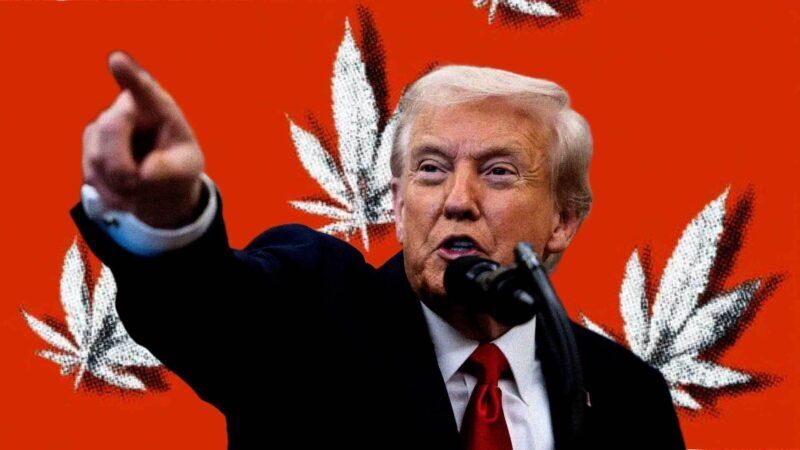
President Donald Trump on Thursday signed an executive order directing federal agencies to fast-track the reclassification of marijuana, marking a major shift in U.S. drug policy that could expand medical research while stopping short of full federal legalization.
Announcing the decision from the Oval Office, Trump said the move would significantly ease long-standing barriers to studying cannabis for medical purposes.
“This reclassification order will make it far easier to conduct marijuana-related medical research, allowing us to study benefits, potential dangers and future treatments,” Trump said. “It’s going to have a tremendously positive impact.”
The order instructs Attorney General Pam Bondi to expedite the regulatory process for loosening federal restrictions on cannabis, though it does not set a specific timeline. The directive follows months of intense lobbying by the cannabis industry, patient advocacy groups, and hemp producers.
“I’ve never been inundated by so many people as I have about this particular reclassification,” Trump said, underscoring the scale of pressure surrounding the issue.
From Schedule I to Schedule III
Under federal law, marijuana is currently classified as a Schedule I drug, a category reserved for substances deemed to have no accepted medical use and a high potential for abuse. Other Schedule I substances include heroin, LSD and ecstasy.
The executive order sets the stage for cannabis to be reclassified as a Schedule III drug, which the Drug Enforcement Administration defines as substances with recognized medical value and “a moderate to low potential for physical and psychological dependence.”
“The facts compel the federal government to recognize that marijuana can be legitimate in terms of medical applications when carefully administered,” Trump said, calling the decision “common sense.” He added that in some cases, cannabis could serve as an alternative to addictive opioid painkillers.
While the move represents a historic federal acknowledgment of marijuana’s medical potential, the White House emphasized that it does not legalize marijuana nationwide. Recreational use remains governed by state law, and the order does not include criminal justice reforms, sentencing changes, or expungement measures.
Implications for CBD and Hemp
The order also directs the White House to work with Congress to revise the statutory definition of hemp-derived cannabinoid products, after a recent government funding bill restricted products containing more than 0.4 milligrams of THC per milligram.
That provision had alarmed CBD advocates, patients, and hemp farmers, who warned it could effectively ban widely used CBD products relied upon for epilepsy, chronic pain, anxiety, and post-traumatic stress disorder.
Dr. Mehmet Oz, administrator of the Centers for Medicare & Medicaid Services, announced alongside Trump a new pilot model that could unlock Medicare funding for CBD treatments for some seniors.
“The innovation center models are going to allow millions of Americans on Medicare to become eligible to receive CBD as early as April of next year and at no charge, if their doctors recommend them,” Oz said.
Industry Reaction: Progress, But Not a Finish Line
Cannabis companies and industry groups welcomed the executive order, though many cautioned that significant regulatory hurdles remain.
“We’ve been operating with both hands tied behind our back,” said Kim Rivers, CEO of Trulieve. “Now it’ll only be one hand tied behind our back.”
Industry leaders argue that reclassification could ease tax burdens that have long plagued cannabis businesses. Under Schedule I rules, companies cannot deduct standard business expenses, a restriction that experts say has pushed many operators toward insolvency.
“That alone has been enough to make a huge portion of cannabis businesses unprofitable,” said Adam Hoffer, director of excise tax policy at the Tax Foundation. He described reclassification as “probably the biggest Christmas wish any operator in the cannabis space could ask for.”
Scientific and Legal Uncertainty Remains
Despite the optimism, researchers and policy experts warn that reclassification is only a symbolic first step. Strict federal controls over cultivation, research approval, and clinical use of marijuana remain in place.
“The assumption is that marijuana will be treated like every other Schedule III drug, but there are lots of reasons to suspect that it won’t be,” said Cat Packer, a lawyer with the Drug Policy Alliance. “We don’t yet know how cannabis will be enforced under this new regime.”
While Schedule III drugs can technically be prescribed, marijuana occupies a legal gray zone because doctors may only prescribe substances approved by the Food and Drug Administration.
“Once it becomes Schedule III, doctors will face a real struggle figuring out how to help patients,” said Dr. Sue Sisley, president of the Scottsdale Research Institute. “But they’re going to have many more patients asking about it because of this new status.”
Critics Warn of Mixed Signals
Opponents of the move argue that reclassification sends a misleading message about marijuana’s safety, particularly to young people.
“This isn’t grounded in public health — it’s driven by profit,” said Kevin Sabet, president of Smart Approaches to Marijuana. “It doesn’t legalize marijuana, but it sends a powerful signal that it’s less harmful than it actually is.”
A Politically Calculated Shift
Trump first voiced support for revisiting federal marijuana policy during the 2024 presidential race, as both parties sought to appeal to younger voters. However, internal divisions reportedly delayed action, and marijuana reform was notably absent from the DEA’s list of policy priorities earlier this year.
The order follows years of federal resistance to rescheduling cannabis, despite President Joe Biden’s 2022 directive to review its classification and a 2024 recommendation by health officials to move marijuana to Schedule III.
For now, advocates see Trump’s move as a turning point — not a conclusion.
“It’s progress,” Rivers said, “but it’s not the end of the road.”