





They were traveling to the German town of Michigan, Frankenmuth, because it was a fairly American Christmas thing to do. Even though her niece, Salwa, was petrified of small-town America because she was Palestinian and living there on a student visa, Mother knew Americans were hospitable, and they were only against people who were coming in from the outside and taking their jobs, not people who were working hard to become dentists like Salwa. It was Christmas Day. Americans loved Christmas, and Mother loved Christmas as much as they did. She wanted Salwa to experience the sort of Christmas that people from Palestine and other countries only witnessed on the television. As for the visa stuff, Salwa was being paranoid. It wasn’t like they were going to arrest her just for being a different skin color. If that was the case, why was she able to go to Walgreens or Walmart without any fuss? Mother felt Salwa was being hard on Americans because of a handful of stories getting blown out of proportion by the media, and Mother was set to prove her wrong.
They were on the highway, in the car, driving to the little islet on which the Bavarian town stood. Looking out of her window, Salwa remarked in Arabic, “؟This is Michigan”
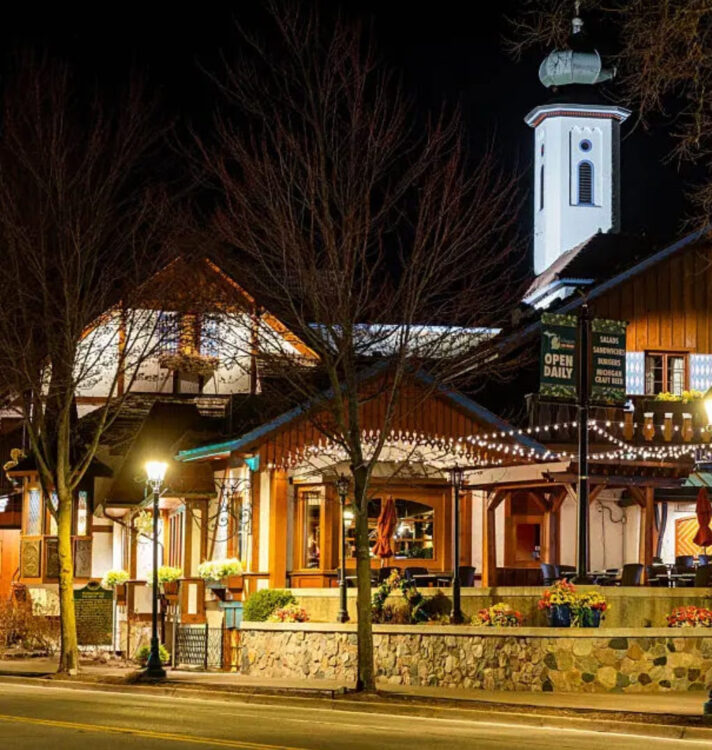
Mother chuckled. Just from the bridge, one could make out the tiny pointed roofs on the shops, on the Holiday Inn, on the supermarket. It gave everything a little German touch. It was very different-looking from the suburbs, or Ann Arbor, or Detroit. And yet being able to look so foreign despite being in the USA, that was also very American. It was like Miami for the Cubans, or San Antonio for the Mexicans. People came to the land and brought their food, changed the way the buildings looked. Yes, there were locals who complained, but there were many other locals who liked the new styles and adapted to them.
That was the most exciting part of being American, being part of that experiment.
With a full sense of pride, Mother said, in her thickest American English, “It’s hard to believe, but this is Michigan. If no one told me, I’d have thought I was in Germany.”
“That’s not true,” Salwa said in English to respond to Mother, slurring the last syllable of ‘true’ in true American style. “The roads are so wide. And everything’s so commercial looking.” She switched back to Arabic for comfort. “.Look at that house, for example ؟Does it look Bavarian .It has a Bavarian flag hanging .It has a Bavarian crest. It has all these things for sale written on the wall .The paint is so fresh, it looks like it was painted yesterday .Everything looks too well maintained .Nothing in Europe looks like this”
Mother asked, with a slightly raised tone, “Have you been to Europe?”
“No.”
“Then how do you know what Europe looks like?”
“I know the difference between things that were built to look a certain way versus things that were built over the centuries. I come from an old country. I know this.”
Mother rolled her eyes. “I think you know nothing. You’re being arrogant.”
It was like Salwa to be this way. Mother was new to Mother’s life. She had been invited to study at the University of Michigan, and since Mother was the only cousin of her mother’s based in the US , let alone Michigan, it was obvious she was going to make an attempt to make their part of the world feel like home. In those three years since they got to know each other, Mother found that Salwa was quick to make these sorts of quick critical comments at anything she observed. It might have been a cultural difference, as Mother generally found Palestinians who stayed in Palestinian too blunt for her liking, but she also felt it was annoying to make comments without having spent time observing a situation or context. Like, how could Salwa know anything about what Frankenmuth was like just by observing it in the car? Once they reached the central plaza and walked around, she’d see it a little bit more properly. Yes, Mother could admit to herself, it wasn’t exactly like Germany, but there were teeny-tiny multi-colored houses, the women would be dressed in the flowing white garbs of Central Europe, and there would be all brands of cheese and artisanal chocolates freshly made and ready to be bought. Not to mention the Christmas lights would be hanging, and people would be singing carols. It was a mood of its own, and a treat to be able to enjoy. But rather than being grateful for this charming moment Mother was trying to gift her, Salwa was spoiling it.
Father suddenly interrupted Mother and Salma’s back-and-forth by paying Salwa a compliment. “Your English has improved so much, Salwa. You’re really starting to sound like an American. That’s great.”
Father was exaggerating, probably because he wanted to distract Mother from blowing the argument out of proportion, but there was an element of truth to it. When Salwa had first arrived some years ago from Palestine, she had had the habit of truncating the words at the end of her sentences, as if they were a part of a sneeze. Now, she was elongating her words and letting the vowels be heard in a drawl. So, even Salwa’s English was changing, adapting, and sounding a lot less foreign, though she still very much had that something different sound to her accent that any non-native speaker inevitably had.
Nonetheless, Father’s compliment was still an overreach, and Salwa didn’t like to be told something that she didn’t feel she’d earned. She switched back to Arabic.
“.That is not the truth .I speak like a foreigner .People come up to me and ask where I am from .They know from the moment I open my mouth that I am not from here”
“Because you do speak differently” Mother said, this time in Arabic. Then she switched back to English, embarrassed by how American her Arabic had sounded. Who was she to lecture Salwa on speaking differently when she herself spoke their language poorly? “But you’re learning, and that’s good. See, you’ve only been here for a few years. Once it’s been a few decades, your accent and your way of speaking will naturally become more American, like ours.”
Salwa smirked. Despite the fogginess of the rearview mirror, Mother could see it clearly.
“I don’t think I’m staying here after I finish my studies. And I don’t know if I want to sound more American.”
Mother grimaced. There was an element in her tone that made it sound like she was mocking Mother directly, as if she didn’t like this sort of Arab who had become American and who spoke English more naturally than her own language. Mother had already felt this sort of judgment from her niece when they were first getting to know each other. It was always an odd contrast whenever they went out together: Mother would be fully veiled and in a hijab, while her niece would show off her midriff and shoulders in a spaghetti strap or a low top or some flowing summer dress. Yet her niece would speak only in Arabic, and Mother only in English. Mother dressed as Muslim as she could, cooked every Palestinian recipe she could find on the Internet, and took weekly classes in the Qu’ran, but unlike Mother Salwa had been born and brought up in the land, and it showed in every small way she lifted her eyebrows and twitched her fingers. No matter how much Mother wanted to feel connected to being Palestinian, there was a sense that they really came from two different countries, two different landscapes, and two different worlds.
Father had found a parking place. This wasn’t the time to dwell on roots and origins. Mother was a Palestinian and Salwa was a guest, and no matter what, in Palestinian culture a guest was to be given a great time—and Mother believed Frankenmuth was the type of place built to help people have a great time. Everything from antique toys to chocolate-dipped pretzels were on sale. Frost glazed the rooftops of the store like sugary icing, carols were being blasted on the speakers, and there were walking by horse carriages illuminated by Christmas lights. There was a subtle spectacle in the choice of lighting, from a chilly blue to a festive green, that brought a sense of peace to Mother’s mind. And there were so many people of various skin tones, dress styles, and languages—people like her who wanted to experience an American moment, just as it was in the movies. This was the spirit of the United States that Mother wanted Salwa to witness and partake in.
They passed by a fudge store. Father loved fudge and stopped to stare at the creamy samples on display in the window.
‘؟You want’ Father said in Arabic, his love for the fattening and sugar-filled junk food making him speak uninhibitedly.
‘Lah,’ Mother said, but as she observed the fudge, she couldn’t help but add, “You don’t see things like this in Palestine.”
“You do not,” Salwa agreed.
“I cannot imagine the type of bloodshed or suffering you would be going through if you were still there.”
Salwa’s eyebrows fused together.
“You look at fudge, and you think of atrocities?”
Even Father was looking up at Mother, shaking his head, as if this was not the most appropriate subject to mention at the moment.
Mother ignored it.
“I am saying you should be grateful to this country and all it is giving you. You have been invited here. We have even invited you, as family. But instead, you’re saying all the time that you want to leave, you don’t like it, you think Trump’s going to put you in some prison. You’re having a great life here, dear. Grow up.”
Salwa put her hands on her hips. She moved her teeth up and down inside her mouth, like she was chewing something. Or maybe she was mouthing something that she didn’t want to say out loud. She started walking away, clacking her heels against the pavement, without even dismissing herself. Mother found it rude, considering that Father and her were Salwa’s hosts.
“I’m telling you something,” Mother shouted. Still, Salwa continued walking, disappearing into the hazy, snowy backdrop. It was so disobedient. It was not how Palestinians were trained, to disrespect an elder when they were talking to them.
Mother started chasing after her. “Hey, you, you stop.” Salwa clearly wasn’t stopping, so she shouted again, louder, “You, stop now.”
It was like she was talking to her son all over again, when he’d open his eyes while they were praying, or when he’d try to stick his hands into the cookie jar after he had had the two he was allotted after dinner. Of course, those minor disobediences were nothing compared to when he would brazenly go and meet homosexual men at those sex dungeons and then have the audacity to come back home with the smell of their sweat all over him.
Salwa was far from being that defiant, but what was it about people of that age wanting to make problems for their elders, particularly when their elders were going out of their way to help them?
Mother shouted, as if she wanted the entire street to hear, “You stop and listen to me now!”
That got a lot of faces turning toward her. Even Salwa turned back. Mother finally caught up and put her hands on her.
“I need some alone time,” Salwa explained.
“This is family time. We are meant to enjoy it together.”
“Do you not understand the concept of giving me some space?”
“There’s nothing to give space over. We were just looking at some fudge, and you felt like making it into a conversation.”
“I said nothing. You were the one who started saying nonsense.”
“Nonsense? You call what your aunt says nonsense? How rude!”
Mother and Salwa were starting to paw at each other, more than Mother actually realized. In her mind, she didn’t notice how much she was gripping Salwa. She was just trying to pull her back toward her husband so that they could go back to having an innocuous evening of shopping and singing Christmas songs as she had planned. But Salwa was pushing her back, and when Salwa pushed, Mother felt the instinct to push as well.
Mother didn’t even notice the police officer until he was between them. “Excuse me, what is going on here?” he said, putting his hands on their shoulders to keep them apart.
Mother immediately froze in position. She said, “I’m sorry, officer,” but didn’t know what else to say.
Salwa said, “Please take your hands off of me,” as if she was still talking to her aunt, and not this police officer.
The officer wasn’t used to her style of speaking, brash and direct. He asked, “Can I see your identification?”
That snapped Salwa out of it. Her eyes widened. The officer repeated himself, and then she started looking in her purse.
Mother tried to explain the situation to the officer. “This is my niece. She is here as a student at the University of Michigan.”
The police officer asked, “Where is she from?”
Mother wasn’t sure if she should say Dearborn, where Mother and her family were based, or Ramallah, where her niece was from. But would this random Black American know where Ramallah was? It was certainly safer than saying Palestine, given the feelings he might have against Muslims. And Palestinians were in the media for all the wrong reasons. Whatever this police officer was thinking, it was probably already negative.
Salwa finally retrieved her ID, which was a driver’s license. The police officer eyed it, then eyed her.
Mother explained more. “We were just having an argument. She and I, we, well, we were just disagreeing on some fudge. My husband wanted us to get some, but she really didn’t want any, and I felt…I felt bad because we have driven so far to get here, and I love fudge from Frankenmuth. You must too…we all do…and I just wanted her to try some properly…but she’s stubborn. I love her so much. She’s my cousin’s daughter. It’s so nice to have family at home, even when you have disagreements about everything.”
The entire time Mother spoke, Salwa was looking down, but her eyes were bulging out like a frog’s. Her mouth was completely shut. It was like she was caught in a giant’s fist, and she refused to budge, because if she did in any which way, she knew the fingers around her would tighten, and she would be crushed.
The officer looked at the two of them, then handed the document back. “Don’t make so much noise. You are family. You ought to love each other! You two have a good night, and Merry Christmas.”
“Merry Christmas,” Mother and Salwa chimed together. The police officer went off to sample some cheddar cheese in the distance, and both Mother and Salwa exhaled, breaking their flustered postures. Father had caught up with them at that point. He asked, panting, “What just happened?”
Salwa and Mother talked, not to Father but to each other.
Salwa started with, “I thought he was ICE.”
Mother said back, “I was afraid of that too.”
Salwa said, “I thought I’d get deported.”
“Don’t be ridiculous,” Mother said, but then she let her thoughts catch up to her, and she realised she had been afraid of it too. She told Salwa, “You have to be careful when you go out.”
Salwa shouted, “That is what I was telling you.”
“Be quiet. This is America. You can’t yell out like you are in a souk.” Mother took some breaths, also trying to calm herself down. “But at least nothing happened. He was kind, like I told you.”
“But still…I could have been sent to one of those detention centers. You would have never heard back from me. And then where would I have gone? To Palestine? To die in the middle of a bomb blast? Where would I even go?”
“Don’t think like that. Focus on your breathing. You are safing. Nothing has happened to you. And nothing would have happened.”
But could it have happened? Could the police officer had made some other phone call and gotten her deported? And if Salwa were to be sent back to Palestine, what would have happened? What would happen to her other semesters at Michigan? What would happen to all the money her parents had spent just to make sure she’d even have this opportunity? And what would she do in Palestine, given most of it wasn’t in a liveable shape at the moment? Would they even fly her to Palestine? Or would she have been sent to one of these random countries that was hosting the convicts or illegal immigrants?
It wasn’t worth thinking on. It was over, it was done, and the way things had gone put an end to Mother’s worries. “No matter what happens to you, we will fight for you,” Mother said to Salwa, almost as an afterthought. But then Salwa extended her arms—she was reaching for a hug. As they wrapped themselves around each other, Mother felt some snow fall on the top of her nose. Was it really snow, or Salwa’s tears, or her sweat condensing from the cold?
They were still that proud Palestinian family that had settled in Dearborn, out to celebrate an American Christmas. Mother told Salwa, “Let’s go try some of that cheese. It will help to improve your mood.” The police officer was gone, so Salwa nodded, hesitantly at first, but as they walked, Salwa kept close. Salwa did find the cheese quite tasty, and they ended up buying a few blocks of it. Then they found the toy store, and the Christmas decoration store, and as they kept exploring, Mother found that Salwa was having a good time and finally forgetting what had just happened to her, even if she probably couldn’t ever truly forget it at all.