








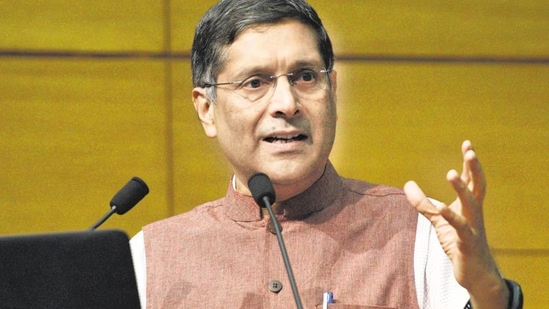
Tamil Nadu has emerged as one of India’s most attractive destinations for global companies seeking to diversify manufacturing operations away from China, strengthening the state’s position as a key driver of India’s industrial and inclusive growth, according to economist Arvind Subramanian.
Speaking at an event marking the launch of a major laptop distribution scheme for government college students, Subramanian said Tamil Nadu’s manufacturing success challenges long-held assumptions about India’s inability to replicate China’s rapid industrial growth.
“If India has to develop today, then the Hindi heartland has to become what Tamil Nadu is today,” Subramanian said. “Leading states like Tamil Nadu can be a model that others can emulate by attracting talent, knowledge, and technology.”
Subramanian, a member of the five-member Economic Advisory Council to Tamil Nadu Chief Minister M K Stalin, highlighted that the state has become a preferred hub for global manufacturers under the widely discussed “China-plus-one” strategy, where multinational firms seek alternative production bases to reduce dependence on China.
Tamil Nadu as India’s ‘China Moment’
Addressing the narrative often raised by economists and policymakers about why India has not grown like China, Subramanian offered a reframing of the question.
“When people ask why India can’t grow like China, the question suddenly becomes why some parts of India can’t grow like the China of Tamil Nadu in India itself,” he said. “The question and the perspective changes completely.”
He attributed Tamil Nadu’s success to consistent government focus on social justice, broad-based education, human capital development, and economic dynamism. According to Subramanian, these factors have created a stable ecosystem that attracts long-term investment rather than speculative capital.
The economist noted that Tamil Nadu has played a crucial role in expanding low-skill formal manufacturing, which he described as essential for inclusive growth and employment generation.
“While we are all rightly focusing on artificial intelligence and the knowledge economy, we should not forget that manufacturing still has a very big role to play in creating jobs and inclusive growth,” he said.
Benefiting From the China-Plus-One Strategy
Subramanian pointed out that when global companies first began diversifying supply chains away from China, India did not receive the bulk of investment.
“In that first wave, very little capital came to India. It went to Vietnam and Indonesia,” he said. “But in the last three, four, five years, the one location that these investors are increasingly choosing is Tamil Nadu.”
He added that the shift is evident in the “range and variety” of companies that have established operations in the state, spanning electronics, precision manufacturing, and advanced materials.
Tamil Nadu has become a central hub for Apple’s manufacturing operations in India, with global supplier Foxconn and domestic player Tata Electronics Private Limited (TEPL) setting up large-scale facilities. This has positioned the state as the focal point of Apple’s India production strategy.
In addition, major U.S. technology companies such as Cisco and Corning have established manufacturing units in Tamil Nadu in recent years, reinforcing the state’s reputation as a reliable destination for high-value global manufacturing.
Government’s Focus on Education and Skills
The remarks were made during the launch of a state government initiative to distribute laptops to 10 lakh government college students, a programme aimed at strengthening digital access and skills among youth.
Chief Minister M K Stalin said the laptops are being manufactured by global brands including HP, Dell, and Acer, and come with high configurations suitable for academic and technical use.
“These laptops are designed to meet the needs of students,” Stalin said, adding that the government would continue to support young people so that “their only job is to study.”
The initiative reflects Tamil Nadu’s broader strategy of pairing industrial growth with investment in human capital — a combination economists say is critical to sustaining long-term development.
A Model for Other States
Subramanian emphasised that Tamil Nadu’s experience demonstrates that India is capable of building globally competitive manufacturing ecosystems, provided the right policy mix is in place.
“Tamil Nadu is challenging the narrative that India cannot replicate the China miracle,” he said, noting that strong state-level governance can compensate for national-level constraints.
By combining social equity, education, and manufacturing-led growth, Tamil Nadu has positioned itself as a blueprint for other Indian states seeking to attract global investment and generate employment at scale.
As geopolitical tensions reshape global supply chains, Tamil Nadu’s rise as a manufacturing hub underscores the importance of stable institutions, skilled labour, and proactive governance. For policymakers across India, the state’s trajectory offers a compelling case study of how regional success can drive national transformation.