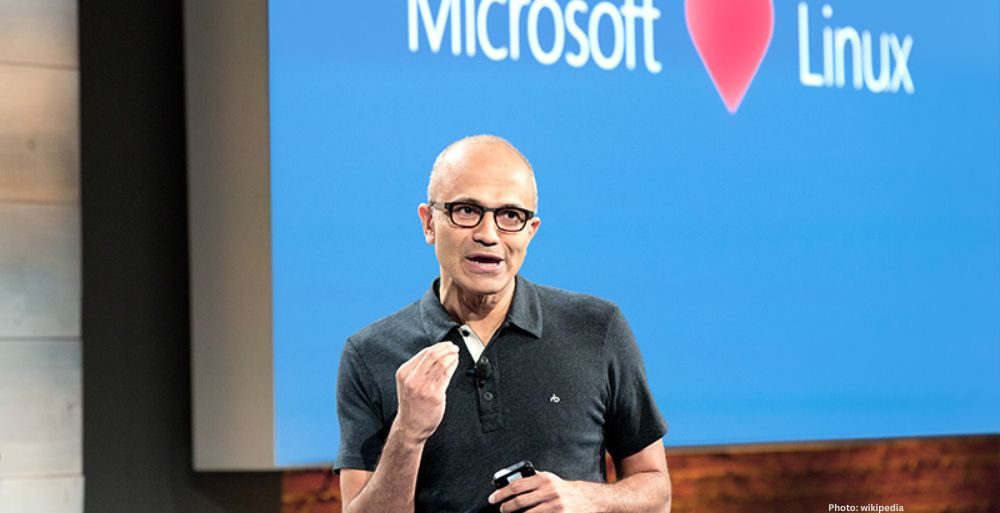










As artificial intelligence enters its next phase of evolution, Microsoft CEO Satya Nadella is calling for what he describes as a fundamental reset in how the technology is discussed, designed, and deployed. In a reflective blog post published toward the end of last year, Nadella argued that the AI industry has moved past its novelty phase and must now confront a more difficult challenge: proving that AI can deliver meaningful, real-world value beyond spectacle.
Nadella’s comments come at a moment when public discourse around AI has become increasingly polarized. Merriam-Webster’s word of the year for 2025 — “slop” — captured widespread frustration with low-quality, AI-generated content flooding social media platforms. But Nadella believes that fixation on “AI slop” versus sophistication risks distracting the industry from more important questions about long-term impact.
“As I reflect on the past year and look toward the one ahead, there’s no question 2026 will be a pivotal year for AI,” Nadella wrote. “Yes, another one. But this moment feels different in a few notable ways.”
According to Nadella, AI is no longer in its early discovery stage. Instead, it has entered a phase of widespread diffusion, where the technology is being adopted across industries, workplaces, and daily life.
“We have moved past the initial phase of discovery and are entering a phase of widespread diffusion,” he noted. “We are beginning to distinguish between ‘spectacle’ and ‘substance.’”
For Nadella, the defining question is no longer where AI is headed technologically, but how society chooses to shape its influence.
“We now have a clearer sense of where the tech is headed,” he wrote, “but also the harder and more important question of how to shape its impact on the world.”
Moving Beyond the AI “Slop” Debate
At the heart of Nadella’s argument is a call to move beyond endless debates about low-quality AI-generated content. Microsoft, he made clear, is betting heavily on a future where AI agents — not traditional software suites like Windows and Office — become the primary interface for productivity, creativity, and decision-making.
Rather than framing AI as an autonomous intelligence, Nadella emphasized a more human-centered vision inspired by Apple co-founder Steve Jobs’ famous description of computers as “bicycles for the mind.”
In Nadella’s view, AI should function as a cognitive amplifier — a tool that enhances human thinking rather than replacing it.
“A new concept that evolves ‘bicycles for the mind’ such that we always think of AI as a scaffolding for human potential versus a substitute,” Nadella explained. “What matters is not the power of any given model, but how people choose to apply it to achieve their goals.”
This shift, he argues, demands a rethinking of product design itself. Instead of obsessing over raw model performance, developers must focus on how AI fits into human workflows, relationships, and decision-making.
“We need to get beyond the arguments of slop versus sophistication,” Nadella wrote, “and develop a new equilibrium in terms of our ‘theory of the mind’ that accounts for humans being equipped with these new cognitive amplifier tools as we relate to each other.”
He described this as one of the most important design challenges facing the tech industry.
From Models to Systems
Nadella also outlined Microsoft’s strategic direction for AI in the coming years, emphasizing a shift from standalone models to integrated systems designed for real-world impact. While Microsoft continues to invest in more advanced AI models to strengthen Copilot and its broader AI ecosystem, Nadella stressed that technical capability alone is not enough.
“We will evolve from models to systems when it comes to deploying AI for real-world impact,” he said.
These systems, Nadella argued, must account for broader social and environmental consequences. Decisions about where to deploy AI — and where not to — will increasingly carry ethical and economic weight.
“The choices we make about where we apply our scarce energy, compute, and talent resources will matter,” he wrote. “This is the socio-technical issue we need to build consensus around.”
The implication is clear: AI’s success will be judged not by how impressive it looks in demos, but by whether it delivers tangible benefits without undermining trust, sustainability, or human agency.
Understanding the “AI Slop” Problem
The term “AI slop” has gained traction as a way to describe the flood of low- to medium-quality content generated by AI tools. This includes images, videos, audio, and text — often produced quickly, cheaply, and with little concern for accuracy or authenticity.
Examples range from obviously fabricated viral images to more subtle content that appears credible at first glance, blurring the line between reality and fiction. Much of this material thrives on social media platforms, where engagement-driven algorithms reward volume over value.
Critics argue that AI slop crowds out higher-quality content, pollutes information ecosystems, and erodes public trust. Nadella does not dismiss these concerns, but he believes they represent a symptom rather than the core problem.
For him, the deeper issue is whether AI is being designed to meaningfully support human goals — or merely to generate attention.
A Defining Year Ahead
Nadella’s call for an AI reset reflects a broader shift within the technology industry. As AI tools become ubiquitous, expectations are rising. Businesses, governments, and users increasingly want proof that AI can improve productivity, decision-making, and quality of life — not just generate impressive outputs.
By framing AI as a partner rather than a replacement, Nadella is positioning Microsoft’s strategy around trust, usability, and long-term value. His vision suggests that the next chapter of AI will be less about novelty and more about responsibility.
If 2025 was the year AI’s excesses dominated the conversation, Nadella believes 2026 must be the year the industry proves its maturity.
The challenge, he argues, is not to make AI smarter, but to make it matter.