









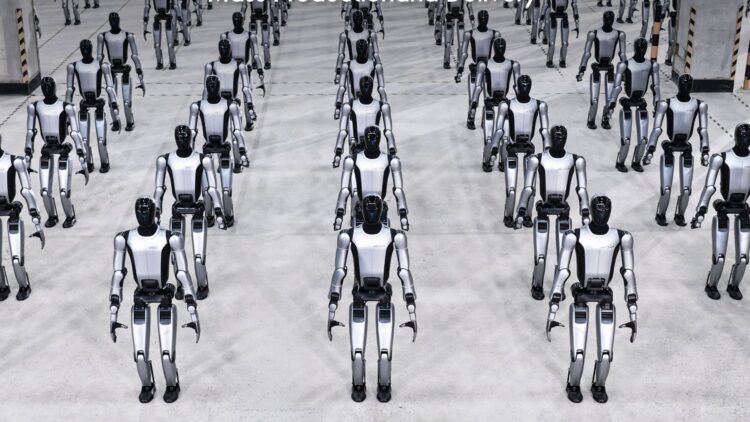
China has taken a decisive step toward automating border management, officially deploying humanoid robots for round-the-clock surveillance, inspections, and logistics at its border crossings. In a move that signals how rapidly artificial intelligence and robotics are being integrated into state infrastructure, UBTech Robotics has secured a 264 million yuan (about $37 million) contract to deploy its Walker S2 humanoid robots at border checkpoints in Fangchenggang, in the Guangxi region bordering Vietnam. The rollout is scheduled to begin in December.
According to UBTech, the humanoid robots will be responsible for managing the “flow of personnel,” assisting with inspections, and handling logistics operations at border facilities. While the robots will initially perform support tasks under human supervision, officials and industry observers say the deployment represents a major shift toward continuous, automated border operations.
“Humanoid robots allow for persistent operation in complex and remote environments,” the company said in a statement. “They can reduce human workload while improving efficiency and consistency in high-demand areas such as border crossings.”
A New Era of Border Patrols
The sight of humanoid robots patrolling borders may feel like science fiction, but in China, it is becoming operational reality. Unlike human guards, robots do not require rest, shelter, or food — critical factors at remote border posts where logistics can be challenging. The Walker S2 is equipped with a self-replaceable battery system, allowing it to swap depleted batteries independently in about three minutes, enabling near-continuous operation.
This capability significantly lowers long-term operational costs. “Energy autonomy changes the entire maintenance model,” one robotics industry analyst noted. “Instead of constant supervision, you move toward planned maintenance cycles, which is far more efficient for large-scale deployments.”
For now, UBTech says the robots will focus on support and inspection-related duties at the China–Vietnam border, with human operators retaining decision-making authority, often via remote control systems.
Not China’s First Experiment With Robotic Borders
China’s use of robots in border and customs management is not entirely new. Humanoid robots have already been deployed at customs checkpoints and airports across the country, assisting travelers and monitoring facilities. What makes the Fangchenggang deployment notable is its scale and permanence, along with the move toward 24/7 robotic presence in an active border environment.
The expansion has also driven demand for vendor-independent fleet management software, capable of handling programming, teleoperation, and compliance reporting across different robot models. Such systems allow human supervisors to oversee multiple robots simultaneously, even from distant command centers.
“Safety checks can now be carried out more clearly, with humans in charge — even if that control is remote,” UBTech said.
Inside the Walker S2 Humanoid Robot
UBTech’s Walker S2 is designed to closely resemble human proportions and movement, making it particularly suited for environments built for people. The robot stands 176 centimeters tall, weighs 70 kilograms, and walks at speeds of up to 2 meters per second, roughly equivalent to a brisk human pace.
Its design includes a flexible waist with rotation and angle ranges similar to a human’s, ambidextrous hands capable of carrying up to 7.5 kilograms, and high-precision sensors in each hand for delicate tasks. Equipped with microphones and speakers, the robot can also engage in basic verbal interactions.
Constructed from composite materials and aeronautical-grade aluminum alloy, with a 3D-printed main casing, the Walker S2 is engineered for durability in demanding environments. UBTech emphasizes that the robot’s humanoid form allows it to operate existing infrastructure — doors, tools, checkpoints — without requiring major redesigns.
From Pilot Project to Mass Production
While the Fangchenggang deployment is officially described as a pilot program, UBTech’s ambitions extend far beyond the border. In a recent press release, the company announced plans to begin mass production and large-scale shipping of its industrial humanoid robots, citing a surge in orders throughout 2025.
“This is a strong signal that humanoid robots are moving from experimental showcases to real-world applications,” the company said. Shareholders appear to agree: UBTech has framed the project as a milestone in the commercialization of humanoid robotics.
Industry experts say border crossings are a logical testing ground. “Borders are dynamic, noisy, exposed to weather, and require constant vigilance,” said one robotics researcher. “They are exactly the kind of environment where robots can complement or gradually replace human labor.”
A Glimpse of the Future
For now, China insists that humans remain in control, with robots serving as force multipliers rather than autonomous enforcers. But analysts suggest that as AI decision-making improves, humanoid robots may be entrusted with increasingly independent responsibilities.
The Fangchenggang deployment underscores a broader trend: nations are beginning to “hire” machines for roles once thought inseparable from human judgment. Whether in logistics, surveillance, or security, humanoid robots are steadily moving from novelty to necessity.
As one observer put it, “What we’re seeing at China’s borders today may soon become standard practice elsewhere — a future where the first line of contact is no longer human, but humanoid.”