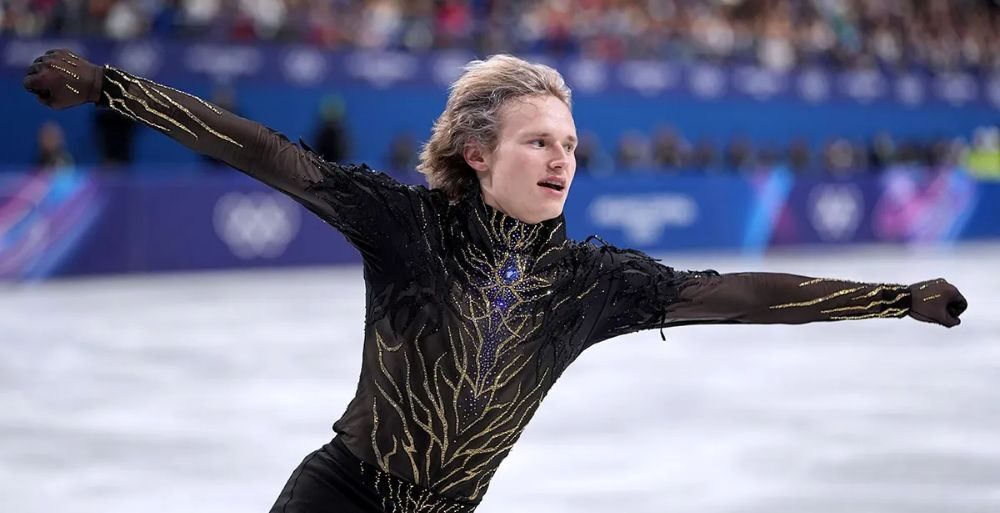









The 2026 Winter Olympics witnessed one of the most unexpected turns in recent figure skating history as Ilia Malinin, the heavy favorite for the gold medal, failed to reach the podium following a challenging free skate. Entering the final men’s event at the peak of his career, the 21-year-old American carried the expectations of a nation and the label of a technical pioneer. However, the athlete who branded himself the Quad God struggled to maintain his composure during the sport’s most significant moment, finishing well outside the medal positions after a series of uncharacteristic errors on the ice.
Malinin entered the free skate with a commanding lead of more than five points after a dazzling short program that seemed to solidify his status as the frontrunner. His technical prowess and consistency over the past several seasons had made him the clear choice for the top step of the podium. Despite this momentum, the final night of competition proved to be a different environment entirely. The skater suffered a major breakdown in his routine, falling twice during his program and failing to complete two jumps that were intended to be high-scoring quadruples. The collapse was particularly striking given Malinin\’s reputation for landing the most difficult jumps in the history of the sport with relative ease.
Following the performance, a visibly shaken Malinin expressed his disbelief at the turn of events. He noted that he felt prepared and confident throughout the season and during his training sessions leading up to the Games. The skater admitted that the realization of his performance hit him immediately after the music stopped. He described the experience as a moment where he felt his preparation was sound, yet the execution vanished under the unique pressure of the Olympic stage. His inability to land a single quadruple Axel during the competition was a significant departure from his usual technical dominance.
The gold medal was claimed by Mikhail Shaidorov of Kazakhstan, who delivered a steady and technically proficient performance to finish with a total score of 291.58. Japan secured the remaining spots on the podium, with Yuma Kagiyama earning the silver medal with a score of 280.06 and Shun Sato taking the bronze with 274.90. These athletes demonstrated the consistency required to navigate the high-stakes environment of the Winter Games, capitalizing on the opening left by the American favorite’s struggles.
Malinin’s free skate score of 156.33 was a career low for a major international competition, placing him eighth in that segment and leaving him with a total score of 264.49 for the event. This result marked his first competitive loss since November 2023 and the first time he had finished outside the top three since March 2022. The statistical drop-off highlighted the magnitude of the upset, as Malinin had been nearly undefeated in the two years leading up to the 2026 Games. The absence of his signature technical elements left him unable to recover the ground lost during his falls.
In his post-event analysis, Malinin reflected on the psychological weight of the Olympics. He suggested that he might have entered the ice with too much confidence, which perhaps led to a lapse in the meticulous focus required for his high-risk programs. He emphasized that the atmosphere of the Olympics is fundamentally different from any other championship or Grand Prix event. According to the skater, the mental strain of the Olympic environment is a factor that is difficult to replicate in training or other competitive settings. This psychological barrier appeared to be the primary hurdle that prevented him from executing his usual technical repertoire.
The disappointment was further underscored by comments Malinin made while waiting for his scores in the Kiss-and-Cry area. A nearby microphone captured the skater reflecting on his absence from the 2022 Beijing Games. He was heard suggesting that had he been selected for the previous Olympic team, he might have possessed the necessary experience to handle the pressure of the 2026 final. This sentiment was echoed by commentators who noted that the lack of previous Olympic experience often affects even the most seasoned world champions. Malinin later clarified these remarks, stating that while he cannot know for certain how a 2022 appearance would have changed his trajectory, the lack of familiarity with the specific stresses of the Games played a role in his performance.
The historical context of Malinin\’s rise makes this defeat even more significant for the United States figure skating program. After the retirement of previous Olympic champions, Malinin was viewed as the standard-bearer for the next generation of American skaters. His ability to land the quadruple Axel had revolutionized the sport and set a new technical benchmark that few others could match. His failure to medal in 2026 raises questions about the sustainability of such a high-difficulty strategy under the intense scrutiny of the Olympic spotlight, where the margin for error is virtually nonexistent.
Moving forward, the focus for Malinin and his coaching staff will likely be on mental conditioning and finding a balance between his historic technical ambitions and the consistency needed for major championships. The skater expressed a desire to process the event and learn from the mistakes made on the ice, though he admitted the experience was difficult to articulate in the immediate aftermath. As the skating world looks toward the next quadrennial, the lessons from this final will likely shape Malinin\’s approach to future international assignments.
The 2026 Winter Olympics will be remembered for Shaidorov’s historic victory for Kazakhstan and the resilient performances of the Japanese team, but it will also be defined by the unexpected fall of a reigning champion. The unpredictability of figure skating remains its most compelling attribute, as even a five-point lead and a season of dominance cannot guarantee a place on the podium. For Malinin, the journey continues with a newfound understanding of the unique pressures that come with being the gold medal favorite on the world\’s most prestigious sporting stage.
Ilia Malinin Fails to Medal After Unexpected 2026 Winter Olympics Performance