





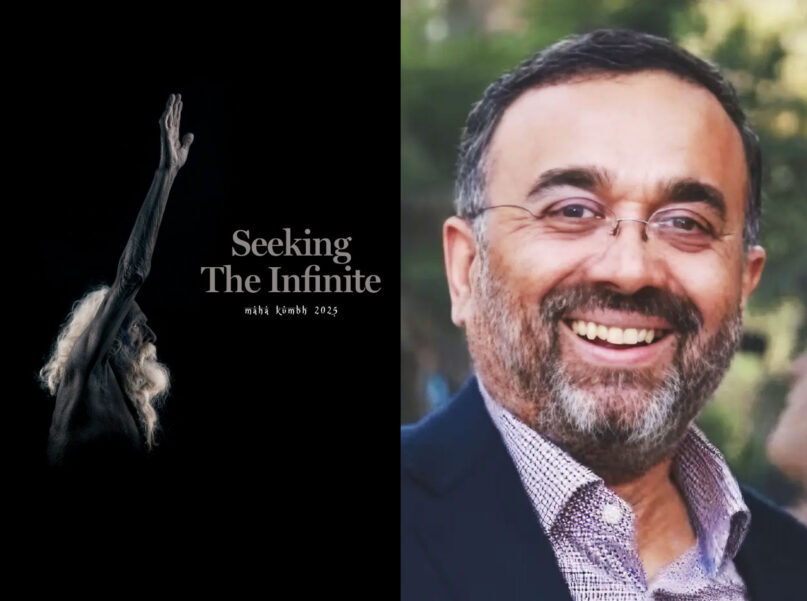
Mega-events such as the Mahakumbh Mela often remind humanity of a deeper, shared spiritual core — a truth that transcends borders, religions, and ideologies. In his evocative introduction, “United in the Quest of the Infinite,” Yakub Matthew frames the Mahakumbh as a sacred convergence not only of rivers, but of souls seeking meaning, unity, and transcendence.
His monumental coffee-table book, Seeking the Infinite: Mahakumbh 2025, is a visually arresting and philosophically rich tribute to a once-in-144-years spiritual phenomenon — the Mahakumbh Mela of 2025 in Prayagraj. What began as a personal celebration of Yakub Matthew’s 60th birthday with his wife Shilpa and a circle of global friends transformed into a profound collective pilgrimage — one that now lives on as an enduring testament to faith, reflection, and universal spirituality.
More than a travelogue, the book weaves together personal insights, poetic meditations, scholarly perspectives, and luminous photography to capture the mystical energy of the Triveni Sangam, where the Ganga, Yamuna, and the mythical Saraswati merge. The sacred confluence becomes both a geographical and metaphysical metaphor — symbolizing unity amid diversity, faith amid doubt, and the eternal merging of the human with the divine.
A Book That Bridges Polarities and Heals Divides
In an era increasingly fractured by ideological binaries — Left versus Right, belief versus skepticism — Seeking the Infinite emerges as a bold call for reconciliation and harmony. Austin-based poet Usha Akella, who offers a deeply reflective critique of the anthology, describes the book as a radiant work that reframes the Mahakumbh not merely as a Hindu or Indian event, but as a shared heritage of humanity.
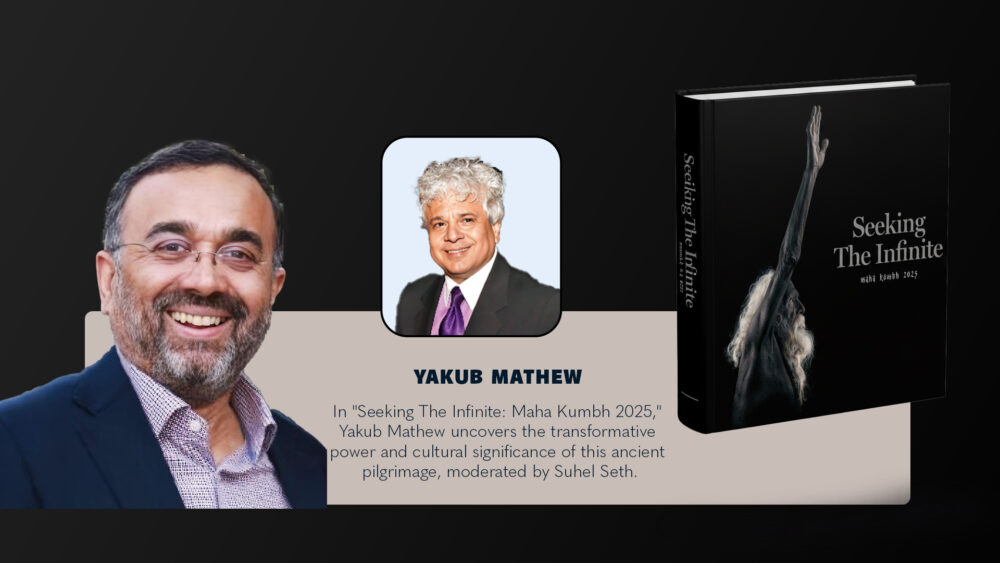
Through water — the book’s recurring metaphor — readers encounter themes of purification, surrender, continuity, and healing. Akella writes that the Mahakumbh becomes a “clarion call from India”, affirming the truth of one universal religion: humanity.
“Turning the pages feels like entering sacred waters,” she reflects — beginning with blessings from spiritual luminaries such as Sadhguru, Swami Avdeshanand Giri Maharaj, Oswald Cardinal Gracias, and Radhanath Swami, and flowing onward into deeper philosophical reflections that explore faith, ritual, mysticism, science, and human longing.
The Magnitude of the Mahakumbh — and the Miracle of Peace
The 2025 Mahakumbh welcomed an estimated 640 million devotees, unfolding peacefully across nearly two months — an extraordinary feat of spiritual devotion and logistical harmony. The rare astronomical alignment of Jupiter, the Sun, and the Moon underscored the sacred timing of the gathering, reinforcing its cosmic symbolism.
Yakub Matthew captures this grandeur with humility, describing his experience as one of cosmic insignificance and spiritual awe:
“I was just an insignificant speck of dust on the soap bubble of the universe.”
Immersed in the swelling crowds and sacred waters, he describes the sensory chaos not as noise, but as “the pulsations of my own soul.” His prayer — offered for peace in a turbulent world — reflects the Mahakumbh’s transformative power to dissolve ego and awaken collective consciousness.
A Chorus of Voices Across Disciplines
One of the book’s greatest strengths is its diverse and illustrious roster of contributors, spanning spirituality, politics, arts, science, sports, medicine, and literature. Voices include Kabir Bedi, Dr. Shashi Tharoor, Barkha Dutt, Anupam Kher, Muzaffar Ali, Sagarika Ghose, Farokh Engineer, Swami Sarvapriyananda, Sadhvi Bhagwati Saraswati, Ustad Hidayat Khan, and dozens more.
Their reflections examine the Mahakumbh through lenses ranging from mythology and astronomy to medicine and modern technology. Notably, Amitabh Kant highlights the deployment of 2,750 AI-powered CCTV cameras, while Dr. Dinesh Singh reimagines the mythical Saraswati as “the flow of humanity itself.”
Meanwhile, Dr. Achintya Moulick likens his surgical practice to a personal Mahakumbh — a sacred confluence of science and faith, where “every heartbeat becomes a mantra.”
Yakub Matthew: A Seeker Beyond Labels
Though he calls himself an “accidental author,” Matthew emerges as a lifelong seeker shaped by diverse influences — from childhood mentorship under Mother Teresa and Bishop Paulos Gregorios, to a career bridging political power, global finance, and spiritual inquiry.
His identity as a Syrian Christian, New York-based banker, and Indian-rooted humanist enables him to approach the Mahakumbh as a truly inter-national heritage, unconstrained by religious or geographical boundaries.
A Living Archive of Faith and Unity
Ultimately, Seeking the Infinite stands not as a celebrity anthology, but as a collective hymn — a multi-voiced tribute to the greatest spiritual gathering on Earth. It immortalizes the Mahakumbh as a symbol of unity in diversity, echoing India’s Sanatan message of coexistence and transcendence.
Even for those who could not attend the event, the book offers a ritual-like reenactment, inviting readers to metaphorically dip into sacred waters. As Akella concludes, Prayagraj — like Mecca, Jerusalem, or Kashi — becomes a mirror of the human heart, where contradictions dissolve and love emerges as the beginning, the journey, and the destination.
“This book will help us listen more deeply — to the longings of our own heart, to the silent music of creation, and to the voice of the One who speaks through both.”