








Humans’ long-standing attraction to alcohol may be far older than civilization itself. Scientists now believe that our preference for alcoholic drinks originated millions of years ago with our primate ancestors, who actively sought out naturally fermented fruits in the wild. This ancient dietary behavior helped shape both our biological ability to process alcohol and the social habits linked to drinking today.
Fermented Fruit and the Birth of Alcohol Tolerance
Early primates are believed to have relied heavily on ripe and overripe fruits for survival. As these fruits naturally fermented on trees and forest floors, they produced ethanol, the same type of alcohol found in modern beverages. These fruits were not only rich in sugar but also calorie-dense due to their alcohol content, making them an appealing energy source.
Research suggests that about 10 million years ago, a critical genetic mutation emerged among African apes — the ancestors of humans, chimpanzees, and gorillas. This mutation dramatically improved their ability to metabolize alcohol, allowing them to break it down around 40 times faster than earlier primates. Scientists from the University of California identified this adaptation as a key evolutionary advantage.
According to Nathaniel Dominy of Dartmouth College, this mutation helped early apes locate fermented fruit more efficiently using its strong aroma and safely consume it without severe toxicity. When humans later developed agriculture around 10,000 years ago, they began intentionally fermenting crops — transforming a natural instinct into a cultural practice. “Our brains are essentially programmed to enjoy alcohol,” Dominy explained.
The “Drunken Monkey” Theory
The idea that alcohol shaped primate evolution is supported by the famous “drunken monkey hypothesis,” proposed nearly 25 years ago by Robert Dudley of University of California, Berkeley. The theory suggests that early attraction to ethanol offered survival advantages linked to nutrition and foraging efficiency.
However, Dudley also warns that many modern health problems tied to alcohol arise because our ancient biology is now clashing with today’s unlimited access to high-strength alcoholic beverages — something our evolutionary system was never designed to handle.
Modern Apes Still Consume Natural Alcohol
Recent findings published in BioScience reveal that wild chimpanzees in parts of West and East Africa regularly eat fermented fruit equivalent to 1.4 to 1.5 standard alcoholic drinks per day. Despite this, they do not appear visibly intoxicated due to their efficient alcohol metabolism.
Another study published in Science Advances showed that chimpanzees consume over 10 pounds of ripe fruit daily, which is more than 10% of their body weight. This fruit naturally contains 14–15 grams of alcohol.
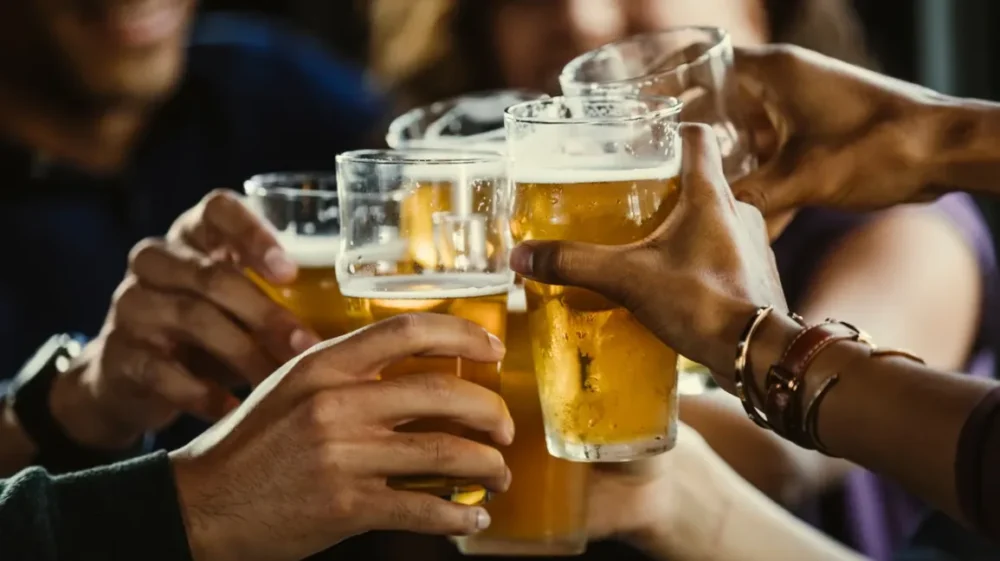
Interestingly, chimpanzees often eat these fruits in groups through a behavior known as “scrumping.” This communal feeding closely resembles human social drinking. Scientists have also observed that apes become more sociable and occasionally more daring after consuming fermented fruit, suggesting that alcohol may enhance social bonding, just as it does in humans.
Some ape communities are even known to share fermented fruits, reinforcing the idea that alcohol-related behaviors linked to cooperation and group bonding existed long before modern humans appeared.
Evolution’s Lasting Influence on Human Drinking
Together, these discoveries paint a picture of alcohol as not merely a modern indulgence but an ancient evolutionary companion. Over millions of years, the ability to process alcohol supported survival, social interaction, and energy intake. Today, those same biological rewards still influence human behavior — although in an environment where alcohol is far more potent and widely available than nature ever intended.
Scientists believe understanding this evolutionary connection may help explain why humans are drawn to alcohol, and why moderation remains such a challenge in modern societies.