









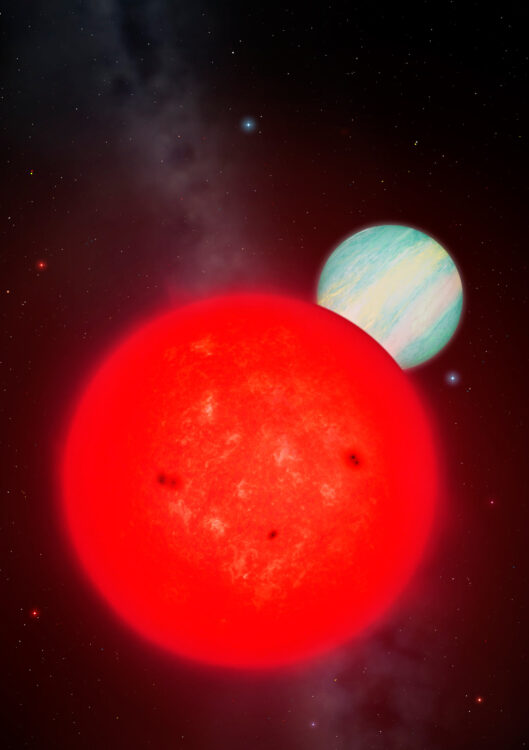
Astronomers have discovered TOI-6894b, a gas giant exoplanet that defies expectations by orbiting the smallest known star capable of hosting such a planet. The red dwarf, TOI-6894, is only about 20% the mass of the Sun, yet its companion—slightly larger in radius than Saturn—has only about half of Saturn’s mass. Despite its modest mass, it boasts a notably low density, making it a fluffy gas giant.
This system contradicts traditional models, such as the widely accepted core accretion theory, which suggests that stars of such low mass lack both the raw materials and gravitational pull to form or support massive planets. The revelations from TOI-6894b are prompting astronomers to rethink how and where giant planets can form.
The planet’s transit is exceptionally deep—blocking roughly 17% of its star’s light—making it one of the clearest exoplanet signals ever observed. Researchers plan to conduct detailed atmospheric studies using next-generation telescopes, hoping to probe methane and ammonia signatures that could offer clues to its formation and composition.
Since small red dwarfs are the most common type of star in the Milky Way, findings like these raise the possibility that such “impossible” giant planets may be more prevalent than previously thought. This groundbreaking discovery opens a new chapter in understanding planet formation in the galaxy.