








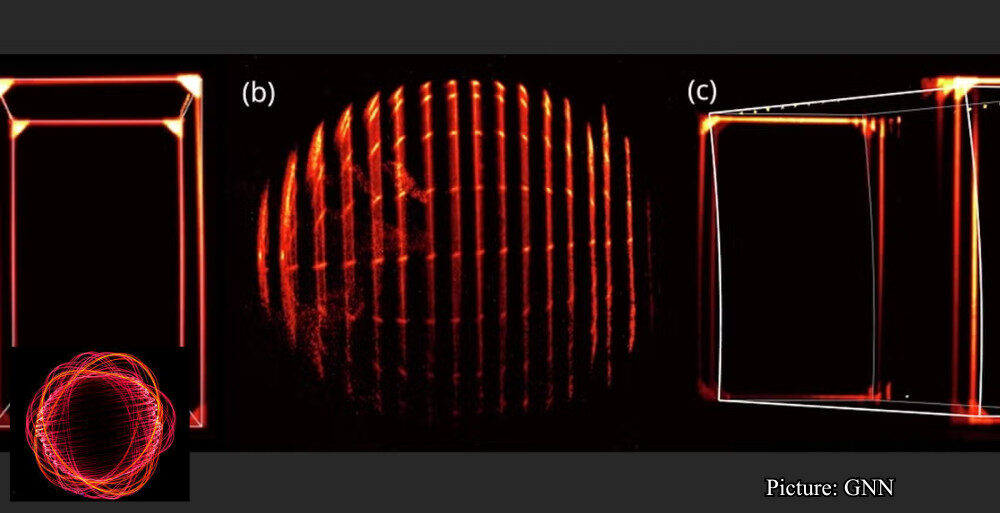
In a groundbreaking development that pushes the boundaries of both science and our visual perception, scientists have achieved the seemingly impossible: making the speed of light visible. This remarkable feat, akin to capturing the ethereal dance of photons, has been accomplished through an innovative method that stitches together numerous thin \’slices\’ of light as they reflect off an object. This technique not only redefines our ability to visualize the fundamental forces of nature but also opens new frontiers in scientific research and technological advancement.
To appreciate the significance of this achievement, one must first understand the sheer velocity at which light travels. At approximately 299,792 kilometers per second, light’s speed is a cornerstone constant in the realm of physics, underpinning Einstein’s theory of relativity and serving as a universal speed limit. The notion of capturing light in motion, therefore, is not just a technical challenge but a conceptual one, demanding a radical rethinking of how we perceive and measure time and space.
The method employed by scientists involves capturing light in a series of ultra-fast frames, each representing a minuscule fraction of a second. These frames are then meticulously stitched together to create a coherent sequence that reveals the path of light as it interacts with various surfaces. This technique is akin to creating a stop-motion film of a phenomenon that occurs at a scale far beyond human perception. The result is a visual representation of light’s journey, a dance of photons that is both mesmerizing and enlightening.
Historically, the pursuit of capturing light\’s speed has been a quest marked by incremental advancements in technology and understanding. In the early 20th century, high-speed photography was revolutionized by Harold Edgerton, whose work with strobe lights allowed for the capture of fast-moving objects such as bullets in motion. Edgerton’s pioneering efforts laid the groundwork for future innovations, but even his work could not approach the challenge of visualizing light itself.
The current breakthrough is made possible by advances in computational imaging and optics. By using sophisticated sensors and algorithms, researchers can now capture and process data at previously unimaginable speeds. This capability is not merely academic; it has profound implications for fields ranging from physics and astronomy to medicine and engineering. For instance, understanding how light interacts with biological tissues at such high speeds could lead to new diagnostic tools and therapies.
Moreover, the ability to visualize the speed of light has cultural and philosophical implications. It challenges our intuitive understanding of reality, prompting us to reconsider the nature of time and motion. In a world where the lines between science fiction and reality are increasingly blurred, such advancements remind us of the limitless potential of human ingenuity.
The images produced by this method are indeed amazing, not just for their aesthetic beauty but for what they represent: a new lens through which to view the universe. They invite us to ponder questions that have fascinated humanity for centuries, from the nature of light itself to the fundamental laws that govern our existence.
As technology continues to evolve, the possibilities for what we can capture and understand grow exponentially. This achievement is a testament to the power of scientific curiosity and the relentless pursuit of knowledge. It serves as a reminder that, in the words of Carl Sagan, \’somewhere, something incredible is waiting to be known.\’ By making the speed of light visible, scientists have taken us one step closer to uncovering the incredible mysteries of our universe.