







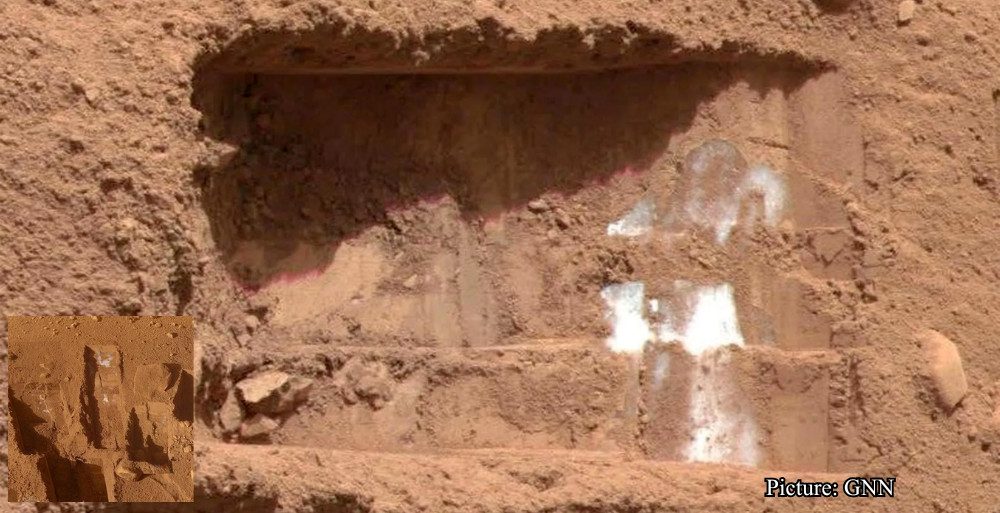
Mars’ frozen ice caps might be more than just relics of the planet’s cold past; they could be time capsules preserving ancient life. Recent experiments demonstrate that essential protein building blocks can endure millions of years in pure ice despite constant cosmic radiation. However, when ice is mixed with Martian-like soil, organic material degrades rapidly. This discovery suggests that future missions should prioritize drilling into pristine, buried ice over examining rocks or soil.
The Red Planet has long intrigued scientists and enthusiasts alike, not just for its striking red hue but for the tantalizing possibility that it might once have harbored life. Mars, with its polar ice caps and evidence of ancient riverbeds, presents a landscape that is both alien and oddly familiar. The idea that life could have existed—or might still exist in some form—beneath its surface is a hypothesis that has driven decades of exploration and research. A recent study by NASA, published in ScienceDaily, sheds new light on this possibility, suggesting that the Martian ice caps may hold the secrets of life from millions of years ago.
The study’s findings are based on meticulous laboratory experiments that simulated Martian conditions. Researchers focused on the stability of amino acids, the building blocks of proteins, when trapped in ice. Under the relentless onslaught of cosmic radiation, these organic molecules were found to endure for tens of millions of years if encased in pure ice. This is a significant revelation, as it implies that any ancient life forms that might have existed on Mars could potentially be preserved within the planet’s ice caps, waiting to be discovered by future missions.
However, the study also highlighted a crucial caveat: the presence of Martian-like soil significantly accelerates the degradation of these organic materials. This finding underscores the importance of targeting specific areas for exploration. Rather than focusing on the planet’s rocky surface or its dusty regolith, future missions might yield more fruitful results by drilling into the clean, buried ice. This approach could provide a more direct and untainted glimpse into the planet’s biological past.
The implications of this research are profound. If life ever arose on Mars, the preservation of organic molecules in ice could offer the most direct evidence of its existence. This shifts the focus of Martian exploration from the planet’s surface to its subsurface ice, a strategy that could revolutionize our understanding of the planet. The discovery also raises questions about the potential for similar processes on other icy bodies in our solar system, such as the moons of Jupiter and Saturn, which are believed to harbor subsurface oceans beneath their icy crusts.
Historically, the search for life on Mars has been a story of shifting paradigms. In the late 19th and early 20th centuries, telescopic observations led to the belief that Mars was crisscrossed with canals, a notion that fueled popular imagination and scientific inquiry. This was later debunked, but the idea of a once-livable Mars persisted. The Viking landers of the 1970s conducted the first direct search for life on the Martian surface, but their results were inconclusive, leaving scientists with more questions than answers.
In recent years, the focus has been on understanding Mars’ geological history and climate evolution. The discovery of seasonal methane emissions and recurring slope lineae, which are thought to be caused by briny liquid water, have reignited interest in the possibility of extant life. However, these phenomena are difficult to study directly, and their implications for life are still hotly debated.
The new findings from NASA’s study add a compelling piece to this puzzle. By demonstrating the long-term stability of organic molecules in ice, researchers have identified a potential reservoir of ancient Martian life that could be accessible with current technology. This presents a clear directive for future missions, which could employ advanced drilling techniques to extract samples from the ice caps. Such missions would require careful planning and execution, not only to avoid contamination but also to ensure the integrity of the samples collected.
The technological challenges of drilling on Mars are formidable. The harsh conditions, including extreme cold and harsh radiation, require robust and reliable equipment. Moreover, the logistics of transporting and operating such equipment remotely from Earth add another layer of complexity. Nevertheless, the potential rewards of such an endeavor are immense. Successfully retrieving and analyzing samples from Martian ice could provide unprecedented insights into the planet’s history and its potential for life.
In the broader context of astrobiology, these findings also have implications for the search for life beyond our solar system. They suggest that icy worlds, often overlooked in favor of more Earth-like planets, could also be promising targets in the search for life. This could influence the design of future space telescopes and missions, which might prioritize the detection of ice-covered exoplanets.
As we continue to explore our cosmic neighborhood, the prospect of finding life—or evidence of past life—on Mars remains one of the most tantalizing possibilities in science. The recent study by NASA represents a significant step forward in this quest, providing a clearer roadmap for future exploration. With each discovery, we come closer to answering the age-old question of whether we are alone in the universe, a question that has profound implications for our understanding of life and our place in the cosmos.