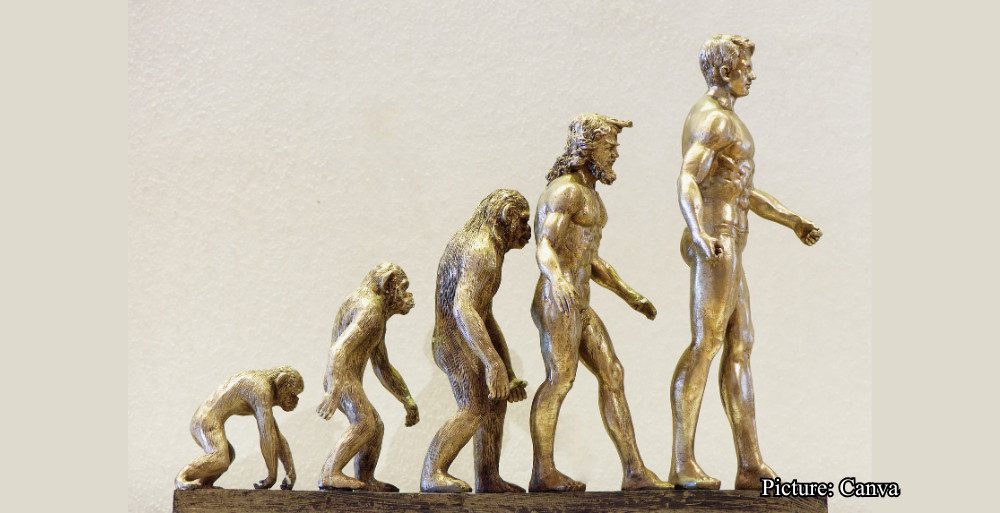










A comprehensive review of nearly two decades of genetic research suggests that the cognitive foundations for human language were established at least 135,000 years ago, long before the explosion of symbolic culture seen in the archaeological record. By tracking the divergence of early human populations through maternal and paternal lineages, researchers from MIT and the American Museum of Natural History have identified a timeline that suggests language may have initially developed as an internal cognitive tool before evolving into a social communication system. This findings challenge previous theories that linked language emergence solely to the appearance of physical artifacts, proposing instead that the biological “hardware” for complex syntax was a prerequisite for the subsequent leap into modern human behavior.
CAMBRIDGE, Mass. — The quest to identify the precise moment when “man became man” through the power of speech has moved from the realm of speculative archaeology to the precision of genomic mapping. A team of interdisciplinary researchers led by Massachusetts Institute of Technology (MIT) linguist Shigeru Miyagawa has published a landmark study proposing that the cognitive capacity for language was fully present in Homo sapiens no later than 135,000 years ago.
The research, published in the journal Frontiers in Psychology, synthesizes 15 major genetic studies conducted over the last 18 years. By aligning these genetic milestones with the known history of human migration and the appearance of symbolic artifacts, the authors argue that the biological capacity for syntax and word-building predates the African exodus of early humans. This timeline places the birth of language significantly earlier than many traditional “cultural explosion” theories, which often date the origin of complex communication to roughly 50,000 to 100,000 years ago.
The Genetic Clock and Population Divergence
The study’s methodology rests on a fundamental principle of population genetics: if every human population across the globe possesses the exact same complex capacity for language, that capacity must have existed before those populations split.
“The logic is very simple,” stated Dr. Miyagawa, who collaborated on the project with Rob DeSalle and Ian Tattersall of the American Museum of Natural History (AMNH). “Every population branching across the globe has human language, and all languages are related. I think we can say with a fair amount of certainty that the first split occurred about 135,000 years ago, so human language capacity must have been present by then, or before.”
To reach this conclusion, the team reviewed a massive dataset including Y-chromosome analysis (tracking paternal descent), mitochondrial DNA (tracking maternal ancestry), and whole-genome sequencing. These diverse datasets consistently point to a period 135,000 years ago when the initial, unified population of Homo sapiens in Africa began to diverge into distinct groups. Because every resulting group—no matter how geographically isolated—retained the same intricate linguistic architecture, researchers conclude the trait was already “hard-coded” into the species.
Language as an Internal Cognitive Tool
One of the study’s more provocative assertions is that language did not necessarily begin as a way to talk to others. Instead, Miyagawa and his colleagues suggest it may have first emerged as a “private cognitive system”—an internal method for organizing complex thought.
According to this model, the biological mutation that allowed for “Merge”—the linguistic operation of combining two elements to create a new, larger expression—offered an immediate evolutionary advantage for internal reasoning. Only later, perhaps over a span of 35,000 years, did this internal system adapt for vocalized social communication.
“Language is both a cognitive system and a communication system,” Miyagawa explained during a briefing on the findings. “My guess is that prior to 135,000 years ago, it did start out as a private cognitive system, but relatively quickly that turned into a communications system.”
This distinction helps explain a long-standing mystery in anthropology: the gap between the biological emergence of modern Homo sapiens (roughly 300,000 years ago) and the appearance of sophisticated tools and art. If language began as a silent, internal process, it would leave no trace in the archaeological record until it was utilized for social coordination and symbolic expression.
From Syntax to Symbolism
The study identifies a secondary milestone at approximately 100,000 years ago. At this point, the archaeological record begins to show a “symbolic surge.” Early humans started creating red ocher pigments, engraved ostrich eggshells, and personal ornaments.
Ian Tattersall, a paleoanthropologist and co-author of the study, has long maintained that language was the “trigger” for this modern human behavior. In the team’s view, the existence of language allowed for the transmission of complex ideas, leading to a “cascade of innovations.”
“If we are right, people were learning from each other and encouraging innovations of the types we saw 100,000 years ago,” Miyagawa noted. The ability to categorize the world through nouns and manipulate those categories through syntax allowed for the planning, storytelling, and social bonding necessary to sustain larger, more complex tribal units.
Debating the “Big Bang” vs. Gradualism
While the MIT-AMNH study provides a robust empirical framework, it enters a field characterized by intense debate. The “gradualist” school of thought argues that language did not appear through a single genetic event but evolved slowly over millions of years, starting with the vocalizations of early hominids.
Miyagawa remains skeptical of the gradualist approach, emphasizing that human language is “qualitatively different” from animal communication. While primates have vocal abilities, they lack the “infinitely generative” system created by the combination of words and grammar.
“Human language is unique because there are two things—words and syntax—working together to create this very complex system,” he said. “No other animal has a parallel structure.”
Critics of the study point out that while genetic divergence proves the capacity for language was present, it does not strictly prove that language was being used. They suggest that cultural pressures or environmental shifts might have been the primary drivers, rather than a specific genetic “switch.” However, the sheer consistency of the 135,000-year genetic window provides a new, high-resolution anchor for the conversation.
Implications for Modern Linguistics
By rooting the origin of language in a common ancestral population, the study reinforces the concept of a “Universal Grammar”—the idea that all human languages, from English to Bantu to Japanese, share a deep underlying structure. Miyagawa’s previous work has highlighted these hidden commonalities, suggesting that the “rules” of language are a biological constant of our species.
As genetic sequencing technology continues to improve, the researchers hope to narrow the window even further. For now, the 135,000-year mark serves as a foundational boundary, suggesting that the very essence of human thought was forged in the heat of the Middle Stone Age, long before the first word was ever carved into stone or painted on a cave wall.
“Our approach is very empirically based, grounded in the latest genetic understanding,” Miyagawa concluded. “I think we are on a good research arc, and I hope this will encourage people to look more at human language and evolution.”