







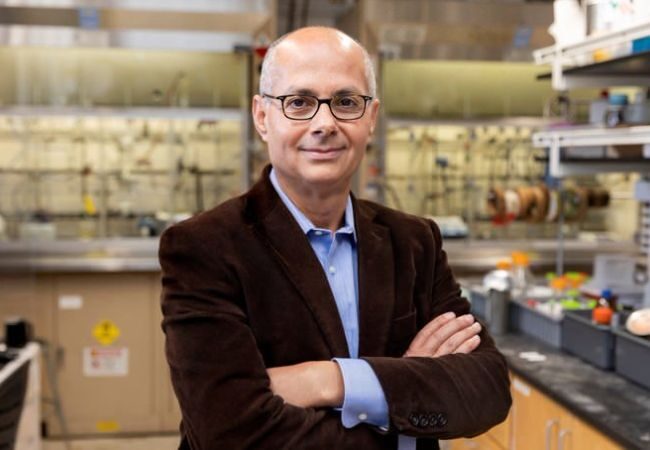
When Saudi-American scientist Omar M. Yaghi stepped onto the Nobel stage in 2025, the moment marked more than a personal triumph. It was a historic milestone for Saudi Arabia, the Arab world, and for basic science itself. Yaghi became the first Saudi national to receive a Nobel Prize and only the second Arab-born scientist to win the Nobel Prize in Chemistry, following Egyptian-American chemist Ahmed Zewail in 1999.
Yaghi shared the prestigious award with Richard Robson of Australia and Susumu Kitagawa of Japan for their groundbreaking work on metal-organic frameworks (MOFs) — crystalline, sponge-like materials capable of storing gases, capturing carbon dioxide, and harvesting water from air. The trio also shared the 11 million Swedish krona ($1 million) prize, recognizing over five decades of scientific contributions that have reshaped modern materials chemistry.
Once considered an abstract academic pursuit, MOF science is now applied globally, with research underway in more than 100 countries. Its applications range from climate change mitigation and hydrogen storage to clean water access, positioning MOFs as one of the most versatile material innovations of the 21st century.
Yet Yaghi’s path to global scientific acclaim began far from elite laboratories.
A Childhood Shaped by Displacement and Discipline
Born in 1965 in Amman, Jordan, Yaghi grew up on the outskirts of the Al-Wehdat refugee camp as one of ten children in a Palestinian refugee family. Their single-room home lacked electricity, and water arrived just once a week — sometimes less.
Despite these hardships, Yaghi resists romanticizing adversity as destiny.
“It’s not the poetic idea that because I had hardship with water when I was a child that I was determined to solve the problem,” Yaghi told Arab News.
“I was much more motivated by solving problems that the world didn’t really care about. That’s basic science.”
His upbringing revolved around three places: the family home, the butcher shop his father Mounes Yaghi ran in downtown Amman, and Bishop’s School in Jabal Amman. At the butcher shop, Yaghi absorbed lessons that would later define his career.
“There, I learned the power of work ethic, honesty, and responsibility,” he said. “Those values stayed with me.”
The family traced its roots to Al-Masmiyya, a Palestinian village destroyed during the 1948 Nakba. In 2018, Yaghi returned to the site, seeking fragments of family memory preserved through storytelling.
Discovery, Migration, and the Language of Science
A pivotal moment came when Yaghi discovered molecular drawings in his school library at age 10 — an encounter that sparked his fascination with chemistry.
At just 15 years old, he traveled alone to the United States, enrolling at Hudson Valley Community College in New York. With limited funds and fluent reading but weak spoken English, Yaghi worked supermarket jobs, tutored math, and immersed himself in American culture through newspapers and television.
“Most words weren’t even in my dictionary,” he recalled. “But I learned fast.”
Within months, he had mastered conversational English. By 1985, he earned a bachelor’s degree in chemistry, followed by a PhD from the University of Illinois Urbana-Champaign in 1990.
Building the Architecture of the Invisible
Yaghi’s most transformative contribution came in 1995, when he coined the term “metal-organic framework.” Four years later, he introduced MOF-5, celebrated for its unprecedented internal surface area. By 2003, he demonstrated that MOFs could be rationally designed, unlocking limitless customization.
“Once you solve an intellectual challenge,” Yaghi said, “you provide a foundation for enormous societal benefit.”
Today, MOFs can trap carbon, store hydrogen, and extract potable water from desert air.
James Stephenson, CEO of Promethean Particles, described MOFs as “engineered cages”:
“A single gram can have the surface area of 8,000 square meters,” he explained. “It’s the empty space inside them that changes everything.”
Science With Purpose — But Freedom First
Despite MOFs’ real-world impact, Yaghi insists that basic research must remain unconstrained.
“Basic science allows you to be free,” he said. “When you aim only to solve today’s problems, you miss discoveries that solve tomorrow’s.”
Still, Yaghi has embraced entrepreneurship in recent years. He founded Atoco, H2MOF, and WaHa Inc., companies focused on water harvesting, hydrogen storage, and carbon capture. Current MOF-based systems can generate 100 liters of water per day, with future designs targeting 2,000 liters.
With 2.1 billion people lacking access to safe drinking water, according to the World Health Organization, the implications are profound.
Identity Beyond Borders
Yaghi holds Saudi, American, Palestinian, and Jordanian identities — and embraces all of them.
“I am very proud of my Palestinian origin. I was born and raised in Jordan. I became an American citizen. And Saudi Arabia has treated me with extraordinary kindness,” he said.
In 2021, King Salman granted him Saudi citizenship, recognizing his contributions to reticular chemistry and nanomaterials. Yaghi now advises Saudi research institutions and co-directs clean-energy initiatives.
His donation of a MOF-5 model to the Nobel Prize Museum places his work alongside Ahmed Zewail’s femtochemistry apparatus — a symbolic link between generations of Arab scientific excellence.
“A scientist’s role,” Yaghi reflected, “is to advance knowledge. Everything else follows.”