




New Delhi: From selling old notebooks for a few paise to light her home, to helping anchor the world’s highest railway bridge in one of the most challenging terrains on Earth, the life of Madhavi Latha reads like a testament to grit, intellect, and quiet determination. On Sunday, her extraordinary journey received national recognition when she was honoured as co-winner of the Indian Science Icon of the Year at the NDTV Indian Of The Year event.
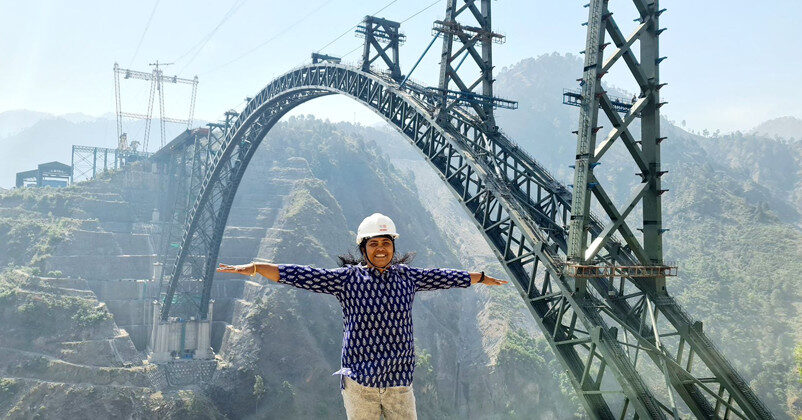
The award celebrates her pivotal contribution to the iconic Chenab Railway Bridge, a project widely regarded as one of India’s most ambitious engineering feats. Rising 359 metres above the Chenab River in Jammu and Kashmir—35 metres taller than the Eiffel Tower—the bridge is the highest railway bridge in the world and a cornerstone of the Udhampur-Srinagar-Baramulla Rail Link (USBRL), finally connecting Kashmir with the rest of the country by rail.
“This award belongs to Indian Railways and to every engineer who worked relentlessly on the bridge,” Professor Latha said while accepting the honour, underlining her trademark humility. “Projects of this scale are never the achievement of one person. They are built by teams that trust each other.”
Engineering Against the Odds
The Chenab Bridge was never just another infrastructure project. Designed as a single-arch steel bridge spanning two steep Himalayan hills with no intermediate supports, it had to withstand earthquakes of up to magnitude 8 and wind speeds touching 220 kmph. The site itself was daunting—unstable rock slopes, extreme seismic vulnerability, and near-total inaccessibility.
“When I first visited the site in 2005, there were no human footsteps on those slopes,” Latha recalled. “We crossed the river by boat and climbed terrain where a landslide could sweep you into the valley at any moment.”
As the project’s geotechnical consultant, she was responsible for designing slope stabilisation systems and foundation strategies, a role she carried out over 17 years. “The arch abuts on two hills without any support in between. Stabilising those rock slopes was a nightmare,” she said candidly. “Every calculation had to factor in earthquakes, landslides, and extreme weather.”
There were moments of intense personal sacrifice. “At one stage, I worked for three days without sleep. I lived in my office because the slope design work was at its peak,” she said. “This bridge became a part of my life.”
From Rural Hardship to Academic Excellence
What makes her achievement even more remarkable is her background. Born in Yedugundlapadu, a tiny village in Andhra Pradesh, Madhavi Latha grew up in severe poverty after her farmer father lost his income. “I still remember my mother crying near the chulha because we had no kerosene,” she said. “That day, I sold my old notebooks for 40 paise so we could cook.”
Educated in a Telugu-medium government school, she went on to study civil engineering at Jawaharlal Nehru Technological University, Kakinada—the first engineer from her village. Hostel life initially overwhelmed her. “I didn’t even know what ‘hi’ meant,” she laughed. “I almost quit college until my grandmother told me, ‘You are meant for big things.’”
That encouragement changed everything. An M.Tech from NIT Warangal and a PhD from IIT Madras followed, before she joined the Indian Institute of Science (IISc) in 2003. She became the first woman faculty member in the Civil Engineering department’s 53-year history and now heads IISc’s Centre for Sustainable Technologies.
Balancing Science and Society
Behind the professional success lay personal struggles. After her PhD, she supported her family on a ₹3,200 monthly scholarship. Later, she moved to IIT Guwahati with her infant daughter and elderly grandmother while her husband worked thousands of kilometres away. “There were days I left home at 4 am, returned at midnight, and still made sure my children were cared for,” she said.
Even today, she acknowledges the invisible labour many women shoulder. “If I travel for a seven-day conference, I cook and freeze food for seven days,” she admitted.
A Role Model for the Next Generation
Professor Latha’s message to young women is clear: “Never hesitate to express yourself. Self-confidence is key. Your ideas will be respected because they have merit—speak up.”
For her, the Chenab Bridge is deeply personal. “It mirrors my life,” she reflected. “From fragile Himalayan slopes to fragile dreams of a barefoot child, both needed stabilisation. Both demanded courage.”
“When I see the bridge, I feel proud,” she added. “It may be taller than the Eiffel Tower, but the real height is the journey.”
As India celebrates a structure that redefines engineering limits, it also celebrates the woman whose resilience helped it stand tall—quietly proving that the strongest foundations are often built against the hardest odds.