










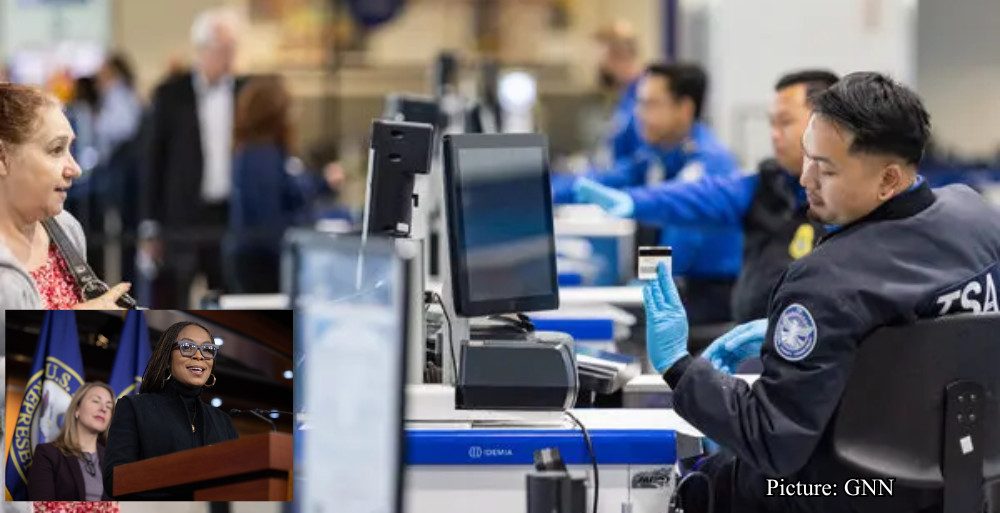
The Trump administration’s expanded use of advanced technology to support its large-scale deportation efforts — and to respond to protests over immigration raids — is facing mounting criticism from Democrats and civil liberties advocates.
The Department of Homeland Security (DHS) has directed funding from President Donald Trump’s One Big Beautiful Bill Act toward acquiring a broad array of surveillance tools capable of tracking migrants as well as U.S. citizens.
Among the technologies obtained are iris-scanning systems, facial recognition software, web and social media scraping platforms, and cellphone tracking tools. Immigration and Customs Enforcement (ICE), which operates under DHS, has also used facial recognition applications such as Mobile Fortify to capture facial images, contactless fingerprints and photos of identity documents for comparison with government databases. DHS has additionally purchased an iris-scanning app capable of reading from several inches away.
The agency has procured WebLoc and Tangles — products from Pen-Link — to monitor geolocation data and collect online information, raising further alarm among privacy advocates.
Democratic lawmakers have introduced multiple bills aimed at limiting ICE’s authority, arguing that the agency may be exceeding legal boundaries and eroding civil liberties. Ed Markey warned that facial recognition sits “at the center of a digital dragnet,” describing the expansion of surveillance capabilities as deeply troubling. He has joined Jeff Merkley and Pramila Jayapal in proposing legislation that would bar ICE and Customs and Border Protection from using facial recognition and other biometric tools, while mandating deletion of collected data.
Separately, Bennie Thompson introduced a bill that would restrict DHS from using Mobile Fortify and similar applications outside ports of entry and require the destruction of images and fingerprints obtained through such systems.
Privacy advocates argue that facial recognition technology has documented accuracy issues, particularly in identifying women and people of color, increasing the risk of wrongful identification. Civil rights groups have also expressed concern about how collected data is stored, shared and safeguarded.
The administration has already faced legal challenges over data-sharing agreements. A plan allowing the Treasury Department to share IRS information with DHS was struck down in court, while a judge permitted the Department of Health and Human Services to share certain Medicaid data with ICE under limited conditions.
Other lawmakers, including Nellie Pou and LaMonica McIver, have questioned whether DHS is operating within its legal authority and suggested stronger legislative or judicial action may be required.
DHS has denied any misuse of technology, stating that its software complies with applicable legal standards and that it addresses congressional concerns through official channels. Companies linked to the technology acquisitions have not publicly commented.
Although Democrats have proposed measures to curb DHS’s surveillance capabilities, the legislation has stalled in the Republican-controlled Congress. GOP lawmakers have largely supported the president’s immigration enforcement agenda, approving $170 billion in enforcement funding as part of last year’s tax and spending package.
Michael McCaul acknowledged constitutional protections against unreasonable searches and seizures but suggested enforcement operations would be better conducted closer to the border rather than in major cities.
Meanwhile, negotiations over DHS funding remain deadlocked. Funding for the agency briefly lapsed earlier this month after lawmakers failed to reach a long-term agreement, though a temporary stopgap measure was previously enacted to keep operations running.