








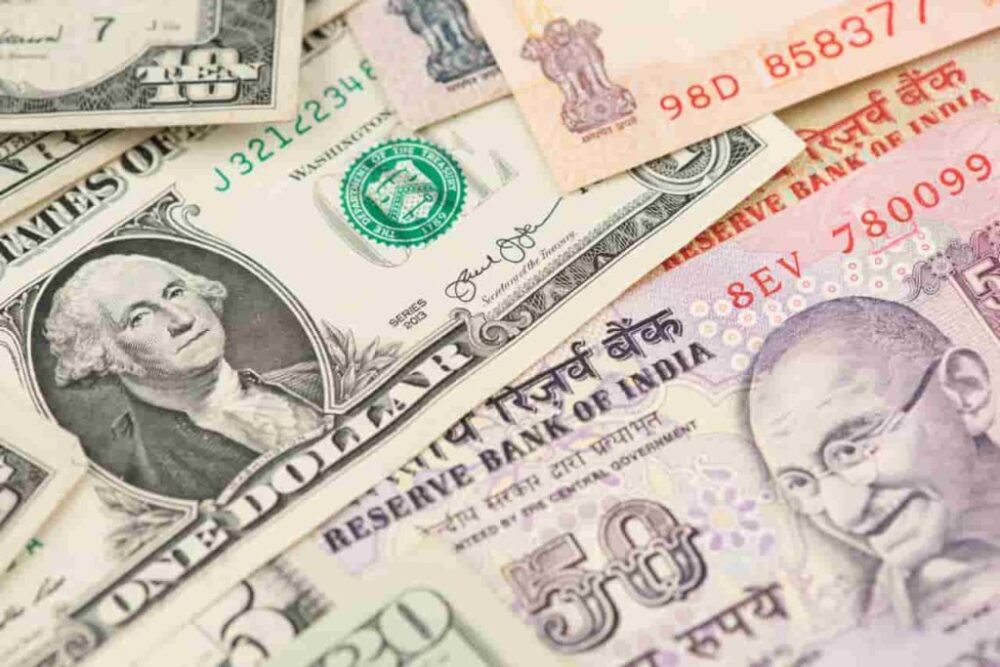
The recent depreciation of the Indian rupee, which crossed the psychologically significant 90-per-dollar mark earlier this month, is the result of a complex interplay of domestic and global factors rather than any single policy decision or market shock, the government informed Parliament on Tuesday.
Responding to questions in the Rajya Sabha, Minister of State for Finance Pankaj Chaudhary said the rupee’s movement during the 2025–26 financial year has been shaped by widening trade imbalances, global currency trends, capital flow dynamics, and evolving geopolitical and economic conditions, including ongoing trade negotiations between India and the United States.
“Various domestic and global factors influence the exchange rate of the Indian rupee,” Chaudhary said in a written reply. “These include the movement of the Dollar Index, trends in capital flows, interest rate levels, crude oil prices, and the current account deficit.”
Trade Deficit and External Pressures
Economists have long pointed out that a widening trade deficit places downward pressure on a country’s currency, and recent data suggests that India’s import bill—particularly for energy and select commodities—has outpaced export growth. This imbalance has coincided with global uncertainty around interest rates in advanced economies and sustained strength in the U.S. dollar.
The rupee’s fall past 90 against the dollar marked a historic level, prompting concerns among businesses and households about the potential impact on inflation and import costs. However, the government stressed that currency movements must be viewed in a broader macroeconomic context.
“Depreciation may raise the prices of imported goods,” Chaudhary acknowledged. “However, the overall impact on domestic prices depends on the extent to which international commodity prices are passed through to the domestic market.”
Impact on Inflation Not Automatic
The minister cautioned against drawing direct conclusions between a weaker currency and inflationary pressure, noting that import costs are influenced by a range of additional factors.
“Import prices are also affected by global supply and demand conditions, whether imports are essential or discretionary, freight costs, and the availability of substitute goods,” he said. “Therefore, the impact of exchange rate movements on inflation and the economy cannot be assessed in isolation.”
This nuanced view aligns with assessments by several analysts, who argue that while a weaker rupee can make imports costlier, subdued global commodity prices or domestic policy measures can offset some of the inflationary impact.
Export Competitiveness a Potential Upside
Chaudhary also pointed out that currency depreciation is not without its potential benefits. A weaker rupee can enhance the competitiveness of Indian exports by making them cheaper in global markets, which can, in turn, support economic growth and job creation.
“Depreciation can improve export competitiveness and support growth,” he noted, while reiterating that the net effect depends on global demand conditions and supply-side constraints at home.
Market-Determined Exchange Rate
The government made it clear that India does not pursue a fixed or target exchange rate regime.
“The value of the rupee is market-determined,” Chaudhary said. “The government does not target any specific exchange rate level or band.”
Instead, the responsibility for managing volatility rests with the Reserve Bank of India (RBI), which actively monitors the foreign exchange market.
RBI’s Role: Managing Volatility, Not Levels
According to the minister, the RBI intervenes only to curb excessive volatility and ensure orderly market conditions, rather than to defend any particular level of the rupee.
“The Reserve Bank of India regularly monitors the foreign exchange markets and intervenes, as and when necessary, to prevent undue volatility,” Chaudhary told Parliament.
He added that the central bank closely tracks global developments that could influence the dollar-rupee exchange rate, including:
- Monetary policy decisions by major central banks
- Key global economic data releases
- OPEC+ decisions affecting crude oil prices
- Geopolitical developments
- Daily movements in major international currencies
This approach, policymakers argue, provides flexibility while insulating the economy from abrupt and destabilising currency swings.
Focus on Capital Inflows and Investment
To strengthen the balance of payments and support the rupee over the medium term, the government continues to emphasise foreign direct investment (FDI) as a key pillar of economic policy.
Chaudhary said India has adopted an increasingly investor-friendly framework, with most sectors now open to 100 percent FDI under the automatic route, except for a few strategically sensitive areas.
“More than 90 percent of FDI inflows now come through the automatic route,” he noted, underscoring the ease with which foreign investors can enter the Indian market.
The government, he added, is working to attract even more investment by easing regulations, streamlining approval processes, improving infrastructure and logistics, and enhancing the overall business environment.
Balancing Stability and Growth
Market observers say the government’s remarks reflect a calibrated stance—acknowledging the challenges posed by a weaker currency while emphasising structural reforms and macroeconomic stability.
“The message is that the rupee’s movement is part of a global adjustment process,” said a senior economist at a domestic brokerage. “What matters more is whether capital inflows remain strong and whether export competitiveness improves over time.”
As global financial conditions remain uncertain and trade negotiations with major partners continue, the rupee’s trajectory is likely to stay sensitive to both external cues and domestic fundamentals. For now, the government appears focused on managing volatility, supporting investment, and letting market forces determine the currency’s path.