





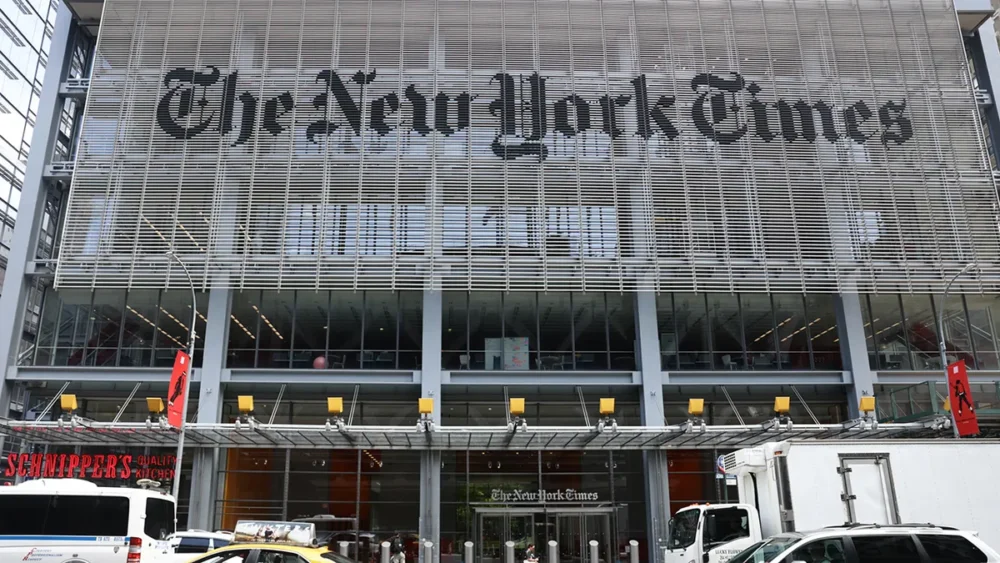
The New York Times has filed a lawsuit accusing the Pentagon of imposing sweeping new reporting restrictions that undermine press freedom and violate core First Amendment protections.
Filed in the U.S. District Court for Washington, D.C., the lawsuit argues that the Defense Department’s new media policy “severely restricts journalists’ ability to gather information” by forcing reporters to sign a 21-page agreement controlling how they interact with Pentagon personnel. Those who decline to sign risk losing their press credentials entirely.
The Times asserts that the rules give the Pentagon “unrestricted authority” to decide what information journalists may seek or publish — even if the material is unclassified or gathered outside Pentagon property.
The lawsuit asks the court to block the policy and declare its most restrictive sections unconstitutional. The Times is represented by veteran First Amendment attorney Theodore J. Boutrous. Julian E. Barnes, one of the paper’s Pentagon reporters, is also a plaintiff.
Pentagon spokesperson Sean Parnell said the department is reviewing the lawsuit and will respond in court.
A Dramatic Shift in Media Restrictions
The challenged rules — enacted in October — represent one of the most significant changes the Pentagon has made to media access in decades. They were rolled out by Defense Secretary Pete Hegseth, who has repeatedly clashed with major news outlets since taking office in January.
Earlier this year, the Pentagon reassigned office space away from several national outlets, instead granting preferred access to conservative-leaning organizations. New limits were also placed on where reporters may move inside the building.
A draft version of the policy circulated in September drew immediate objections from media lawyers. Despite some revisions, the final version still alarmed many newsrooms. More than 20 journalists, including several from The Times, surrendered their Pentagon badges rather than sign the document.
Major news organizations — including ABC, NBC, CNN, CBS and Fox News — publicly condemned the policy as an unprecedented infringement on press freedoms.
Key Concerns in the Policy
The lawsuit highlights several problematic elements in the Pentagon’s new rules:
1. Broad power to label journalists as “security risks”
The Pentagon can revoke a reporter’s access based on its own determination that the journalist poses a safety or security threat — a designation that could be applied for publishing leaks or even unclassified “sensitive” information.
2. Restrictions on soliciting information
A controversial section claims journalists are not protected when they “solicit government employees to violate the law” by sharing confidential material. Media organizations warn this language could criminalize asking sources for news tips or nonpublic information — a basic function of investigative journalism.
3. Punishment for publishing unapproved information
Reporters can be penalized for circulating material not authorized by Pentagon officials, regardless of where it was gathered.
Part of a Larger Pattern of Press Conflicts
Legal battles over press access have been frequent during President Trump’s time in office. Previous cases involved revoked White House press passes and restricted pool coverage at official events. But those disputes targeted individual journalists.
The Pentagon’s new rules, by contrast, apply to the entire defense press corps and could reshape how military reporting is conducted nationwide. Critics argue the policy appears designed to suppress outlets seen as critical of the administration while elevating more favorable media organizations.
After several established news outlets relinquished their credentials, the Pentagon approved a new group of pro-Trump publications to occupy the prime press workspace, raising further alarm among advocates for press freedom.