






The limits of human consciousness are often defined not by what we see, but by what our brains choose to ignore. Through the study of neurological conditions like blindsight and psychological phenomena such as inattentional blindness, researchers are uncovering a vast “unconscious” infrastructure that processes visual data without our awareness. Current debates in neuroscience, centered on the Global Neuronal Workspace Theory, suggest that consciousness acts as a “loudspeaker” for the brain, broadcasting only a fraction of available data to the rest of the mind. This selective processing raises profound questions about the accuracy of human perception in high-stakes environments, from medical diagnostics to legal testimony.
The Hidden Mechanics of Sight
LONDON — For decades, the scientific community has operated under the assumption that “seeing” is synonymous with “awareness.” However, emerging data from the fields of neuropsychology and cognitive science suggest that the human visual system is a tiered hierarchy, where the vast majority of information processing occurs well below the threshold of conscious thought.
The disconnect between physical stimuli and mental recognition is perhaps most vividly illustrated by “blindsight.” This condition occurs following trauma to the primary visual cortex, the region of the brain responsible for mapping visual input. Patients with blindsight report total or partial blindness, yet they demonstrate a baffling ability to “guess” the properties of objects they claim they cannot see.
In a landmark 2004 study, a participant with blindsight was presented with a black bar in their “blind” field of vision. When forced to choose whether the bar was oriented vertically or horizontally, the subject’s accuracy rate was statistically significant, far exceeding the 50% threshold of random chance. Furthermore, the study noted that the subject’s reaction times were influenced by visual cues in their healthy field of vision that pointed toward the hidden object. This suggests that while the “feeling” of seeing was absent, the data was still being integrated into the brain’s navigational and attentional systems.
The Radiologist’s Dilemma: Inattentional Blindness
While blindsight is the result of physical pathology, “inattentional blindness” is a universal quirk of the healthy human mind. It occurs when an individual fails to perceive an unexpected stimulus that is in plain sight because their attention is occupied by another task.
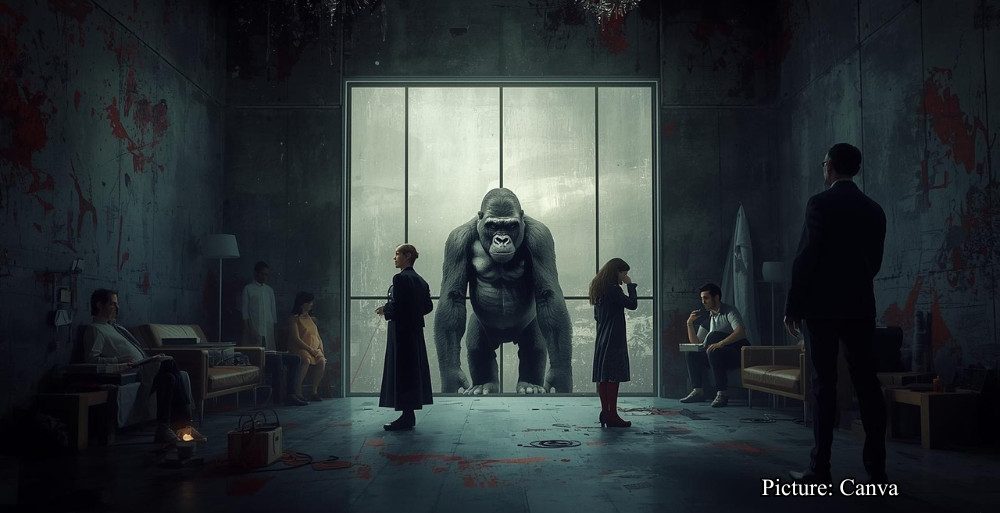
The most famous demonstration of this occurred in 1999, when researchers asked participants to count basketball passes between players in white shirts. Roughly half of the participants failed to notice a human in a gorilla suit walking into the frame, beating their chest, and exiting. The light from the gorilla hit the participants’ retinas; their brains processed the shape; yet, the “gorilla” never reached the level of conscious report.
The implications of this extend far beyond psychological parlor tricks. In a 2013 follow-up study that sent shockwaves through the medical community, 24 expert radiologists were asked to perform a routine lung nodule screening. Unknown to them, a small image of a “dancing gorilla”—48 times larger than the average cancerous nodule—was inserted into the scans.
Despite their years of training and the high stakes of the task, 83% of the radiologists failed to see the gorilla. Eye-tracking data revealed that many of the experts looked directly at the gorilla for up to half a second without “seeing” it. This data highlights a critical vulnerability in human expertise: the more focused we are on a specific data point, the more likely we are to be blind to “obvious” anomalies that fall outside our immediate goal.
The “Loudspeaker” Theory of the Mind
The persistent question for neuroscientists is the “filter problem”: Why does some information become conscious while the rest remains in the shadows? Among the competing frameworks, the Global Neuronal Workspace (GNW) theory has emerged as a leading explanation for this cognitive gatekeeping.
Proposed by researchers such as Stanislas Dehaene, GNW suggests that the brain functions as a decentralized network of specialized modules (evaluating color, motion, or depth). Most of these modules operate autonomously and unconsciously. Consciousness occurs only when a specific piece of information is “ignited” and broadcast to a global workspace—a network primarily located in the prefrontal and parietal cortices.
Under this theory:
- Capacity Limits: The workspace has a narrow bandwidth. It can only “broadcast” one major signal at a time.
- The Loudspeaker Analogy: If the brain is a crowded room of whispering specialists, consciousness is the megaphone. Once a signal is broadcast, every other system in the brain—language, memory, motor control—gains access to it.
- “Fame in the Brain”: As the late philosopher Daniel Dennett famously posited, consciousness is a form of internal “fame.” To be conscious is to have a thought that has successfully competed for the brain’s limited resources and won.
Challenges to the Narrow Workspace
Despite its popularity, GNW is not without its detractors. Some philosophers and neuroscientists argue for “overflow” models of consciousness. These critics suggest that our subjective experience is far richer and more detailed than the GNW theory allows. They argue that we are conscious of the entire visual field at once, but we can only report on the small portion that enters our working memory.
If the “overflow” theorists are correct, the radiologists did see the gorilla, but their memory failed to “save” the file. If GNW is correct, the gorilla never existed in their conscious reality at all.
Policy and Perspective
As we move further into an era of high-speed information and automated assistance, understanding these blind spots is no longer a matter of pure theory. In legal contexts, the reliability of eyewitness testimony is increasingly questioned based on inattentional blindness data. In transportation, the design of “Heads-Up Displays” (HUDs) for pilots and drivers must account for the fact that a person can look directly at a warning light and not “see” it if their mental workspace is full.
Ultimately, the study of what we don’t see reveals a humbling truth: our conscious experience is merely the tip of a neurological iceberg. The vast majority of our interaction with the world happens in the dark, driven by an unconscious engine that is as efficient as it is invisible.