



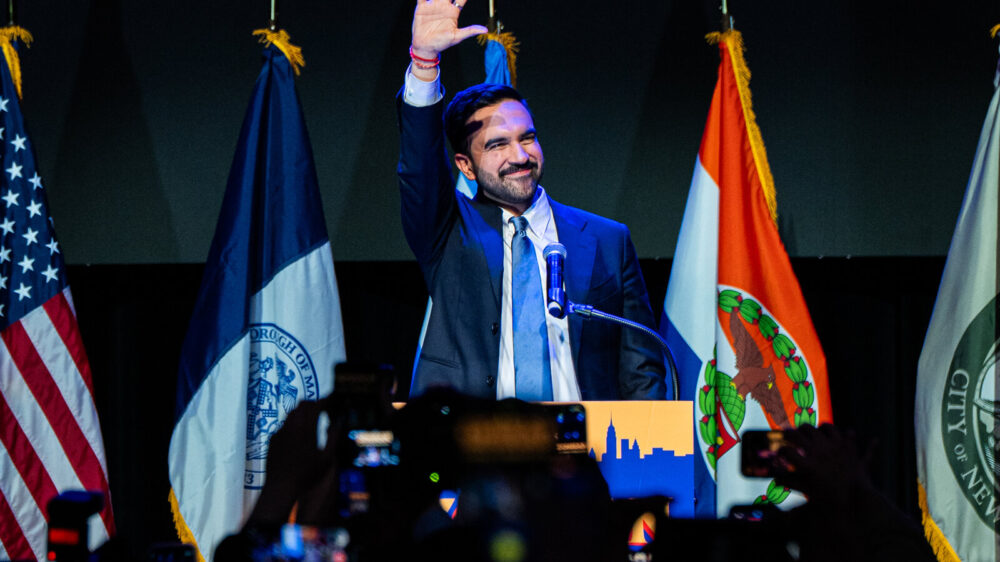
Zohran Mamdani recently made history by becoming New York’s first mayor of South Asian descent. In his acceptance speech, he honored one of modern India’s founding leaders and celebrated amid the energy of Bollywood music.
The son of Indian immigrants belonging to the Muslim community, Mamdani’s victory stands as a strong repudiation of former U.S. President Donald Trump’s immigration restrictions. His win also resonates deeply in a city still healing from the effects of post-9/11 Islamophobia.
His success has sparked reactions both in the United States and India, where people are both applauding and contesting his rise.
Gulfam Khan Hussain of Mumbai stated, “For too long, we have been overlooked.” Meanwhile, artist Tanya Lalwani expressed joy seeing someone of South Asian heritage achieve such a milestone.
Mamdani now joins a global group of diaspora leaders breaking political barriers, alongside figures such as U.S. Vice President Kamala Harris, UK Prime Minister Rishi Sunak, London Mayor Sadiq Khan, Irish leader Leo Varadkar, and Scotland’s Humza Yousaf.
According to Drew University political science professor Sangay Mishra, Mamdani’s victory shifts the spotlight onto the South Asian diaspora.
Central to Mamdani’s public identity is his forthright criticism of Indian Prime Minister Narendra Modi and the ruling Bharatiya Janata Party’s Hindu nationalist agenda.
Mamdani serves as a state assemblyman representing diverse parts of Queens, New York, known for its ethnic and linguistic variety.
Born to Indian parents from Uganda, he was raised in post-apartheid Cape Town, South Africa, before settling in New York.
His parents include Mahmood Mamdani, a scholar of post-colonial studies at Columbia University, and Mira Nair, the renowned Indian filmmaker noted for exploring themes of diaspora and identity in works like “Mississippi Masala,” “The Namesake,” and “Monsoon Wedding.”
Mamdani embraced these influences in his victory speech, openly stating, “I am young, despite my best efforts to grow older. I am Muslim. I am a democratic socialist. And most importantly, I make no apologies for any of it.”
In his speech, he referenced the historic “Tryst with Destiny” address by India’s first Prime Minister Jawaharlal Nehru, delivered on the eve of independence from British rule.
Following his speech, the iconic Bollywood song “Dhoom Machale,” meaning ‘Make Some Noise,’ played, igniting enthusiastic applause.
As Tanya Khan put it, “When Mamdani quoted Nehru, it resonated deeply within us. And ‘Dhoom Machale’? That’s pure Bollywood energy.”
Mamdani’s emergence as a grassroots democratic socialist leader exemplifies a new chapter for the diaspora: transcending mere integration to influence political processes directly.
Sangay Mishra remarked, “It’s significant that a naturalized citizen with a mix of Ugandan, Indian, and American identity, and who also identifies as Muslim, is ready to help shape Democratic Party politics.”
Mamdani’s rise during an administration known for targeting immigrants, crackdowns on H-1B visas, and aggressive ICE enforcement adds special significance for South Asians across generations and countries.
The mayoralty of New York City carries global influence, but Mamdani’s outspoken criticism of India’s Modi government and its policies, including the Citizenship Amendment Act and the revocation of Article 370 in Jammu and Kashmir, positions him in potential tension with his ancestral homeland.
He has gone as far as calling Prime Minister Modi a “war criminal” in relation to the 2002 Gujarat violence, which saw widespread sectarian conflict and loss of life, largely impacting Muslims.
This turbulent history includes an incident where a train carrying Hindu pilgrims was set ablaze, blamed on Muslims by some, which triggered retaliatory attacks and resulted in over a thousand deaths, mostly Muslims, according to official reports.