






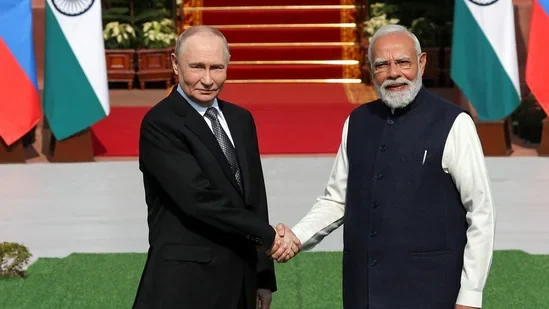
Moscow/New Delhi — Russian President Vladimir Putin’s recent visit to India has sent a clear diplomatic message: New Delhi intends to maintain full strategic autonomy and will not allow Western nations to dictate its foreign policy choices.
A new analysis published by One World Outlook on Saturday concludes that India has no plans to reduce its long-standing partnership with Russia, despite increasing pressure from the United States and other Western allies.
Putin’s state visit — complete with a ceremonial welcome at Rashtrapati Bhavan, a solemn tribute at Rajghat, and wide-ranging bilateral discussions — took place as India grapples with three major geopolitical challenges:
- Expanding Western sanctions on Russia
- Escalating U.S.–China rivalry in the Indo-Pacific
- An evolving India–U.S. trade and technology partnership
According to the report, India’s decision to host Putin with full honors reflects its confidence in pursuing independent relationships rather than falling in line with Western expectations.
“By hosting Putin with full ceremonial honours… India signalled that Russia remains a first-tier partner, not a legacy relationship to be abandoned under Western pressure,” the report said.
The analysis argues that Western capitals have miscalculated India’s willingness to dilute its ties with Moscow. Instead, New Delhi is demonstrating a hybrid model of strategic cooperation — one that engages deeply with the United States while preserving room for high-level partnerships with Russia and the broader Global South.
Military Ties Remain Central to India–Russia Relations
The report highlights that India has no intention of scaling back its defence partnership with Russia. Key capabilities — such as the S-400 air defence system, nuclear submarine cooperation, and missile technologies — remain pillars of India’s deterrence posture.
The 2025 defence roadmap signals:
- Joint development of engines
- Expansion of hypersonic technology collaboration
- Growth in unmanned systems
- Manufacturing and maintenance hubs in India
These areas indicate that India seeks not just procurement but deeper co-production and technological integration with Moscow.
Energy Partnership Continues Unabated
Putin also assured Indian leaders that Russia will remain a stable and discounted supplier of crude oil and petroleum products, despite sanctions or geopolitical disruptions.
This aligns with New Delhi’s oil diversification strategy and helps India maintain energy cost stability. The analysis states that energy ties between the two countries remain largely insulated from external political pressures.
Why Washington Should Rethink Its Approach
The report urges the U.S. to interpret India’s Russia ties as part of a broader hedging strategy, not as a betrayal of partnership with Washington.
Pressuring India to abandon Russia, it warns, would be counterproductive:
“Pushing India to sever the Russian leg of this triangle will not make it fall into America’s arms; it risks nudging New Delhi back toward a more traditional non-alignment.”
Such a move could ultimately diminish U.S. influence in Asia, especially at a time when Washington seeks deeper cooperation with India to counter China.