








India has signed a Comprehensive Economic Partnership Agreement (CEPA) with Oman, stepping up its drive to expand free trade agreements (FTAs) as it looks to cushion the impact of steep U.S. import tariffs and navigate growing uncertainty in the global trading system.
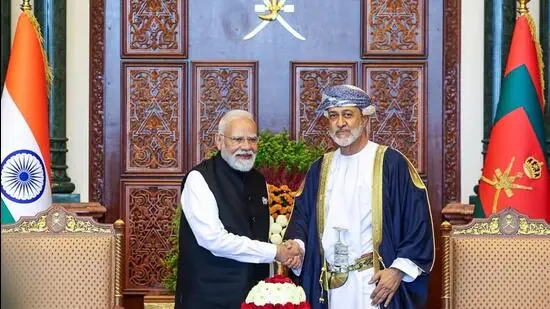
The agreement was signed on Thursday in Muscat, in the presence of Prime Minister Narendra Modi and Oman’s Sultan Haitham bin Tarik, marking India’s second major free trade pact in six months, after the landmark deal with the United Kingdom in May.
The India–Oman pact is aimed at deepening bilateral economic ties, boosting exports, and diversifying market access for Indian businesses at a time when exporters are facing pressure from higher trade barriers in key markets.
According to India’s Ministry of Commerce and Industry, the agreement will grant zero-duty market access to Indian goods on 98.08% of Oman’s tariff lines, covering a wide range of products including engineering goods, textiles, leather, pharmaceuticals, agricultural products, and food items.
In return, India has offered tariff liberalisation on 77.79% of its tariff lines for Omani goods, which will cover nearly 95% of India’s imports from Oman, the ministry said.
“This agreement reflects India’s commitment to strengthening trade partnerships in West Asia and creating stable, predictable access for Indian exporters,” the ministry noted in a statement.
Strategic Response to Global Trade Headwinds
The deal comes as India accelerates negotiations on multiple FTAs amid a challenging global trade environment shaped by tariff disputes, geopolitical tensions, and supply-chain realignments.
In recent months, Indian exporters have been grappling with U.S. import tariffs of up to 50%, which came into effect in August and have weighed heavily on sectors such as textiles, auto components, metals, and other labour-intensive manufacturing industries.
“India is clearly using FTAs as a strategic tool to diversify export markets and soften the impact of steep and uncertain U.S. tariffs,” said Ajay Srivastava, a trade analyst tracking India’s external trade policy.
“By securing preferential access to newer markets, India is trying to reduce over-dependence on any single economy,” he added.
FTAs as a Pillar of India’s Economic Strategy
Free trade agreements have become a central pillar of India’s long-term economic strategy, as New Delhi seeks deeper integration into global supply chains, stronger export growth, and sustained job creation.
By lowering tariffs, simplifying rules of origin, and providing predictable trade frameworks, FTAs are expected to help Indian companies remain competitive globally—particularly in manufacturing and value-added sectors.
India is currently in advanced trade talks with the European Union, New Zealand, and Chile, among others. Negotiations are also underway with several partners across Asia, Africa, and Latin America.
In total, India has 15 free trade agreements covering 26 countries, along with six preferential trade agreements, and is negotiating or exploring trade arrangements with more than 50 nations, Srivastava said.
“Once the ongoing talks conclude, India will have trade agreements with virtually all major global economies except China,” he noted.
Lessons From Recent Trade Deals
Recent agreements with the United Arab Emirates and Australia have already demonstrated the potential benefits of FTAs, significantly boosting bilateral trade volumes and investment flows.
Similarly, the long-awaited India–UK free trade agreement, announced in May, is expected to slash tariffs on products such as Scotch whisky and English gin entering India, while easing access for Indian food products, spices, and manufactured goods in the British market.
Officials say these successes have strengthened the case for faster negotiations and clearer trade frameworks.
“India is negotiating several FTAs at a time of significant challenges in global trade,” Trade Secretary Rajesh Agarwal told reporters this week. “I see positive progress on several of these, next year.”
Balancing Openness and Domestic Concerns
Despite the momentum, trade negotiations remain complex. Indian policymakers face domestic pressure to protect small farmers, micro-enterprises, and sensitive sectors, even as partner countries push for greater market access.
“These agreements require careful balancing,” said a senior government official involved in negotiations. “We have to open markets without undermining domestic livelihoods.”
India–U.S. Trade Talks Still Uncertain
While India is expanding trade ties elsewhere, negotiations with the United States have progressed more slowly. The two sides had hoped to finalise the first tranche of a bilateral trade agreement by the fall, but talks have stalled.
One major point of friction has been India’s continued purchase of discounted Russian crude oil, which Washington argues indirectly supports Moscow’s war effort in Ukraine. New Delhi maintains that its energy decisions are driven by national interest and price stability.
However, recent developments suggest a possible thaw. Prime Minister Modi publicly welcomed President Donald Trump’s peace initiative to end the Russia–Ukraine war, and the two leaders recently spoke by phone to discuss shared interests, including trade.
A U.S. delegation led by Deputy Trade Representative Rick Switzer visited New Delhi last week, holding discussions on strengthening the India–U.S. economic and technological partnership and identifying opportunities to expand bilateral trade, India’s Ministry of External Affairs said.
Wider Diplomatic Engagement on Trade
India’s trade diplomacy has also seen intensified engagement with other partners. New Zealand’s Trade and Investment Minister Todd McClay met Commerce Minister Piyush Goyal last week to review progress on a potential FTA, while EU Trade Commissioner Maroš Šefčovič held talks with Goyal to address sticking points in the long-pending India–EU free trade agreement.
As global trade becomes more fragmented, policymakers say India’s expanding web of FTAs is intended to provide resilience.
“With tariffs rising and supply chains being reshaped, India is betting that a broader network of trade agreements will help anchor its export ambitions and protect growth,” a senior trade official said.