






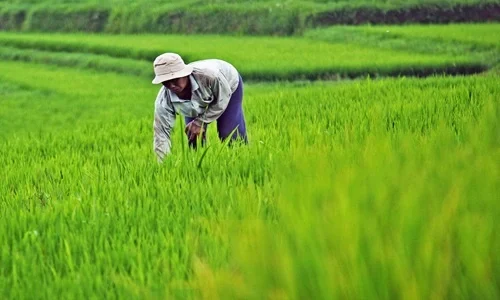
India crossing China to become the world’s largest rice producer in 2025 is more than a statistical victory. It is a moment loaded with symbolism, history, and hard questions about sustainability, equity, and the future of global food security.
With rice production reaching 150.18 million tonnes, surpassing China’s 145.28 million tonnes, India has cemented its position at the top of one of the world’s most critical food chains. Union Agriculture Minister Shivraj Singh Chouhan described the milestone as proof of national self-reliance, declaring that India has moved from food scarcity to becoming a global supplier.
“We have filled our granaries to capacity. Today, India is not dependent on others for food security; we are a country that feeds the world,” Chouhan said while unveiling 184 new crop varieties across 25 field crops, reinforcing the government’s push toward an Aatmanirbhar and Viksit Bharat.
The achievement deserves recognition. Rice feeds more than half the world’s population and anchors food security across Asia, Africa, and parts of the Middle East. In global agriculture, rice is not merely a commodity — it is stability, survival, and geopolitics. By overtaking China, India has placed itself at the center of that equation.
Yet celebration alone would be incomplete without reflection.
Punjab’s Success — And Its Warning
No state embodies India’s rice revolution more vividly than Punjab. Once the epicenter of the Green Revolution, Punjab transformed India from a food-deficient nation into a grain surplus powerhouse. But that success came at a steep environmental cost.
Dr. Satbir Singh Gosal, Vice-Chancellor of Punjab Agricultural University (PAU), calls Punjab the country’s “national laboratory for agriculture” — a place where innovations are tested before being scaled nationally. However, he warns that the same blueprint cannot be blindly replicated.
“Punjab has already paid the price through rapidly depleting groundwater. Now we are seeing similar patterns emerge in other states,” Gosal cautioned. “Stubble burning, water stress, and soil fatigue are no longer isolated problems.”
The government’s push to replicate Punjab’s productivity through the Green Revolution in Eastern India, targeting states like Bihar, Odisha, Assam, Jharkhand, and eastern Uttar Pradesh, reflects both ambition and risk. Subsidies, better inputs, and improved access to technology have undeniably boosted output — but the ecological consequences could follow if safeguards are ignored.
Technology Is Changing the Equation
One reason India managed this production leap without an equivalent explosion in water use is varietal innovation. Short-duration, high-yield rice strains such as PB126, PR131, and PB121 mature faster, resist disease, and require less irrigation.
“These varieties deliver higher yields while significantly reducing water demand,” Gosal explained. “They are a crucial bridge between productivity and sustainability.”
PAU and other research institutions are now focusing on flood-tolerant rice varieties, particularly for eastern India, where erratic monsoons and climate volatility threaten crop stability. This marks a quiet but essential shift: productivity alone is no longer the goal — resilience is.
Feeding India, Supplying the World
Unlike China, India’s rice dominance is not just about domestic consumption. India is also one of the world’s largest rice exporters, shipping millions of tonnes annually to Africa, West Asia, and Southeast Asia.
Basmati rice, grown largely in Punjab, Haryana, and western Uttar Pradesh, has become a global brand — synonymous with quality, aroma, and premium pricing. For traders, India represents a rare balance: a country that feeds 1.47 billion people while remaining a reliable exporter.
That balance gives India significant leverage in global food markets, especially as climate shocks, wars, and trade disruptions increasingly threaten grain supply chains.
The Green Revolution’s Long Shadow
India’s current success is inseparable from the Green Revolution of the 1960s, led domestically by M.S. Swaminathan and globally inspired by Norman Borlaug. High-yield seeds, fertilisers, and irrigation transformed agriculture — but also entrenched monocropping and chemical dependence.
Today’s challenge is not to repeat that revolution, but to evolve beyond it.
Higher yields must now coexist with groundwater conservation, reduced emissions, diversified cropping, and farmer income security. Without that shift, record production risks becoming a short-lived triumph.
A Global Context: Indonesia’s Parallel Path
India’s rise coincides with another notable shift in Asia. Indonesia, traditionally a major rice importer, is now considering exports after achieving domestic self-sufficiency and building its largest-ever government rice reserves.
This signals a broader regional trend: Asia’s rice powers are recalibrating from scarcity management to strategic surplus control. In such a landscape, India’s choices will influence global prices, trade flows, and food diplomacy.
The Real Measure of Success
India becoming the world’s largest rice producer is a milestone — but not the finish line.
The true test lies in whether this achievement can be sustained without draining aquifers, choking cities with crop residue smoke, or trapping farmers in input-heavy cycles. It lies in whether innovation reaches small farmers, whether eastern India avoids Punjab’s mistakes, and whether productivity growth translates into higher rural incomes.
Rice has shaped India’s past and will influence its future. The question now is not how much India produces — but how wisely it grows.