








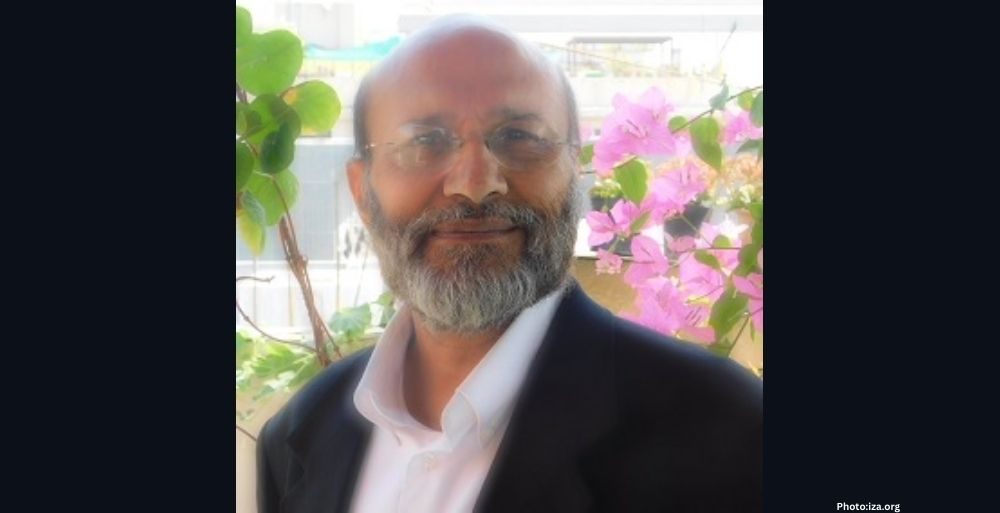
Speaking at the 2026 Anil Agarwal Dialogue, economist Santosh Mehrotra challenged the government’s claim that India’s poverty rate has fallen to five per cent, arguing that flawed methodology, declining non-farm employment, reverse migration of nearly 80 million people, and stagnant wages point to a far more complex and troubling economic reality.
Development economist and labour expert Santosh Mehrotra on February 27 strongly questioned the government’s assertion that India’s poverty rate has fallen to five per cent and that 250 million people have been lifted out of poverty over the past 11 years. He was speaking at the 2026 Anil Agarwal Dialogue hosted by the Centre for Science and Environment (CSE) in Nimli.
Responding to questions from Richard Mahapatra, Managing Editor of Down To Earth, Mehrotra said the claims lack a credible statistical foundation.
“The government currently has neither a clear definition of extreme poverty nor a reliable basis for determining the poverty line. The claim that poverty has fallen to five per cent and that 250 million people have moved out of poverty is misleading and hollow,” he said.
Reverse Migration and Employment Decline
Mehrotra pointed to a sharp slowdown in non-agricultural job growth over the past four years. Employment generation outside agriculture, which once expanded by about 7.5 million jobs annually, has reportedly halved. As a result, he said, nearly 80 million people have returned to farming due to reverse migration, particularly after COVID-19.
According to him, young people have been disproportionately affected by unemployment and shrinking opportunities in manufacturing and other non-farm sectors. Many households, he added, are sustaining livelihoods through personal borrowing and record levels of gold loans.
Disputed Poverty Measurement
Mehrotra also raised concerns about the methodology behind the five per cent poverty estimate, noting that it is based on the 2022–23 Consumer Expenditure Survey. He argued that comparisons with earlier poverty estimates are problematic because the methodology differs significantly from that used in the 2011–12 survey.
Referring to the poverty lines established by the Tendulkar Committee and the Rangarajan Committee, Mehrotra said that consumption survey data from 2022–23 suggests poverty may be closer to 26 per cent.
“It cannot be denied that growth is occurring. But stating that poverty has shrunk to five per cent is inaccurate. Poverty lies somewhere between five and 26 per cent — certainly not as low as five per cent,” he said.
Shift from Consumption to Multidimensional Poverty
The economist criticised the move away from consumption-based poverty measurement toward the Multidimensional Poverty Index (MPI), introduced by the United Nations Development Programme. While MPI factors in health, education, and living standards, Mehrotra argued that consumption expenditure offers a more direct and historically consistent measure of economic deprivation.
“For decades, poverty was assessed globally based on consumption expenditure — what people spend on essentials. That method was straightforward and comparatively reliable. Consumption reflects real-life conditions at the minimum level of subsistence,” he said.
Policy Impacts and Economic Slowdown
Mehrotra further contended that job growth slowed significantly after 2013, citing policy decisions such as demonetisation as contributing to setbacks in the Micro, Small and Medium Enterprises (MSME) and unorganised sectors. This, he said, triggered broader economic ripple effects, including weak manufacturing growth and stagnant wages.
On the impact of COVID-19, he noted that while the global economy contracted by 3.1 per cent in FY 2021, India’s economy shrank by 5.36 per cent. He attributed this to what he described as mismanagement of both the public health response and economic strategy during the crisis.
Wages and Rural Employment
Mehrotra highlighted the earlier impact of the Mahatma Gandhi National Rural Employment Guarantee Act (MGNREGA), introduced in 2003, which he said boosted rural wages during a period of rapid economic growth and rising investment. At that time, labour was being drawn out of agriculture into other sectors, tightening rural labour markets and pushing up real wages across both rural and urban areas.
In contrast, he said, the recent expansion of the agricultural labour force signals a lack of non-farm employment opportunities. Real wages have stagnated, while household savings are increasingly sustaining economic activity.
“Retail borrowing is rising, banks are focusing heavily on consumer lending, and gold loans have reached record levels because wages are not increasing. The economy is effectively running on household savings,” Mehrotra said.
Questioning Growth Narratives
While acknowledging that India has been among the world’s fastest-growing economies over the past 25 years, Mehrotra argued that headline growth figures do not automatically translate into widespread poverty reduction.
“In the last 25 years, we have been the second-fastest growing economy. Yet if we compare with China, which has increased its GDP fivefold since 1995, the broader economic outcomes tell a more complex story,” he said.
As a technical economist, Mehrotra concluded that the claim of a five per cent poverty rate is unlikely to withstand international scrutiny, calling for greater transparency and methodological clarity in assessing India’s poverty levels.