





A coalition of 20 US states, led by California, has filed a lawsuit challenging the Trump administration’s decision to impose a $100,000 fee on new H-1B visa petitions, arguing that the move is unlawful and threatens critical sectors of the American economy that rely on highly skilled foreign workers.
California Attorney General Rob Bonta announced the lawsuit on Friday, saying the administration’s policy exceeds the authority granted by Congress and undermines the purpose of the H-1B program, which allows US employers to hire skilled foreign professionals in specialty occupations. The lawsuit includes 19 other states, all represented by Democratic attorneys general, and will be filed in federal court in Massachusetts.
“No presidential administration can rewrite immigration law,” Bonta said during a press conference in San Francisco. “No president can ignore the co-equal branch of government of Congress, ignore the Constitution, or ignore the law.”
The controversial fee increase was introduced through a presidential proclamation issued in September, sharply raising costs for employers seeking to sponsor foreign workers under the H-1B programme. Traditionally, H-1B-related filing fees range from a few thousand dollars, depending on company size and visa category.
Impact Beyond Big Tech
While the H-1B programme is most closely associated with major technology firms, Bonta warned that the new levy would have far-reaching consequences beyond Silicon Valley. He said the steep fee could worsen labour shortages across sectors vital to state economies, including healthcare, education, scientific research, and public services.
“The idea that this only affects tech companies is simply wrong,” Bonta said. “This will make it harder to recruit physicians, nurses, teachers, researchers, and public servants — people our communities rely on every day.”
Tech employers are among the largest users of H-1B visas, a fact frequently cited by MAGA-aligned Republicans, who accuse companies of abusing the programme to replace American workers with lower-cost foreign labour. However, state officials argue that the new fee risks deterring legitimate employers from hiring specialised talent that is difficult to source domestically.
Concerns Over Selective Enforcement
Bonta also raised alarms about how the fee could be enforced, noting that the proclamation gives significant discretion to the Department of Homeland Security, currently led by Secretary Kristi Noem.
“The danger here is selective application,” Bonta warned, suggesting the administration could apply the fee unevenly, creating uncertainty for employers and foreign workers alike.
The lawsuit comes amid renewed tensions within Trump’s political coalition over high-skilled immigration. H-1B visas have long been a point of contention between Trump’s populist base, which favours strict immigration limits, and his allies in the technology sector, who argue that access to global talent is essential for innovation and competitiveness.
Trump Signals Mixed Messages
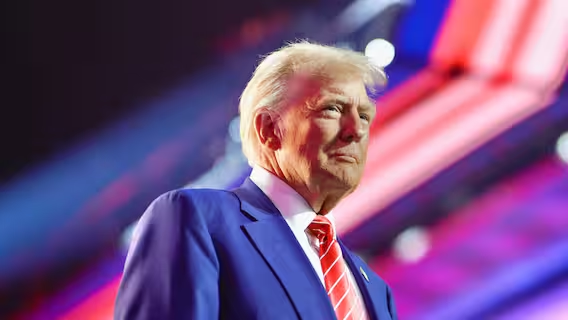
In recent weeks, President Trump has appeared to soften his rhetoric on skilled immigration, particularly as he has strengthened ties with technology leaders whose companies depend on H-1B workers. Speaking last month with Fox News host Laura Ingraham, Trump questioned whether the US workforce alone could meet demand in certain specialised fields.
“We don’t always have the people,” Trump said during the interview. “There are areas where you still need to bring in workers.”
Despite this, the White House defended the new fee on Friday. Taylor Rogers, a spokesperson for the administration, said the policy is both legal and necessary.
“President Trump promised to put American workers first,” Rogers said in a statement. “This commonsense action on H-1B visas discourages companies from spamming the system and driving down American wages, while providing certainty to employers who need to bring the best talent from overseas.”
Legal Challenges Mount
The states’ lawsuit is the latest in a growing series of legal challenges to the policy. Earlier this fall, the US Chamber of Commerce, joined by associations representing research universities, filed suit arguing that the administration bypassed statutory limits set by Congress. Another lawsuit has been brought by a broader coalition that includes labour unions from multiple sectors.
The Massachusetts case will be co-led by Massachusetts Attorney General Andrea Joy Campbell, and marks the 49th lawsuit filed by Bonta’s office against the Trump administration this year.
While Bonta did not outline specific reforms to the H-1B system, he acknowledged that improvements could be made. “Like any programme, it can probably benefit from changes,” he said. “But those changes must come from Congress, not unilateral executive action.”
As the legal battle unfolds, employers and foreign professionals alike face growing uncertainty, with the outcome likely to shape the future of high-skilled immigration in the United States.