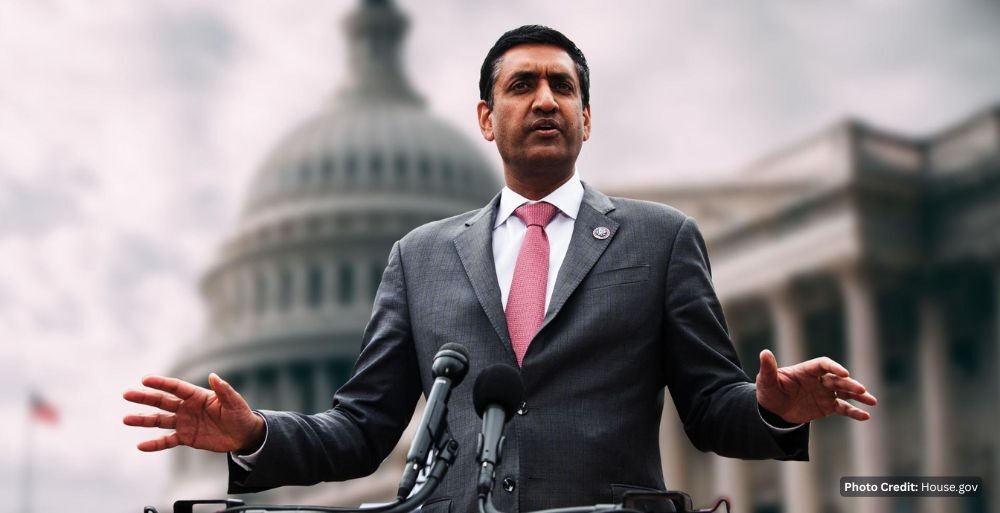







Representative Ro Khanna of California has recently ascended into a more prominent position within the national political spotlight following his decision to read the names of six previously redacted individuals associated with the Jeffrey Epstein files on the House floor. The move serves as a culmination of months of advocacy by the Democratic lawmaker, who has positioned himself as a leading voice in the push for full transparency regarding the court documents. By framing the Epstein scandal not merely as a criminal matter of abuse but as a systemic failure involving wealth and power, Khanna has shifted the traditional political narrative surrounding the case.
The 49-year-old congressman, who previously served as a co-chair for Senator Bernie Sanders’s 2020 presidential campaign, has leveraged his position to advocate for victims and survivors of the late financier’s sex-trafficking ring. Political observers note that Khanna’s focus on the intersection of elite influence and the legal system resonates deeply with a Democratic base that often views the current political and judicial structures as fundamentally broken. This strategic alignment allows Khanna to link the specific details of the Epstein investigation to a broader story about institutional accountability in American politics.
Khanna’s efforts have not been limited to floor speeches. He has actively engaged with survivors, many of whom have shared personal accounts of their experiences within his congressional office. The representative has stated that these interactions transformed the legislative pursuit into a personal cause. According to Khanna, the survivors he has met often come from working-class backgrounds, contrasting sharply with the immense wealth and social standing of the men accused of abusing them. He has characterized the \”Epstein class\” as a group of individuals who believe they are above the law, further tying the issue to populist themes of class struggle and elite overreach.
In his pursuit of the files, Khanna has demonstrated a willingness to engage in bipartisan cooperation. He worked alongside Republican Representative Thomas Massie of Kentucky to pressure House leadership into allowing a vote on legislation that would mandate the release of the remaining Epstein-related documents. This cross-aisle collaboration forced the hand of Speaker Mike Johnson and highlighted Khanna’s ability to navigate a divided Congress to achieve specific transparency goals. Strategists suggest that this track record provides Khanna with a unique legislative victory that he can present to voters as evidence of his effectiveness and commitment to justice.
The timing of Khanna’s increased visibility coincides with ongoing discussions regarding the 2028 Democratic presidential primary. While the congressman has not officially declared an interest in the White House, he has privately indicated to allies that he has not ruled out a future run. Supporters believe that if a lane for a progressive candidate opens, Khanna is well-positioned to enter the race with a distinct platform. His work on the Epstein case is seen by some as a more tangible achievement than those of other high-profile progressives, providing him with a narrative of direct action against powerful interests.
Beyond the Epstein investigation, Khanna has recently increased his media presence, appearing on major networks such as CNN and the BBC to discuss governmental transparency. He has been particularly vocal in questioning the Department of Justice regarding the initial withholding of names in the court filings. During recent testimony from Attorney General Pam Bondi before the House Judiciary Committee, Khanna continued to press for answers, reflecting his stated duty to ensure that survivors receive a full accounting of the facts.
However, Khanna’s rising profile has not been without friction within his own party. In what some political analysts viewed as a preview of potential 2028 friction, Khanna recently criticized California Governor Gavin Newsom. He cited concerns from his constituents regarding allegations of fraud and waste in the state government in Sacramento, even calling for an independent audit and suggesting that congressional hearings might be necessary. These comments reportedly frustrated some members of the Democratic establishment who view such internal critiques as counterproductive to party unity.
Despite these tensions, Khanna remains a frequent subject of early 2028 polling, though he currently trails established figures such as Governor Newsom and former Vice President Kamala Harris. His supporters argue that his focus on holding \”the elites\” accountable—ranging from the Epstein case to state-level fiscal oversight—will eventually bridge the gap with voters who are looking for a candidate willing to challenge the status quo. Khanna has articulated a vision where the working class is protected from the predatory behavior of those he describes as the \”rich and powerful Americans\” who have long evaded legal consequences.
The focus on the Epstein files also allows Khanna to address international and domestic policy through a single lens of accountability. He has frequently linked the behavior of the wealthy elite to broader systemic issues, including what he describes as the extraction of wealth from the working class and the promotion of foreign conflicts. This holistic approach to policy and ethics is designed to appeal to the progressive wing of the party while maintaining a focus on the rule of law that can attract more moderate voters concerned with judicial transparency.
As the legal proceedings and document releases related to the Epstein case continue to unfold, Khanna appears committed to maintaining his role as a primary legislative advocate for the survivors. He has stated that regardless of his future political path, he considers it his duty to see the investigation through to its conclusion. This persistence ensures that his name remains associated with one of the most high-profile transparency battles in recent memory, providing a consistent platform as the next election cycle begins to take shape.
The evolving role of Representative Khanna highlights a broader trend within the Democratic Party where younger, media-savvy legislators are using specific investigative causes to build national brands. By successfully navigating the complexities of the Epstein files, Khanna has managed to secure bipartisan wins while reinforcing his credentials as a progressive fighter. Whether this will be enough to propel him into the top tier of future presidential contenders remains to be seen, but his current trajectory has undeniably established him as a key figure to watch in the coming years.
Representative Ro Khanna Increases National Profile Through Jeffrey Epstein Investigation