





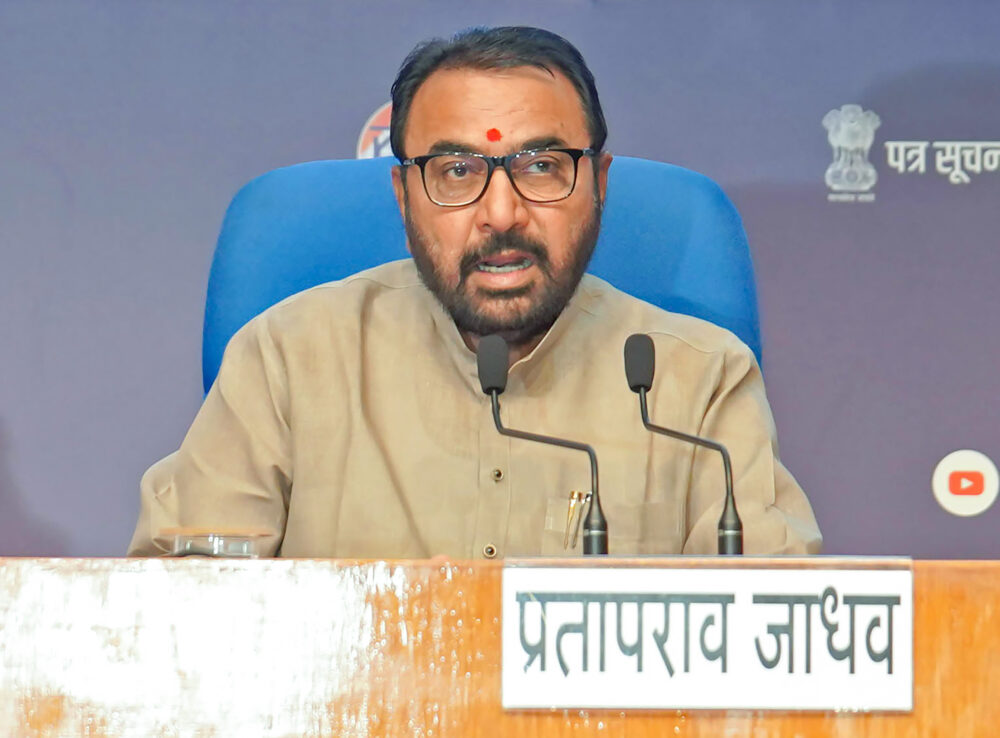
New Delhi — Institutions rooted in India’s traditional systems of medicine, particularly Ayurveda, can play a decisive role in strengthening the country’s long-term healthcare vision when they work in synergy with modern medical science, Union Ayush Minister Prataprao Jadhav said on Monday.
Addressing the Padmabhushan Dr. P. K. Warrier Memorial Ayurveda Seminar, held at the India International Centre, the minister emphasised that integrative healthcare is central to India’s ambition of building a healthier nation. The event marked a historic moment for the seminar, as it was hosted outside Kerala for the first time in its 62-year history.
“The Ministry of Ayush is continuously striving to ensure that all traditional systems of medicine, including Ayurveda, work together with modern medicine to play a significant role in realising the vision of a ‘Swasth Bharat’,” Jadhav said in a virtual message to delegates, practitioners, and scholars attending the seminar.
The event was organised by Kottakkal Arya Vaidya Sala, one of India’s most respected Ayurveda institutions, which has been providing healthcare, education, and research services for more than 125 years. The seminar commemorated the legacy of Padmabhushan Dr. P. K. Warrier, a towering figure in the modern revival and global recognition of Ayurveda.
Jadhav described Arya Vaidya Sala’s contribution to India’s healthcare landscape as “extremely inspiring,” noting that the institution has successfully preserved ancient Ayurvedic knowledge while embracing modern scientific approaches. “Its work has enhanced the global prestige of India’s traditional medicine systems,” he said. “The institution’s commitment to providing accessible, safe, and effective Ayurvedic healthcare services to the public is truly commendable.”
The minister’s remarks come at a time when India is increasingly promoting integrative healthcare models that combine evidence-based traditional medicine with contemporary medical practices. Policymakers believe such an approach can help address the growing burden of lifestyle diseases, improve preventive healthcare, and reduce pressure on tertiary medical facilities.
Speaking at the seminar, Dr. P. M. Varier, Managing Trustee and Chief Physician of Kottakkal Arya Vaidya Sala, said the decision to hold the event in New Delhi carried a symbolic message. “This is the first time in 62 years we have brought our Ayurveda Seminar out of Kerala to the capital of India,” he said. “We wanted to send a clear message of unity among the Ayurvedic fraternity of the north and the south.”
“North or south, Ayurveda is one,” Dr. Varier added. “We must join hands for the growth, glory, and globalisation of Ayurveda, ensuring that the roots of tradition, strengthened by science, reach every human being.”
The seminar highlighted the growing consensus within the Ayurveda community on the need for collaboration — not only across regions but also across disciplines. Experts at the event stressed that research-driven validation, quality standards, and global engagement are essential for Ayurveda to realise its full potential as a complementary healthcare system.
K. Harikumar, CEO of Kottakkal Arya Vaidya Sala, underscored the institution’s social commitment, particularly its charitable healthcare initiatives. “Over the last 10 years, our charitable hospital has treated more than 20 million patients,” he said. “We provide free treatment, meals, accommodation, and medicines to those in need.” According to Harikumar, the institution treats more than 18 lakh patients annually across India through its Ayurveda services.
The global outlook for Ayurveda was also addressed at the seminar. Ayush Ministry advisor Kousthubha Upadhyaya said India has taken concrete steps to promote Ayurveda internationally. “Export promotion councils have been formed to support the global expansion of Ayurveda products and services,” he said.
“More than 25 countries have already recognised Ayurveda,” Upadhyaya noted. “Just three days ago, at the second WHO Global Summit, nearly 100 countries participated and agreed to promote traditional medicine — especially Ayurveda and Yoga.”
Observers say such developments reflect a growing global appetite for holistic and preventive healthcare systems, particularly in the post-pandemic world. With increasing international endorsement and institutional backing, Ayurveda is steadily transitioning from a traditional practice to a globally acknowledged component of integrative medicine.
As India advances its healthcare vision, leaders at the seminar agreed that institutions like Kottakkal Arya Vaidya Sala — rooted in tradition yet open to innovation — will be central to shaping a future where ancient wisdom and modern science coexist for the well-being of society.