








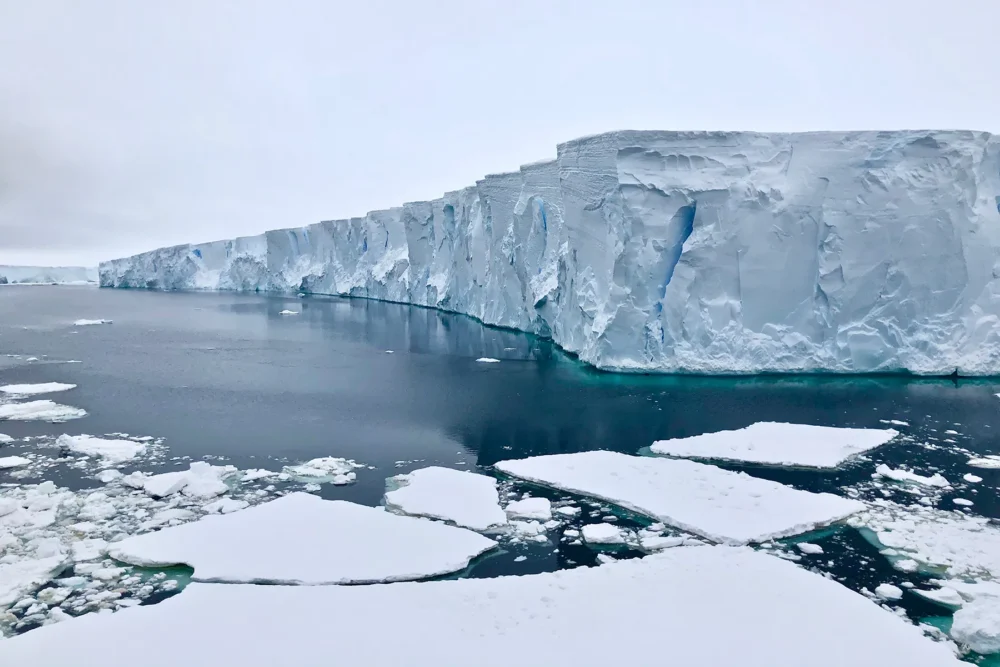
Often described as the “glacier at the end of the world,” the Thwaites Glacier has long worried scientists because of how much ice it holds—and what could happen if it gives way. Now, new research suggests the threat is becoming more complex and potentially more dangerous: the glacier is not only melting, but tearing itself apart from the inside.
Thwaites, located in West Antarctica, contains enough ice to raise global sea levels by about 65 centimetres (roughly two feet) if it were to collapse completely. That kind of rise would not be a distant abstraction. It would translate into flooded subway tunnels, higher storm surges, rising insurance costs, and more frequent “nuisance flooding” in coastal cities from Miami to Mumbai.
A new international study led by Debangshu Banerjee at the University of Manitoba Centre for Earth Observation Science reveals that a crucial part of Thwaites is weakening in a way scientists did not fully anticipate. Instead of melting from below being the dominant problem, the research shows that internal cracking and mechanical damage are loosening the glacier’s grip on the seafloor and accelerating its slide toward the ocean.
“What we’re seeing is not just ice being eaten away by warm water,” Banerjee explained. “The ice shelf is being pulled apart by growing fractures that feed on themselves.”
Why Thwaites matters so much
Thwaites is the widest glacier on Earth and a key component of the West Antarctic Ice Sheet, which is already losing ice at an accelerating rate. Much of this ice rests on bedrock below sea level, making it especially vulnerable to warm ocean water that can flow underneath and thin it from below.
For now, floating platforms of ice known as ice shelves act like brakes, slowing the flow of land-based ice into the ocean. “Think of them like a cork in a bottle,” said one polar scientist not involved in the study. “If the cork weakens or pops out, what’s behind it moves much faster.”
The International Thwaites Glacier Collaboration, a joint U.S.-U.K. effort, has repeatedly warned that sustained retreat of Thwaites and nearby glaciers could eventually contribute several metres of global sea level rise over centuries. While experts stress this would not happen overnight, they emphasize that decisions made this century will strongly influence how fast the process unfolds.
Two decades of cracks and movement
To understand what is happening inside the glacier, Banerjee and colleagues analyzed 20 years of satellite and ground data, combining high-resolution imagery from Landsat and Sentinel‑1 with precise GPS measurements drilled directly into the ice.
Their focus was the Thwaites Eastern Ice Shelf, a floating extension that is partially anchored by a shallow underwater ridge known as a pinning point. Between 2002 and 2022, the team tracked how cracks formed and spread within a narrow strip of ice called a shear zone, where different parts of the shelf slide past each other at varying speeds.
“It’s a bit like pulling taffy,” Banerjee said. “When one side moves faster than the other, the ice stretches, thins, and eventually tears.”
A dangerous feedback loop
The researchers identified four phases of weakening, including two major stages of fracturing. First, long cracks formed parallel to the direction of ice flow. Later, shorter fractures sliced across the flow, breaking the ice into smaller, weaker blocks.
This shift turned the pinning point from a stabilizing anchor into a source of stress. As damaged ice struggled to hold onto the ridge, it began to accelerate—creating a positive feedback loop in which faster motion produced even more cracks.
“Once that cycle starts, it’s very hard to stop,” Banerjee noted. “The damage feeds on itself.”
Crucially, the study found that crack growth is now outpacing melting at the base of this part of the ice shelf. While warm ocean water remains a major threat, internal damage and mechanical stress have become the leading drivers of instability in this region.
What this means for the world
If the Thwaites Eastern Ice Shelf collapses, the glacier behind it is likely to speed up, adding more ice to the ocean over time. The shelf itself accounts for about 4% of current global sea level rise, but its real importance lies in how much ice it restrains.
Similar cracking patterns are already being observed on other Antarctic ice shelves. A recent briefing by the British Antarctic Survey warned that large parts of West Antarctica could be lost by the 23rd century if ice loss continues to accelerate.
For people living far from the poles, these changes can feel remote. But scientists stress that what happens inside Thwaites will shape how much coastal protection future generations must build—and how often communities will face flooded streets and homes.
“At the end of the day,” Banerjee said, “understanding these hidden fractures is about preparing for a warmer, wetter world.”