









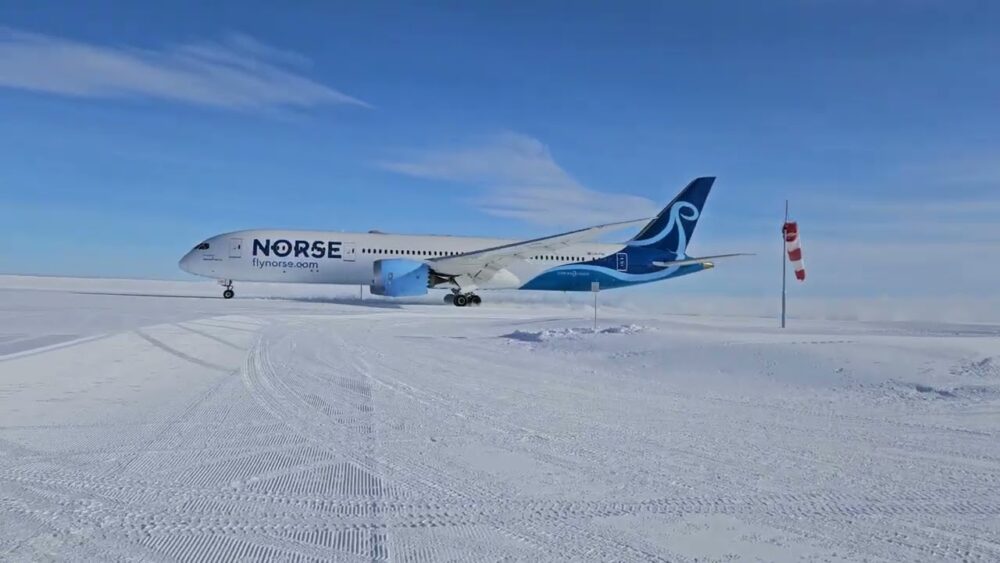
In a moment that looked more like science fiction than commercial aviation, a pilot flying a Boeing 787 Dreamliner has made history by becoming the first person ever to land the widebody aircraft on Antarctic ice. The landmark landing, carried out by Norse Atlantic Airways, has stunned aviation experts and enthusiasts alike, with surreal footage capturing the massive jet touching down on a frozen runway at the bottom of the world.
The historic flight, operated in November 2023, saw a Boeing 787 Dreamliner descend onto Troll Airfield in Queen Maud Land, Antarctica — a location defined not by asphalt or concrete, but by a runway carved entirely out of compacted ice and snow. Measuring 9,840 feet long and just 100 feet wide, the icy strip is among the most challenging landing environments on Earth.
As the aircraft’s wheels met the frozen surface, surrounded by endless white and sub-zero silence, the moment marked a new chapter in aviation history.
“This was not just a landing,” an aviation analyst noted. “It was a demonstration of precision, planning, and trust in modern aircraft engineering pushed to its absolute limits.”
Not a Passenger Flight, but a Mission of Science
Despite the dramatic visuals, this was not a commercial or tourist flight. Instead, the Dreamliner was deployed for a critical scientific mission. The aircraft transported 45 researchers and 12 tons of specialised equipment, most of it destined for the Norwegian Polar Institute’s Troll Research Station.
The passengers were scientists, engineers, and support staff — not thrill-seekers — heading to one of the most remote research outposts on the planet.
“The goal was not spectacle,” one project official explained. “It was about moving people and equipment safely, efficiently, and reliably to a place where logistics are incredibly complex.”
Why the Boeing 787 Was Chosen
The decision to use a Boeing 787 Dreamliner was deliberate — and strategic.
First, the aircraft’s exceptionally large cargo capacity made it ideal for the mission. The Dreamliner offers more than 5,000 cubic feet of cargo space, allowing it to transport heavy and sensitive research equipment in a single journey.
Second, and perhaps more crucially, was fuel efficiency.
The Dreamliner completed the demanding Cape Town–Antarctica–Cape Town round trip on a single tank of fuel, a feat that significantly reduced the risks associated with refuelling in Antarctica — a continent where fuel storage, transport, and handling are notoriously difficult.
“This aircraft’s efficiency directly addressed the logistical challenges of operating in Antarctica,” said Paul Erlandsson, a Boeing field service representative. “Minimising fuel dependency is critical in such an extreme environment.”
Landing on ‘Blue Ice’
Unlike conventional airports, Antarctica has no paved runways. Aircraft instead land on “blue ice” runways — naturally occurring, wind-polished ice surfaces that are dense enough to support heavy aircraft but offer little margin for error.
The footage from Troll Airfield shows the Dreamliner approaching with remarkable stability before touching down smoothly, a testament to both pilot skill and aircraft design.
“A landing like this leaves no room for improvisation,” an experienced polar pilot commented. “Every variable — wind, temperature, ice condition, braking distance — has to be calculated perfectly.”
The successful touchdown demonstrated that large, modern widebody jets can safely operate in polar conditions previously limited to smaller, specialised aircraft.
A Milestone for Polar Logistics
The implications of this landing extend far beyond one flight.
By proving that a Boeing 787 can safely land on Antarctic ice, the mission opens new possibilities for scientific research logistics, emergency response, and potentially more sustainable transport to the continent.
“This changes the equation,” a polar logistics expert said. “It means fewer flights, less fuel consumption, and safer transport for researchers working in one of the harshest environments on Earth.”
While there are no immediate plans to introduce regular Dreamliner operations to Antarctica, the success of this mission has already sparked discussions about future use cases.
A Truly Surreal Moment
For viewers watching the footage, the contrast is striking: one of the world’s most advanced commercial aircraft set against a vast, untouched ice landscape.
“It doesn’t look real,” one aviation enthusiast wrote online. “A Dreamliner landing on ice feels like something from another planet.”
Yet it was very real — and very historic.
As aviation continues to push boundaries, this extraordinary landing stands as a reminder that innovation is not always about speed or scale, but about precision, purpose, and courage in the face of the extreme.