





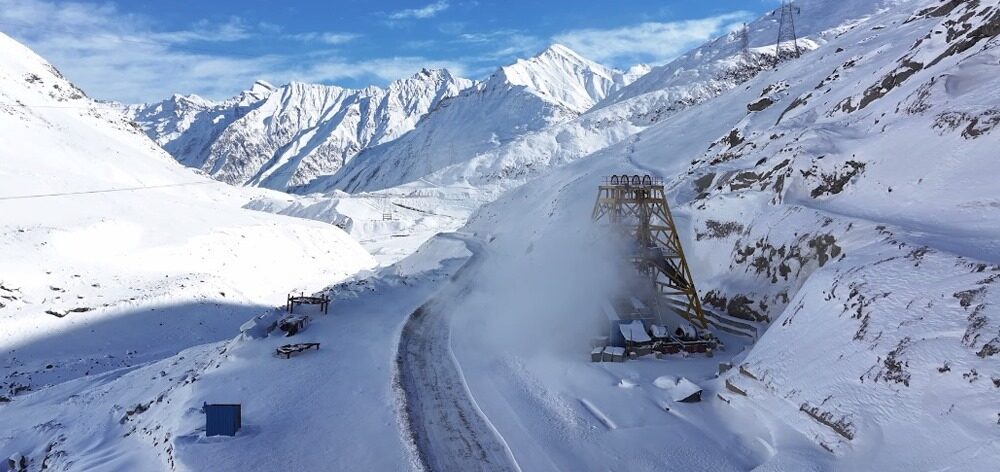
For generations, winter in Ladakh meant isolation. When snowstorms swept across the Zojila Pass, the only surface road connecting the region to the rest of India vanished under meters of ice, cutting off supplies, people, and movement for nearly half the year. Today, that reality is being rewritten from the inside of the mountain itself.
With the excavation of a nearly nine-kilometre tunnel beneath the Zojila Pass, India has carved a permanent corridor through one of the most hostile stretches of the Himalayas. The Zojila Tunnel is not just an infrastructure project; it is a transformation of geography, logistics, security, and daily life at the top of the world.
“This tunnel fundamentally changes how Ladakh connects with the country,” said a senior official associated with the project. “For the first time, winter will no longer mean isolation.”
A Pass That Disappeared Every Winter
At an altitude of more than 3,500 metres, the Zojila Pass was long known as both a gateway and a choke point. Even moderate snowfall could erase the road entirely. For five to six months each year, Ladakh functioned in survival mode. Fuel depots filled early, food and medicines were stockpiled, freight costs soared, and movement of civilians and troops slowed to a crawl.
The challenge was not simply travel time but unpredictability. “You could plan everything right and still lose access overnight,” said a logistics operator who has worked on the Srinagar–Leh route for two decades. “The mountain decided the schedule.”
Instead of fighting snow and avalanches year after year, engineers opted for a radical solution: bypass the weather altogether by going underground.
Building Where Air Is Thin and Rock Is Young
Constructing the Zojila Tunnel meant operating in an environment where oxygen levels drop to nearly 60 percent of those at sea level. Workers faced faster exhaustion, slower recovery, and heightened medical risk. To address this, project teams built heated prefabricated living units, redesigned work shifts, and installed constant medical monitoring systems.
Power reliability posed another challenge. At such altitude, even short outages could turn dangerous. Independent power generation systems were installed to ensure uninterrupted lighting, ventilation, and communication inside the tunnel.
Then came the mountain itself.
The Himalayas are geologically young and unstable, formed by the collision of tectonic plates that are still in motion. Rock conditions shift dramatically within short distances, alternating between solid formations and fractured, water-logged zones.
Tunnel boring machines, often used in stable geology, were deemed too risky. Instead, engineers adopted a controlled drill-and-blast method, advancing metre by metre and adjusting techniques in real time.
“Every blast is calculated,” said an engineer involved in excavation. “You don’t rush a mountain like this. You listen to it.”
Stabilising the Mountain Before It Moves
After each controlled detonation, the newly exposed rock face is immediately stabilised. Fast-setting shotcrete coats the surface, steel rock bolts anchor weak layers together, and steel arches reinforce fragile sections. This rapid response prevents collapses and distributes stress evenly through the tunnel structure.
Water posed a constant, invisible threat. Meltwater seepage can freeze, expand, and fracture concrete over time. Engineers installed extensive drainage channels and waterproof membrane systems to intercept water before it reaches the final lining.
“If you don’t control water early, it will control the tunnel later,” said a senior project consultant.
From Excavation to a Living Corridor
Once structural excavation was completed, the tunnel began to evolve into a full-scale transport system. Final linings sealed the structure, followed by heavy-duty road paving designed for military convoys and commercial traffic.
Advanced systems were then installed: continuous lighting, high-capacity ventilation fans, air-quality sensors, fire-detection systems, emergency communication units, and surveillance cameras. In the event of an incident, the tunnel can automatically redirect airflow to clear smoke and guide evacuations.
What was once a hole in the mountain became a living, monitored artery.
A Permanent Link with Strategic Impact
The Zojila Tunnel reduces travel time between Srinagar and Leh from hours of hazardous mountain driving to roughly 20 minutes inside a protected corridor. More importantly, it ensures year-round connectivity.
For Ladakh, this means reliable access to healthcare, education, employment, and essential goods. For businesses, it brings predictability to supply chains. For national security, it enables rapid troop and equipment movement along a sensitive border region.
“In strategic terms, a tunnel like this is priceless,” said a defence analyst. “It removes uncertainty from logistics in one of India’s most critical regions.”
Redefining Life at the Top of the World
Snow will continue to fall on Zojila. Avalanches will still roar across the surface. But beneath it all now runs a brightly lit, climate-controlled passage that does not disappear with the seasons.
The Zojila Tunnel represents a decisive shift in how India responds to extreme geography — not by resisting nature on its terms, but by designing around it.
As one engineer put it, “We didn’t make the Himalayas kinder. We learned how to live with them.”