







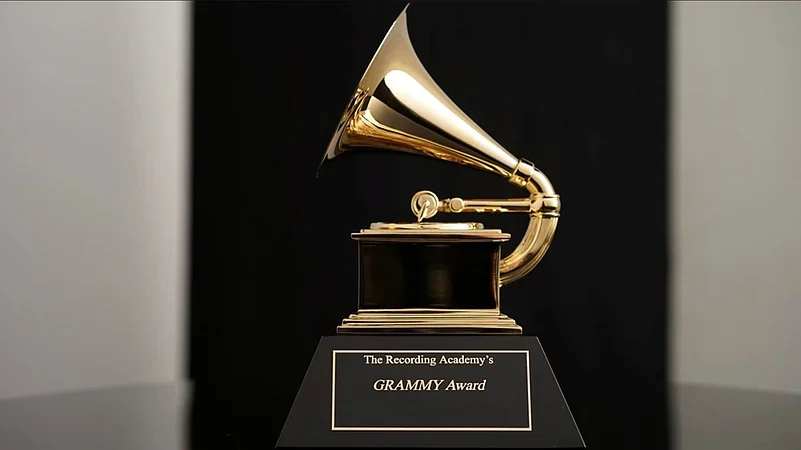
More than five decades after album covers were last recognised as a standalone honour, the Grammy Awards are once again shining a spotlight on the visual artists who help define how music is seen, felt and remembered. The newly revived Best Album Cover category will be presented this year, marking a significant shift in how the music industry acknowledges creative contributions beyond sound.
The move comes at a time when album artwork, once thought to be losing relevance in the streaming era, has reasserted its cultural power. From viral aesthetics to carefully constructed visual worlds, cover art has become an essential extension of an album’s identity.
Among the inaugural nominees are Wet Leg’s Moisturizer, Bad Bunny’s Debí Tirar Más Fotos, Tyler, the Creator’s Chromakopia, Perfume Genius’ Glory, and Djo’s The Crux. The award is primarily given to art directors, though in most cases this year, the recording artists themselves are also credited for their hands-on involvement in shaping the final image.
A category returns after half a century
In recent years, album covers were judged under the broader Best Recording Package category, which considered all physical components such as booklets, typography and inserts. However, industry leaders felt that cover art deserved its own moment again.
Recording Academy CEO Harvey Mason Jr. has said the decision reflects the renewed impact of cover imagery in a digital-first world. While listeners may no longer flip through CD booklets, the album cover is often the first — and sometimes only — visual cue that introduces an artist’s work to a global audience.
The revived category also aligns with the academy’s goal of recognising the full ecosystem of creators who shape music culture.
Wet Leg’s “beautifully repulsive” contrast
For British indie band Wet Leg, the nomination validates a process rooted in instinct and creative friction. The cover for Moisturizer was conceived during a weekend retreat, where the band gathered unusual objects — velvet worms, oversized hair props and reptilian gloves — to spark ideas.
“I wanted it to be something that was both super girly and feminine, but then at the same time, just totally repulsive,” said lead singer Rhian Teasdale, who co-art-directed the cover alongside Iris Luz and Lava La Rue. “That juxtaposition creates something that’s evocative.”
The final image features a creature-like version of Teasdale, crouched with outstretched hands and an unsettling grin. The visual mirrors the album’s emotional terrain, which explores tenderness and longing alongside moments that Teasdale herself describes as “feral.”
Capturing mood over meaning
The striking simplicity of Chromakopia offers a different approach. The monochrome portrait of Tyler, the Creator, his face partially concealed by a mask, was reportedly the final shot taken during the session.
What stood out most, according to the creative team, was the intensity in Tyler’s eyes. The image emerged from what collaborators describe as an “unspoken language” developed over years of working together — a shared understanding of movement, framing and restraint.
Rather than explaining itself, the cover invites interpretation, reinforcing Tyler’s reputation for blending mystery with control.
When ambiguity becomes the aesthetic
For Perfume Genius, ambiguity was the goal. The cover of Glory shows the artist reclining on a patterned carpet in a dim interior, his stiletto boots pointed toward a bright window while colourful cords trail across the floor.
Art director and photographer Cody Critcheloe, who collaborated with Andrew J.S., said the image was never meant to capture a specific narrative.
“It was mostly about an energy,” Critcheloe explained. “People have said they can’t quite figure out what the aesthetic is — and that’s the best thing to hear.”
The image reflects the internal tension explored on the album: the safety of private life versus the vulnerability required by a public-facing persona.
Building an entire world in one frame
Few covers this year demonstrate scale and storytelling like The Crux, the third album by Djo, the musical project of actor Joe Keery. Shot on a studio backlot designed as a fictional hotel, the image functions like a cinematic still packed with micro-narratives.
Photographer Neil Krug, alongside collaborators Jake Hirshland and William Wesley II, filled the scene with intentional detail: a couple kissing in one window, a man arguing over a parking ticket in the foreground, and Djo himself seen only from behind, suspended from a window in a white suit.
“Everything is intentional,” Wesley said. “It’s the sum of many people’s contributions.”
Minimalism, memory and meaning
In contrast, Debí Tirar Más Fotos relies on restraint. Art-directed by Bad Bunny himself, the cover features just two white plastic chairs and plantain trees, photographed by Eric Rojas. The simplicity evokes nostalgia — backyard gatherings, beachside afternoons — while reinforcing the album’s themes of memory, diaspora and cultural history.
Both Debí Tirar Más Fotos and Chromakopia have also earned nominations for Album of the Year, underlining the deep connection between visual storytelling and musical impact.
Why album covers still matter
Although Grammy rules no longer require albums to exist physically for eligibility, all nominees this year are available on vinyl or CD. For many artists, physical formats remain central to the creative conversation.
“When vinyl lives in your home, it lives with you,” Krug said. “There’s a rediscovery of the art form happening.”
As the Grammys reintroduce Best Album Cover, the message is clear: in an age of endless content, a single image can still define an era.