






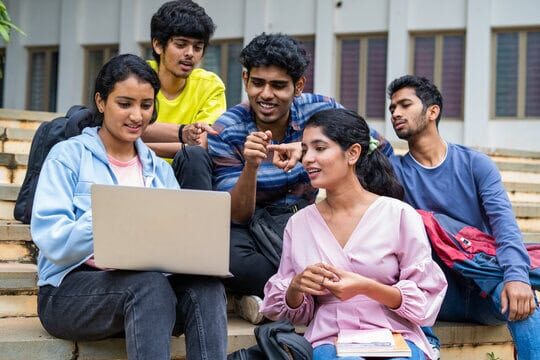
India has the potential to host as many as 1.1 million international students by 2047, positioning itself as a major global hub for higher education — but only if it undertakes deep and sustained structural reforms, according to a comprehensive report released by NITI Aayog on Monday.
The report, Internationalisation of Higher Education in India: Prospects, Potential and Policy Recommendations, presents a detailed assessment of India’s current standing in global education flows and outlines a roadmap for transforming the country into an internationally competitive academic destination.
“India requires a substantial increase in the inflow of international students to emerge as a global destination for higher education and research,” the report states, adding that the country’s demographic dividend, academic diversity, and growing research ecosystem provide a strong foundation — if matched by policy and institutional capacity.
A Stark Imbalance in Student Mobility
Despite being one of the world’s largest higher education systems, India currently hosts only about 47,000 international students, though some estimates place the number closer to 72,000. In sharp contrast, more than 1.3 million Indian students pursue education abroad, underscoring a persistent imbalance.
According to the report, for every international student who comes to India, nearly 28 Indian students leave the country. This asymmetry, the authors argue, reflects a long-standing trend of outward mobility dominating India’s internationalisation efforts.
“Since 2001, the number of international students coming to India has increased by 518 percent,” the report notes. “However, outbound student mobility has grown at a much faster pace, contributing significantly to brain drain.”
Economic Cost of Studying Abroad
The financial implications of this trend are substantial. The report highlights a dramatic rise in outward remittances for education under the Liberalised Remittance Scheme (LRS), which climbed from ₹975 crore in 2013–14 to nearly ₹29,000 crore in 2023–24. This figure now accounts for more than half of the Union government’s annual higher education budget.
Projected tuition fees and living expenses for Indian students studying overseas are expected to reach ₹6.2 lakh crore by 2025, roughly 2 percent of India’s GDP.
“The continued outflow of skilled students reduces the pool of talent available to drive India’s development,” the report cautions, adding that unchecked brain drain could weaken long-term innovation and research capacity.
Vision 2047: A Global Education Hub
To reverse this trend, NITI Aayog projects that with the right policy environment, India could increase its share of globally mobile students from the current 0.5 percent to 5 percent by 2047, translating into 1.1 million international students.
Achieving this goal, the report stresses, requires a strategic shift from viewing internationalisation solely as student mobility to embracing a broader ecosystem that includes research collaboration, faculty exchange, joint degrees, and globally aligned curricula.
“Internationalisation must go beyond attracting students,” the report states. “It should build knowledge capital, retain domestic talent, and position India as a serious player in global higher education.”
Key Policy Recommendations
Among the report’s flagship proposals is the introduction of a “Vishwa Bandhu Scholarship”, aimed at international postgraduate students. The scholarship would offer comprehensive support, covering tuition fees, monthly stipends, research grants, accommodation, travel, health insurance, and study-linked internships.
In addition, a “Vishwa Bandhu Fellowship” has been proposed to attract leading international researchers and faculty members to Indian institutions.
The report also recommends easing regulatory restrictions to allow greater participation by foreign universities, including “campus-in-campus” models, where international institutions operate within Indian universities.
To strengthen research funding, NITI Aayog has proposed the creation of a Bharat Vidya Kosh, a national research fund with an initial corpus of $10 billion, contributed by the Indian diaspora and matched by government funding.
Another key recommendation is the establishment of an Alumni Ambassador Network, or “Bharat ki AAN,” to mobilise Indian alumni abroad as global advocates for Indian higher education institutions.
Learning From Global Models
The report suggests that India adopt a multilateral academic mobility framework, inspired by Europe’s Erasmus+ Programme, to promote student and faculty exchanges with ASEAN, BRICS, and BIMSTEC countries.
It also calls for expanding the National Institutional Ranking Framework (NIRF) to include metrics such as global engagement, international outreach, inclusivity, and cross-border collaboration, offering a more comprehensive measure of internationalisation.
Persistent Challenges on the Ground
Despite the opportunities, the report acknowledges significant barriers. Survey data from 160 Indian institutions revealed that 41 percent cited limited scholarships and financial aid as a major obstacle, while 30 percent expressed concerns about the global perception of Indian education.
Other challenges include complex visa regulations, inadequate campus infrastructure, limited student support services, and difficulties related to language and cultural integration.
“Structural and operational bottlenecks continue to constrain India’s attractiveness,” the report noted, warning that policy ambition must be matched by execution.
Implementation Is Key
While recent reforms — including the National Education Policy 2020 and UGC guidelines allowing foreign universities to set up campuses in India — are acknowledged as positive steps, the report emphasises that effective implementation will determine success.
“If India can align policy, infrastructure, and institutional capacity,” the report concludes, “it has the potential to emerge as a globally competitive higher education hub — one that not only attracts international students but also retains talent and strengthens its global academic standing.”