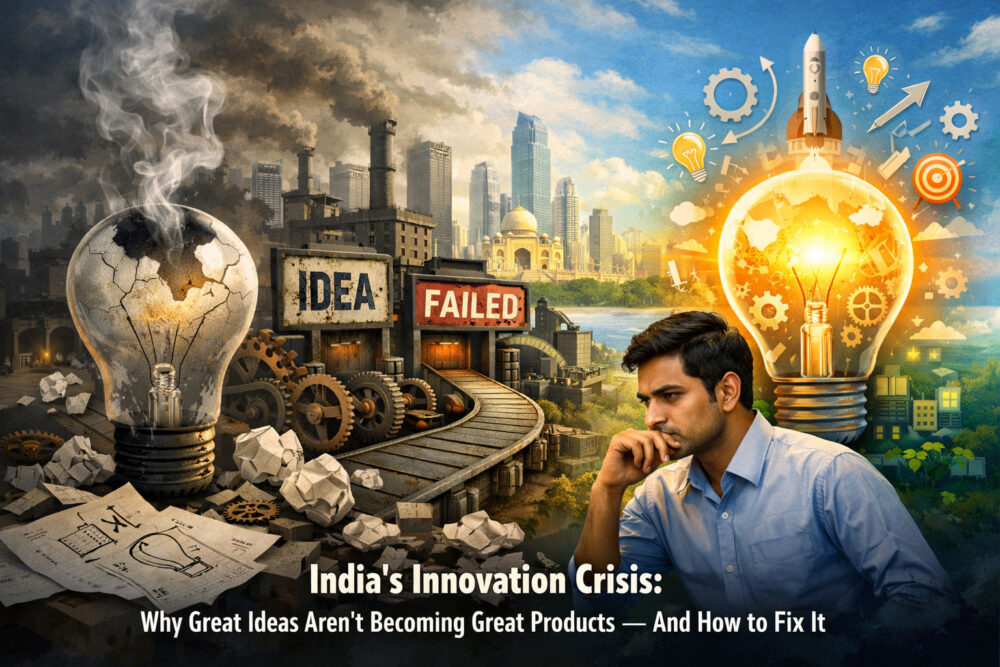










India today finds itself at a pivotal moment in its economic and technological journey. The country boasts world-class scientific talent, globally respected institutions, and one of the fastest-growing startup ecosystems in the world. Yet, despite this abundance of intellectual capital, India continues to struggle with a persistent problem: transforming research breakthroughs into scalable, market-ready products.
This disconnect—often referred to as the “valley of death” in innovation ecosystems—has become increasingly visible as India aspires to position itself as a global manufacturing and technology hub. The challenge, experts argue, is not the absence of ideas but a deep misalignment between academia, industry, investors, and the state.
A system misaligned from the start
India’s academic ecosystem is largely designed to publish research papers rather than build products. Industry, on the other hand, seeks deployable solutions, not early-stage prototypes. Investors typically enter only after commercial viability is proven. The result is a fragmented pipeline where promising innovations stall before reaching the market.
This frustration is widely felt within industry. As the founder of a high-technology Indian company told Swarajya, “We have tried to work with lots of different IITs, and in most cases, there is no strong output that comes from these colleges.” Such sentiments reflect a broader structural issue rather than isolated failures.
Dr. Anurag Agrawal of Ashoka University describes the challenge bluntly: “India has no dearth of bioscience talent, but translating research into real-world health solutions remains a major challenge.” He argues that the country must “back people, not just projects,” and reorient incentives toward outcomes that matter beyond academia.
The TRL bottleneck holding India back
Innovation specialists often point to a specific choke point: the transition from Technology Readiness Level (TRL) 3 to TRL 4, where a lab-tested concept must be validated in real-world conditions. According to innovation strategist Babu Mohanan, “India doesn’t suffer from a shortage of ideas — we suffer from a shortage of products.” He notes that many innovations “never make it beyond the lab door” because the ecosystem is not designed to support the expensive, iterative, and risky process of commercialization.
At this stage, engineering talent, manufacturing partners, regulatory clarity, and patient capital must converge. In India, these elements rarely align at the same time.
Proof that alignment works
Despite these challenges, India has produced notable success stories—evidence that capability is not the issue, coordination is.
One frequently cited example is Prof. Ashok Jhunjhunwala’s work in India’s telecom sector, where his team helped reduce telephone costs from ₹40,000 to ₹10,000 by prioritizing affordability alongside innovation. His philosophy of “putting economics before technology” became a cornerstone of India’s telecom revolution.
Similarly, during the COVID-19 crisis, researchers at IIT Kanpur developed a functional ventilator in just 90 days. The project succeeded because urgency, institutional backing, and cross-disciplinary collaboration converged at the right moment.
A more structural example is the IIT Madras Research Park, which has completed over 900 joint industry-academia projects. It stands as a national benchmark for how universities can drive innovation when incentives and partnerships are intentionally aligned.
Underinvestment at the national level
India’s innovation gap is also tied to chronic underinvestment. The country spends just 0.7% of its GDP on research and development, far below global leaders like South Korea and the United States. Without sustained funding, building deep-tech infrastructure at scale remains difficult.
Former NITI Aayog CEO Amitabh Kant has repeatedly argued that innovation must be treated as a core driver of growth. “We have not yet fully leveraged our innovation potential,” he has said, calling for stronger industry-academia linkages and catalytic public procurement to create demand for indigenous technologies.
The manufacturing paradox
India’s manufacturing sector reflects this contradiction clearly. Entrepreneurs across industrial clusters in Tamil Nadu and Karnataka are resilient and adaptive, yet many remain trapped in low-value manufacturing. Innovation expert Yogesh Pandit describes this as a “low-value trap,” where firms compete on cost rather than capability—not due to lack of ambition, but lack of structured pathways to adopt or co-develop new technologies.
A longer civilizational lens
Historically, India was a civilization of creators—from the Sindhu-Saraswati era to the Chola Empire, Indian technologies and goods shaped global trade. The challenge today is not rediscovering talent, but rebuilding systems that allow that talent to flourish.
India’s next innovation leap will not come from isolated breakthroughs. It will come from aligning incentives across academia, industry, and government; funding the full lifecycle of innovation; and rewarding product creation, not just publication.
The path forward
Experts broadly agree on a set of reforms:
- Reform academic incentives to reward patents, prototypes, and industry collaboration
- Strengthen industry-academia linkages through research parks and shared labs
- Bridge the valley of death with dedicated TRL 3–7 funding
- Increase R&D spending toward 2% of GDP
- Build a product-first culture that celebrates long-term innovation and risk-taking
Conclusion
India’s innovation story is not one of failure, but of untapped potential. The ideas exist. The talent exists. What is missing is alignment. With deliberate reform and sustained commitment, India can move from being a nation rich in ideas to one that consistently builds world-changing products.