








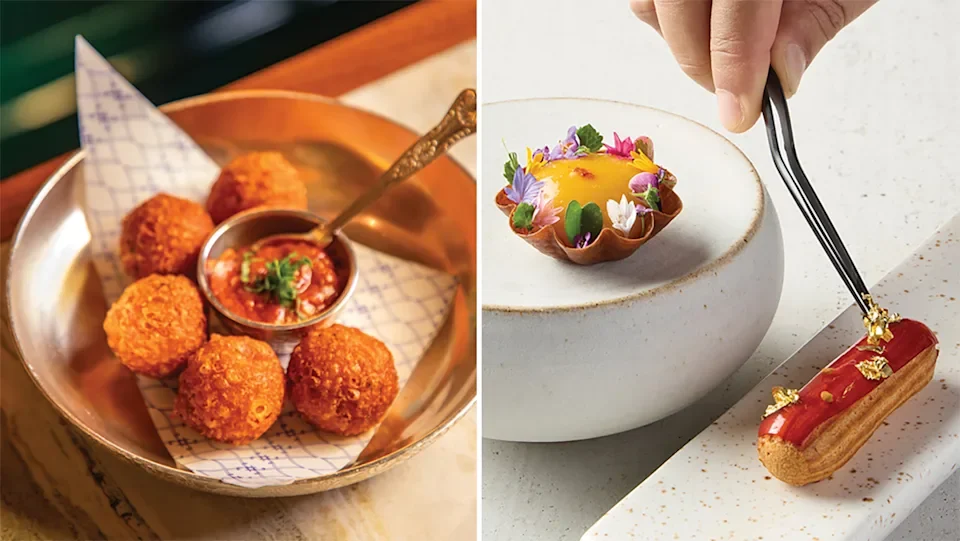
For much of the past half-century, Indian food in the United States lived in a narrow box—beloved, comforting, but often confined to takeout menus, buffet lines, and late-night cravings. That era, chefs and restaurateurs now say, is decisively ending. America has entered what many in the industry describe as a golden age of Indian cuisine, one marked by confidence, regional specificity, and a growing appetite for uncompromised flavor.
“I’ve been cooking Indian food in its different avatars since 2007,” says Srijith Gopinathan, the award-winning chef-owner of Copra. “And I don’t think I’ve seen a better-balanced time for Indian cuisine in the last 20 years.”
Once relegated to a niche, Indian food is increasingly becoming a regular part of the American dining rotation—not as an exotic indulgence, but as a peer to Italian, Japanese, or French cuisines. Upscale Indian restaurants are opening across major cities, and demand is soaring. There are currently only four Michelin-starred Indian restaurants in the United States, stretching from New York to Houston, yet tables at many of them are nearly impossible to secure.
At Indienne, chef and proprietor Sujan Sarkar runs what he openly calls “the most expensive Indian restaurant in America.” The response has been overwhelming. “All 90 seats are booked every night,” Sarkar says, a reality that would have seemed improbable a decade ago.
Social media, sophistication, and the end of dilution
Chefs cite several forces behind this shift, starting with access to information. Platforms like Instagram and TikTok have exposed diners to regional depth and culinary nuance that were long missing from the American perception of Indian food.
“Before, it was very hard to educate,” says Mo Alkassar, the restaurateur behind Ghee Indian Kitchen. “Information wasn’t as readily available. If you had a certain stigma in your head, it took a lot longer to change that.” Now, he adds, “People are more adventurous and get over those stigmas much more rapidly.”
That curiosity has fueled a broader cultural shift. “Don’t give me a diluted version; give me the real stuff,” explains Roni Mazumdar, co-founder of Unapologetic Foods. The New York–based group behind Dhamaka and Semma has arguably done more than any operator to elevate regional Indian cooking in the U.S.
Mazumdar recalls just how intense the appetite has become. At one point, he says, people were “literally fistfighting” to get into the original location of Adda, another Unapologetic Foods concept that later moved to a larger space in Manhattan’s East Village. The chaos, he suggests, was a sign of something deeper: pent-up demand for food that felt authentic, unapologetic, and rooted in lived experience.
Diaspora power and changing tastes
Another driver is the growing economic and cultural influence of the Indian diaspora. “There’s considerable disposable income,” Gopinathan notes, “and people want to spend it on food that tastes like what they remember from home—what their grandparents cooked.”
As diversity expands among decision-makers—restaurant critics, investors, developers, and diners—the question of what food is ‘worth’ spending money on has also changed. Indian cuisine is no longer treated as a bargain category; it is increasingly understood as a canvas for technique, terroir, and storytelling.
That recognition has gone global. International heavyweights are now betting on the American market. London’s Michelin two-star Gymkhana is set to open its first U.S. outpost in Las Vegas, while Ambassadors Clubhouse will bring its luxe Punjabi cooking to New York. “America right now reminds me of London maybe 10 years ago,” says Karam Sethi, food and creative director at JKS Restaurants. “It’s simmering, and it’s ready to explode.”
Still just the beginning
Despite the momentum, chefs stress that the surface has barely been scratched. Gopinathan estimates that less than 20% of regional Indian cuisine has made it to the U.S. so far. Training chefs who understand those regional nuances—and can execute them at fine-dining levels—will take time. But the inflection point, they agree, has arrived.
“I never thought I would live to see this moment,” Mazumdar admits. “I thought the work we were doing would matter only after my lifetime.” His hope now feels tangible: a future where ordering biryani sounds as ordinary as ordering pasta or sushi—where Indian food is neither niche nor novelty, but simply part of the American mainstream.
That normalization, chefs say, is the truest marker of a golden age. And by all indications, Indian cuisine in America is only just getting started.