


Uttar Pradesh, the country’s most populous state, offers an even starker illustration of how symbolic minority marginalisation is being normalised. This year, the BJP government of Chief Minister Yogi Adityanath directed schools to remain open on December 25 and mandated programmes commemorating former prime minister Atal Bihari Vajpayee’s birth anniversary instead of observing Christmas as a holiday. In isolation, such decisions may appear administratively defensible. Taken together, they signal a deeper shift in which civic space for religious minorities is steadily shrinking.
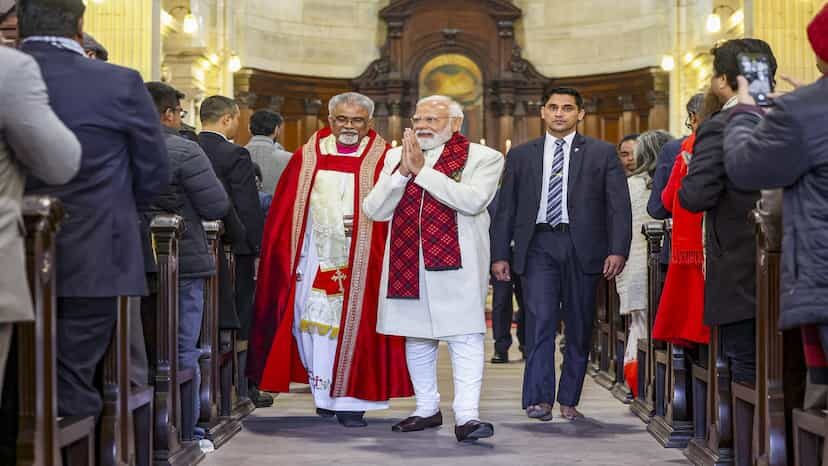
When the bells tolled at New Delhi’s Cathedral Church of Redemption on Christmas Day, what reverberated was a message of peace, compassion, and fraternity. Prime Minister Narendra Modi’s visit to the church, and the carefully staged image of him standing in prayer with members of the Christian community, were meant to project a plural India in which every faith is secure, dignified and equal. Yet this postcard of harmony sits uneasily beside a darker reality in which India is becoming a nation where militant majoritarianism is gaining political impunity at the cost of its beleaguered minorities.
In the days preceding the festival, congregations and public celebrations were disrupted across several states by groups linked to the Sangh Parivar, the right wing Hindu nationalist grouping. In Jabalpur, a BJP district vice-president allegedly assaulted a visually impaired woman inside a church. A group of people vandalised a Christmas tree while chanting ‘Jai Shri Ram’ during festive celebrations at The Hub Mall in Indore. In Assam’s Nalbari, Bajrang Dal activists stormed a diocesan school and destroyed its nativity crib. In Raipur, festive installations in a mall were vandalised. In Delhi, women wearing Santa hats were publicly harassed by vigilantes. Even Kerala, long considered a bastion of religious tolerance, witnessed carol singing interrupted in Palakkad. These were not random provocations. They formed a visible pattern, amplified by social media mobilisation, loosely framed anti-conversion laws and a climate of political impunity.
Local administrations and police establishments were quick to downplay these episodes as sporadic “local tensions.” The data suggest otherwise. The Pew Research Center’s 2022 Social Hostilities Index assigned India a score of 9.3 out of 10, the highest among 198 countries. This is not the profile of a plural democracy in robust health but that of a society in which faith is being steadily politicised.
Kerala Sent A Political Signal
Evangelical Fellowship of India documented at least 840 incidents against Christians in 2024, up from 601 the previous year. Such cases have been concentrated in Uttar Pradesh, Chhattisgarh, Rajasthan, Punjab and Haryana, where militant majoritarian rhetoric has seeped into local governance. Churches have been vandalised, clergy assaulted, prayer meetings disrupted and pastors detained on dubious charges. In Chhattisgarh, nuns and pastors have repeatedly been stopped at railway stations and public transit points, accused of forced conversions or trafficking, allegations that are routinely unsubstantiated.
Within this national climate, the conduct of Kerala Lok Bhavan — the residence of the state governor, a guardian of the Constitution, no less — has taken on particular significance. The decision to deny a Christmas holiday to staff of the Lok Bhavan and to compel attendance at official programmes marking “Good Governance Day” on December 25 was more than a bureaucratic misjudgement. It sent a political signal. Insisting on compulsory official attendance on Christianity’s most sacred day, in an institution representing a state with a substantial Christian population, asserted majoritarian precedence over religious accommodation.
The controversy was sharpened by the earlier inclusion of Hindutva icon V.D. Savarkar’s portrait in Kerala Lok Bhavan’s official calendar. Read together, these acts point to a steady reorientation of the public sphere around Hindutva symbolism at the expense of constitutional pluralism.
Kerala’s case is particularly jarring because the state is not merely another Indian province. For nearly two millennia, its coastline has absorbed traders, pilgrims and settlers from West Asia, Europe and beyond. Syrian Christian communities trace their roots here to the first century, long before the consolidation of Brahmanical Hinduism in the region. Jews, Muslims and Christians lived for centuries as integral participants in Kerala’s public life, not as tolerated minorities but as co-creators of its social order. This long habit of accommodation made Kerala a rare bastion of religious coexistence in the subcontinent.
That is why recent disruptions to Christmas celebrations, carol-singing programmes and public displays in the state are so unsettling. Catholic bishops, ecumenical bodies and political leaders across party lines have warned that such actions undermine Kerala’s pluralistic inheritance and violate the Constitution’s guarantees of religious freedom.
Normalisation Of Minority Marginalisation
Uttar Pradesh, the country’s most populous state, offers an even starker illustration of how symbolic minority marginalisation is being normalised. This year, the BJP government of Chief Minister Yogi Adityanath directed schools to remain open on December 25 and mandated programmes commemorating former prime minister Atal Bihari Vajpayee’s birth anniversary instead of observing Christmas as a holiday. In isolation, such decisions may appear administratively defensible. Taken together, they signal a deeper shift in which civic space for religious minorities is steadily shrinking.
What makes this moment especially dangerous is not merely the violence but its growing normalisation. When churches are vandalised, clergy assaulted and religious holidays denied, democratic backsliding ceases to be abstract. The Constitution promises freedom of faith and equal citizenship, but lived reality increasingly suggests that these rights are becoming contingent on ideological alignment — a lesson already etched into public memory by the custodial death of Jesuit priest Stan Swamy after prolonged denial of bail.
Anti-conversion laws, ostensibly framed as safeguards against coercion, have in practice become instruments of intimidation. In Jabalpur, senior clergy were allegedly assaulted inside a police station while trying to intervene on behalf of detained Christian pilgrims. In Odisha’s Balasore, priests and nuns were attacked by mobs accusing them of forced conversions without evidence. These incidents point not only to social hostility but also to institutional failure and complicity.
Beyond physical harm, the psychological toll is considerable. Christian families increasingly live with the fear that a prayer meeting, a carol-singing programme or even festive decoration could invite police scrutiny or mob aggression. Public celebration itself is becoming fraught, a sign that cultural visibility is being systematically curtailed.
Need To Defend Constitutional Secularism
The denial of a single holiday at Kerala Lok Bhavan may appear administratively minor. In reality, it captures a deeper malaise: the quiet normalisation of exclusion in an age of political majoritarianism. It marks the shrinking of symbolic and material space for minorities within India’s civic imagination.
Reversing this trend requires political leadership willing to defend constitutional secularism without equivocation, law enforcement agencies that act impartially, and a media ecosystem that treats attacks on minorities as central to the health of Indian democracy.
In a civilisation that prides itself on treating humanity as one family — “Vasudhaiva Kutumbakam” — the sustained assault on minorities stands as a grave indictment. India’s democratic promise will ultimately be judged not by curated PR images of leaders in pews but by how resolutely it protects its most vulnerable citizens from the machinery of hate.
(The writer is a former UN spokesperson and a contemporary affairs commentator. Views expressed are personal. He can be reached at edmathew@gmail.com / tweets @edmathew)
source: https://southasiamonitor.org/spotlight/when-christmas-becomes-test-indias-pluralism