




Mundgod, Karnataka:
His Holiness the 14th Dalai Lama arrived at Drepung Gomang Monastery in Mundgod, Karnataka, amid a grand and deeply reverential welcome by thousands of monks, nuns, lay devotees, and civil officials, marking the beginning of his visit to one of the most significant monastic centres of Tibetan Buddhism in exile.
His Holiness departed from Dharamsala a day earlier, where large crowds of Tibetans and international followers gathered along the streets and at the airport to bid him farewell. He travelled via Delhi before arriving at Hubli airport on Thursday, from where he proceeded to Mundgod, home to one of the largest Tibetan settlements in India.
At Hubli airport, the Dalai Lama was formally received by Geshé Jigmé Gyatso, Abbot of Drepung Gomang Monastery; Mönlam Gyatso, Senior Administrator; and Jigmé Tsultrim, Chief Representative of the Central Tibetan Administration (CTA) for South India. Representing the local administration were Hubli–Dharwad Deputy Commissioner Divya Prabhu, Police Commissioner N. Shashikumar, and Deputy Commissioner of Police Mahaning Nandaganvi. Abbots of various monasteries and Tibetan settlement officers from five settlements were also present to welcome him.
As His Holiness travelled towards Mundgod, thousands of devotees lined the roads, offering white khatas (ceremonial scarves), flowers, and incense. The Tibetan settlement and surrounding roads were adorned with colourful prayer flags, welcome banners, and spiritual inscriptions, creating a festive yet solemn atmosphere.
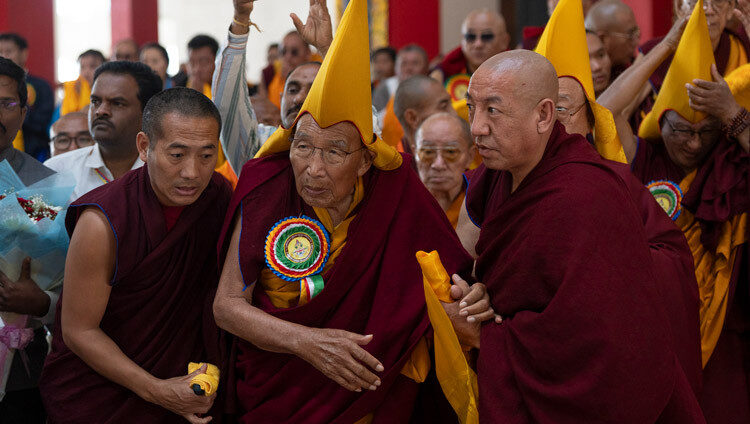
Upon his arrival at Drepung Gomang Monastery, the Dalai Lama was received by senior monastic leaders, including Most Venerable Lobsang Dorjé, the 105th Ganden Tripa, along with the Jangtsé Chöjé and Shartsé Chöjé. Also present were the current Drepung Tripa, two former Drepung Tripas, former and present abbots of Drepung, and numerous abbots and tulkus from other monasteries and institutions.
The gathering also included respected senior monks from Buxar, members of the first generation of Tibetan monastics in exile, as well as prominent figures such as Kundeling Rinpoché and Ling Rinpoché. Civil dignitaries present included Dharwad Police Commissioner Gunjan Arya, Karwar Deputy Commissioner Lakshmi Priya, Karwar Superintendent of Police Deepan M. N., Karwar Zilla Panchayat CEO Dr. Dileesh Sasi, Sirsi Assistant Commissioner Kavyarani, Mundgod Tehsildar Shankar Gowdi, and Tenzin Lungtok, former Chief Justice of the Tibetan Supreme Justice Commission.
Walking from the debate ground to the monastery’s main assembly hall, His Holiness took his seat on the ceremonial throne. The Ganden Tripa, Drepung Tripa, Gomang Abbot, and Mundgod Tibetan Settlement Officer offered mandalas and symbolic representations of the Buddha’s body, speech, and mind. Prayers for His Holiness’s long life, composed by his two tutors, were chanted, followed by the traditional serving of tea and ceremonial sweet rice.
Addressing the gathering, the Dalai Lama reflected on the responsibility borne by Tibetans in preserving Buddhist teachings. “This place where our Tibetan settlements are located lies to the south-west of Tibet,” he said. “The joyful way in which monastic communities have gathered here shows that the vast and profound teachings of sutra and tantra — upheld by great masters like Nagarjuna — continue to be preserved by Tibetans.”
He emphasised that despite the hardships faced in Tibet, devotion to religion and culture has remained unbroken. “We Tibetans feel a deep responsibility for the teachings of the Land of Snows,” he said, noting that respect for Tibetan Buddhism is growing globally, including within China.
Highlighting the relevance of Buddhism in the modern world, the Dalai Lama said interest is rising, particularly among young people. “Some may not be enthusiastic about Buddhism as a religion, but there is strong interest in its methods of study, contemplation, and inner development,” he observed. “That is why we are renewing our engagement with the complete teachings of Tibetan Buddhism.”
He also spoke of his dialogues with scientists, noting their focus on cultivating inner peace rather than metaphysical beliefs. “Scientists are interested in how to develop a calm and disciplined mind,” he said, adding that such interest extends even to predominantly Christian countries.
Recalling the near destruction of Buddhism in Tibet, His Holiness said exile communities played a crucial role in preserving the Dharma. “The complete teachings of the three vehicles remain intact within our tradition,” he said, adding that the growing global interest affirms the universal value of Buddhist ethics and meditation.
Concluding his remarks, and referring to prophecies and dreams suggesting a long life, the Dalai Lama encouraged devotees to work tirelessly to revive and strengthen the Dharma for the benefit of the world. He was later escorted to his residence in the monastery’s debate courtyard.