








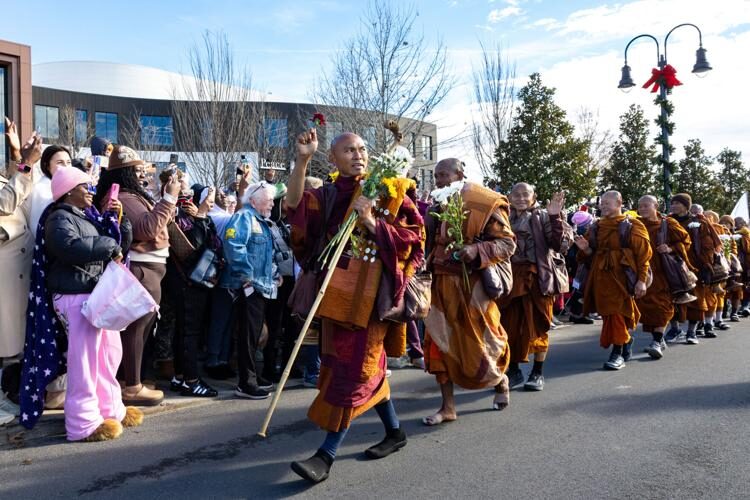
A group of Buddhist monks walking thousands of miles across the United States to promote peace, compassion, and non-violence is refusing to slow down—even after a serious accident left two of their members injured. Their perseverance has turned the journey into a powerful symbol of resilience, drawing growing public attention and a massive following on social media.
The monks, a group of about two dozen practitioners of Buddhism, began their peace walk in Fort Worth, Texas, on October 26. More than two months later, they have reached Georgia, continuing their deliberate trek toward Washington, D.C., with the goal of highlighting Buddhism’s long-standing tradition of peaceful activism.
On Tuesday, marking the 66th day of their journey, the group planned to walk from the town of Morrow to Decatur, on the eastern edge of Atlanta. They invited members of the public to join them later in the day for a Peace Gathering in Decatur, reinforcing their belief that peace is not a solitary pursuit but a collective effort.
“We do not walk alone,” the monks wrote in a recent social media post. “We walk together with every person whose heart has opened to peace, whose spirit has chosen kindness, whose daily life has become a garden where understanding grows.”
A Journey Across 10 States
The monks’ route spans 10 states and some of the busiest roads in the country. Accompanied by an escort vehicle and their loyal dog Aloka, the group plans to pass through or near Athens, Georgia; Charlotte, Greensboro, and Raleigh in North Carolina; and Richmond, Virginia, before arriving in the nation’s capital.
Aloka—named after a Sanskrit word meaning “enlightenment”—has become an unexpected star of the journey. The dog even has its own hashtag, #AlokathePeaceDog, and regularly features in photos and videos shared by the group’s followers.
Those followers now number more than 400,000 on Facebook alone. The monks’ page is updated frequently with progress reports, reflections, poetry, and messages encouraging compassion and mindfulness in daily life. Supporters from around the world have commented on the posts, offering words of encouragement and describing how the walk has inspired them during difficult personal times.
Persevering After a Serious Accident
The walk has not been without danger. Last month, near Dayton, Texas, outside Houston, the monks were traveling along the side of a highway when a truck struck their escort vehicle. According to Dayton Interim Police Chief Shane Burleigh, the truck failed to notice how slowly the escort vehicle was moving despite its hazard lights being activated.
“The driver tried to make an evasive maneuver to drive around the vehicle and didn’t do it in time,” Burleigh said at the time. “It struck the escort vehicle in the rear left, pushed the escort into two of the monks.”
One monk suffered substantial leg injuries and was airlifted by helicopter to a hospital in Houston. Another monk sustained less serious injuries and was transported by ambulance to a suburban hospital. A spokeswoman for the group later confirmed that the monk with the more severe injuries would require multiple surgeries to heal a broken bone, but added that his prognosis for recovery was good.
Despite the incident, the monks made a conscious decision to continue the walk.
“Our practice teaches us to meet suffering with compassion, not fear,” one supporter close to the group said. “Stopping would have meant letting violence interrupt a message of peace.”
Rooted in an Ancient Tradition
Buddhism traces its origins to the teachings of Gautama Buddha, a prince-turned-teacher believed to have lived in northern India between the 6th and 4th centuries B.C. His teachings emphasize non-violence, meditation, ethical living, and compassion for all beings as the path to end suffering.
While Buddhism has diversified into many traditions over centuries, its commitment to peace has remained a defining principle. Modern Buddhist peace activism has been shaped by influential figures such as Dalai Lama and Thich Nhat Hanh, both of whom applied Buddhist ethics to global movements for peace, environmental protection, and social justice.
The monks’ walk across America follows directly in that tradition—using quiet persistence rather than protest, and presence rather than confrontation, to communicate their message.
Peace in Motion
As the group continues toward Washington, D.C., their journey is increasingly being seen as a moving meditation—one that invites people from all backgrounds to reflect on peace not as an abstract concept, but as a daily practice.
Each step, the monks say, is an offering.
“In every mile, we carry the hopes of those who believe kindness still matters,” their post read. “Peace is not a destination. It is how we walk.”
With injuries behind them and hundreds of thousands watching, the monks’ quiet march has become one of the most visible grassroots peace efforts in the country—powered not by slogans or speeches, but by endurance, faith, and compassion.