








The White House has confirmed that President Donald Trump and his senior advisers are actively discussing a range of options to acquire Greenland, underscoring that the use of U.S. military power remains on the table as part of what the administration describes as a national security imperative in the Arctic.
In a statement issued Tuesday, White House Press Secretary Karoline Leavitt said the president views Greenland as strategically vital to U.S. interests and deterrence efforts against adversaries in the rapidly evolving Arctic region.
“President Trump has made it well known that acquiring Greenland is a national security priority of the United States,” Leavitt said. “The President and his team are discussing a range of options to pursue this important foreign policy goal, and of course, utilizing the U.S. military is always an option at the Commander in Chief’s disposal.”
The remarks represent the clearest indication yet that the administration is not limiting its Greenland strategy to diplomacy or economic engagement, reigniting a debate that first emerged during Trump’s initial term in office.
Strategic Calculations Behind Greenland
Greenland, a self-governing territory of Denmark, spans more than 836,000 square miles and occupies a critical geopolitical position between North America, Europe, and Russia. Its location makes it central to Arctic defense, early-warning systems, and transatlantic military logistics. The island is also believed to contain significant deposits of oil, gas, and rare earth minerals — resources that are increasingly important amid global competition for supply chains.
Secretary of State Marco Rubio told lawmakers this week that the administration is exploring the possibility of purchasing Greenland, according to sources familiar with the discussion. While Rubio reportedly downplayed the likelihood of imminent military intervention, the broader policy review suggests the issue is far from dormant within the administration.
At Rubio’s request, the State Department recently conducted an internal analysis of Greenland’s resource potential. According to officials briefed on the findings, the assessment concluded that no comprehensive, reliable study exists quantifying the scale of Greenland’s untapped resources. It also noted that extraction would involve enormous costs due to extreme weather, limited infrastructure, and logistical challenges.
Despite those caveats, administration officials appear focused less on immediate economic returns and more on long-term strategic positioning in the Arctic, where melting ice is opening new shipping routes and intensifying great-power competition.
Expansionist Rhetoric and Renewed Momentum
President Trump’s renewed interest in Greenland has coincided with a broader shift toward a more assertive foreign policy posture, particularly in the aftermath of the U.S. capture of Venezuelan leader Nicolás Maduro. Speaking to reporters aboard Air Force One on Sunday, Trump framed Greenland acquisition as a security necessity.
“We need Greenland from the standpoint of national security, and Denmark is not going to be able to do it,” Trump said.
Senior White House adviser Stephen Miller reinforced that stance in a televised interview Monday, arguing that Denmark’s claim to Greenland should be questioned and asserting that no country would militarily challenge the United States over the island.
“Nobody is going to fight us over the future of Greenland,” Miller said, casting the issue as one of U.S. responsibility rather than territorial ambition.
European Backlash and NATO Concerns
The administration’s statements have prompted swift reactions from Europe. Leaders from France, Germany, Italy, Poland, Spain, Britain, and Denmark issued a joint declaration emphasizing that Greenland belongs to its people and that Arctic security must be pursued collectively through NATO.
Danish Prime Minister Mette Frederiksen warned that any U.S. military action against Greenland could have devastating consequences for the transatlantic alliance.
“This must be taken seriously,” Frederiksen said, adding that a U.S. attack on Greenland could effectively spell the end of NATO as it currently exists.
Greenland’s own leadership has also responded cautiously. The territory confirmed Tuesday that it has requested a meeting with Secretary Rubio to seek clarification following the administration’s recent comments.
Domestic Political Pushback
Within the United States, Trump’s Greenland strategy has drawn criticism from both Democrats and Republicans. Arizona Democratic Sen. Ruben Gallego announced plans to introduce legislation aimed at preventing a U.S. invasion of Greenland.
“Trump is telling us exactly what he wants to do,” Gallego said in a social media post. “We must stop him before he invades another country on a whim.”
Republican Rep. Don Bacon of Nebraska, a member of the House Armed Services Committee, issued one of the strongest rebukes from within Trump’s own party.
“This is appalling,” Bacon said, calling Greenland a NATO ally and warning that aggressive rhetoric toward Denmark was counterproductive. “We already have a base in Greenland. We could add more bases with Denmark’s cooperation. Treating a proven ally this way is demeaning and has no upside.”
Bacon urged fellow Republicans to “universally oppose” any military action involving Greenland.
Bipartisan concern also emerged in the Senate. Sens. Jeanne Shaheen, a Democrat, and Thom Tillis, a Republican — co-chairs of the Senate NATO Observer Group — reaffirmed the United States’ commitment to Denmark as a trusted ally.
“Any suggestion that our nation would subject a fellow NATO ally to coercion or external pressure undermines the very principles of self-determination that our Alliance exists to defend,” the senators said in a joint statement. They also highlighted Denmark’s increased defense spending and its role as a key partner in Arctic security.
A Familiar Idea With Higher Stakes
Trump has long expressed interest in acquiring Greenland. After winning the 2024 election, he revived a proposal first floated during his initial term — an offer that Denmark swiftly rejected. Nearly a year ago, he openly declined to rule out military force during a news conference at his Mar-a-Lago estate.
“I think we’re going to get it. One way or the other, we’re going to get it,” Trump said during a joint address to Congress last March.
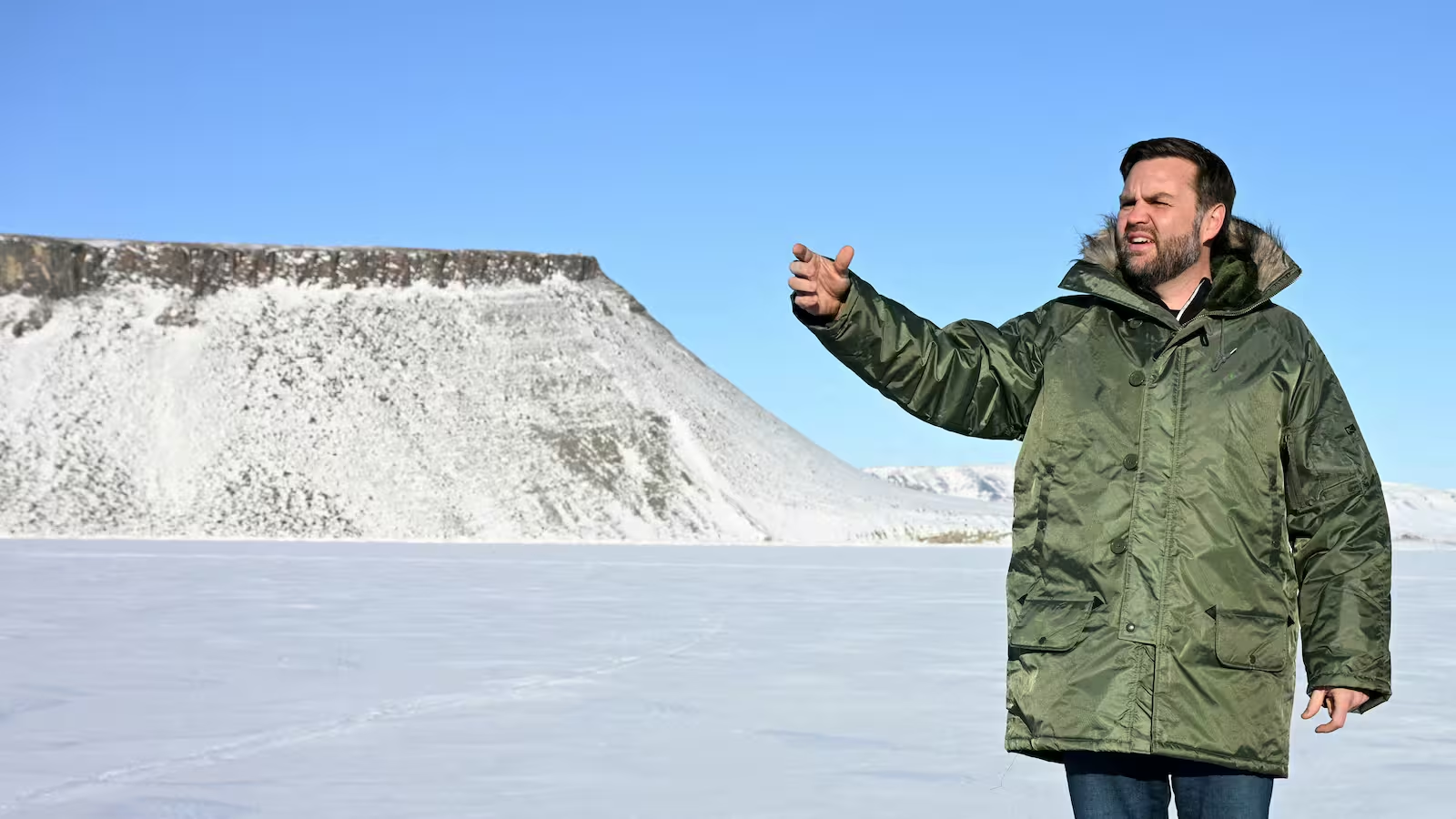
That rhetoric was followed by Vice President JD Vance’s controversial visit to Greenland, which local leaders described as unwelcome. At the U.S. Pituffik Space Base, Vance criticized Denmark’s governance of the island and argued the United States had “no other option” but to increase its presence.
As the Arctic becomes a focal point of global competition, the administration’s Greenland strategy now appears to carry far greater geopolitical consequences — not only for U.S.–Denmark relations, but for the future cohesion of NATO itself.