



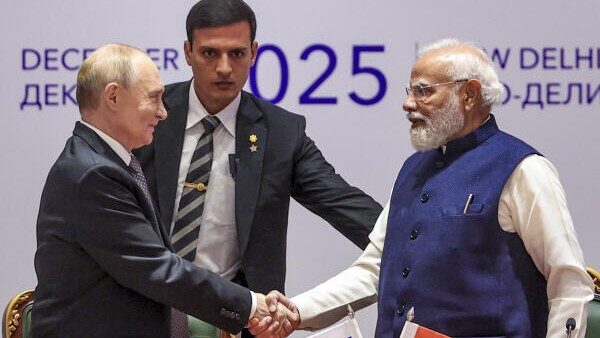
Russian President Vladimir Putin’s visit to India concluded where it began — at Rashtrapati Bhavan, where he received ceremonial honours in the morning and returned in the evening for a state banquet. Between these engagements, Putin held talks with Prime Minister Narendra Modi, addressed a business forum, and announced the launch of Russia Today’s India operations.
This visit, his first since the Ukraine war began in 2022, carried significant symbolic weight. With Western nations keeping Moscow at arm’s length, New Delhi’s warm reception — including Modi personally welcoming Putin at the airport — sent a strong geopolitical signal. But beyond the spectacle, what did both countries actually gain?
Ceremony Over Substance — But Key Messages Delivered
1. Russia revels in the grand welcome
Russian media celebrated the elaborate reception, highlighting the red-carpet treatment Modi extended. For Moscow, the optics alone undermined Western efforts to isolate Putin.
2. Limited but strategic announcements
While no major defence deals were unveiled, several important agreements were signed:
- A Russia–India economic cooperation programme
- A pact on critical minerals and supply chains
- A joint pharmaceutical manufacturing project in Russia’s Kaluga region
Notably absent were announcements on the most sensitive areas of cooperation — defence and energy.
3. Oil: The unresolved question
India’s imports of discounted Russian crude have been the cornerstone of bilateral trade, much to Washington’s displeasure.
Putin reiterated that Russia is ready to maintain steady supplies, but no new terms were detailed. With the U.S. pushing India through heavy tariffs, the decision now lies with New Delhi on how far it will continue balancing between Moscow and Washington.
4. No new major defence commitments
Despite speculation ahead of the visit, India did not announce the purchase of any advanced Russian systems, including fighter jets or missile platforms.
This reflects India’s delicate balancing act: maintaining defence ties with Russia while nurturing its growing security partnership with the U.S.
Putin’s adviser hinted that more sensitive topics were discussed privately during the leaders’ informal dinner — likely covering defence, energy, and geopolitical coordination.
Trade Takes Centre Stage
1. The visit’s strongest theme: boosting economic ties
Both leaders emphasised that bilateral trade has surged dramatically — from $8.1 billion in 2020 to $68.7 billion in 2025 — largely due to India’s oil purchases.
But both countries agree that their economic relationship remains underdeveloped.
2. India’s strategic equation: oil vs. U.S. tariffs
India now faces a near-impossible task:
- Continue buying Russian oil, which benefits its economy,
- While securing a trade deal with the U.S., which is imposing 50% tariffs.
Putin’s offer of uninterrupted supplies is a subtle signal urging India not to bend to U.S. pressure.
3. New agreements beyond oil and defence
Multiple MoUs were announced:
- Shipbuilding and maritime cooperation
- Training Indian seafarers for polar operations
- Investments in new shipping corridors
- Civil nuclear cooperation
- Visa-free travel initiatives
- Collaboration in critical minerals
4. Push toward a free trade agreement
Modi highlighted progress on the proposed FTA between India and the Eurasian Economic Union (EAEU). If completed, it would open markets across Russia, Armenia, Belarus, Kazakhstan and Kyrgyzstan.
5. Ambitious new targets
India and Russia plan to:
- Implement a five-year economic roadmap
- Push bilateral trade toward $100 billion
This will be difficult if discounted crude declines, hence the focus on expanding trade in diverse sectors.
Defence: No Big Deals, But Russia Still Dominant
India made no public comment about acquiring Su-57 fifth-generation fighter jets, though internal negotiations are believed to be ongoing.
The real sticking point:
- India wants timely delivery of pending defence orders, including the remaining units of the S-400 missile system.
- Russia, stretched thin due to the Ukraine conflict, may struggle to meet deadlines.
Even without major announcements, Moscow remains India’s most important defence supplier — a reality unlikely to change soon.
Overall Takeaway
This visit was less about blockbuster deals and more about reinforcing strategic ties during a turbulent geopolitical moment.
- For Russia, the optics were invaluable — a major world leader warmly received despite Western isolation.
- For India, it was an opportunity to strengthen economic options, balance global pressures, and keep defence cooperation stable without provoking Washington.
Trade may have been the headline theme — but the real conversations happened behind closed doors.