





The United States has come under unusually sharp and wide-ranging criticism at an emergency meeting of the United Nations Security Council following its seizure of Venezuelan leader Nicolás Maduro, with condemnation coming not only from traditional adversaries such as Russia and China, but also from close European allies.
While many countries agreed with Washington’s long-held position that Maduro ruled Venezuela illegitimately and presided over repression, a growing number of states argued that the US military action itself crossed a red line — violating international law, undermining the UN Charter, and setting a troubling precedent for global order.
The debate exposed deep fractures within the international community, particularly among European nations struggling to balance their commitment to international legal principles with political reliance on US security support.
European Allies Break Ranks
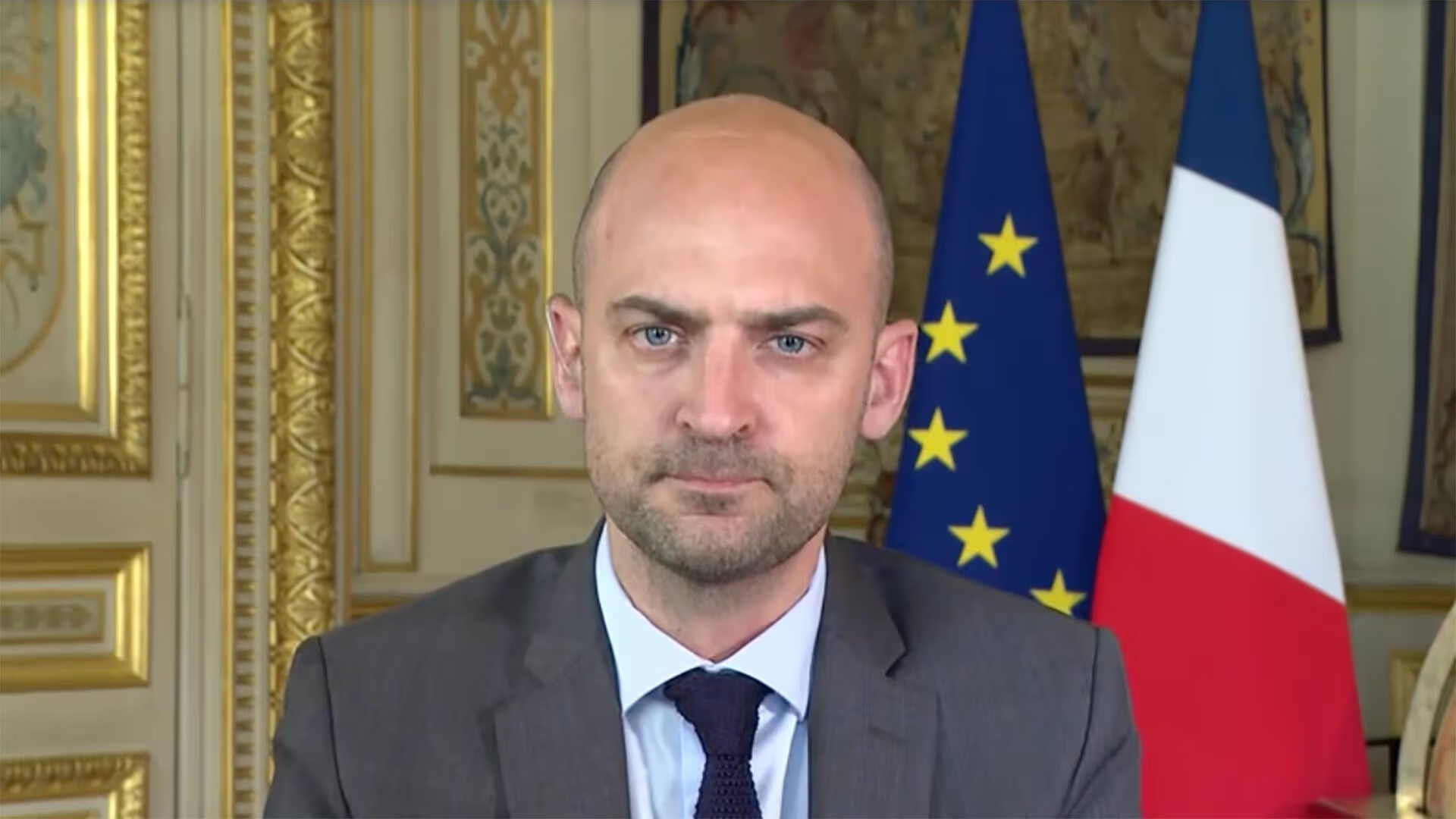
Among America’s allies, France emerged as the most vocal critic. French Deputy Ambassador Jay Dharmadhikari told the Security Council that Washington’s action “runs counter to the principle of peaceful dispute resolution and the non-use of force.”
“The proliferation of violations of the UN Charter and international law by states vested with responsibility as permanent members of the Security Council chips away at the very foundation of the international order,” Dharmadhikari warned. “It undermines respect for independence and territorial integrity of states and weakens international peace and security.”
Denmark echoed that concern. Deputy Ambassador Sandra Jensen Landi said Copenhagen was “deeply concerned” by the unfolding situation, calling the seizure of Maduro “a dangerous precedent.”
“International law and the UN Charter must be respected,” she stressed, marking a notable stiffening of Europe’s tone after initial hesitation by several EU capitals.
Spain had earlier voiced similar concerns, with Prime Minister Pedro Sánchez saying Madrid would “not recognise an intervention that violates international law and pushes the region toward uncertainty and belligerence.”
Silence and Ambiguity From Others
In contrast, the United Kingdom and Greece refrained from condemning the US operation, reflecting what diplomats privately described as unease over confronting Washington directly.
Acting UK Ambassador James Kariuki issued a brief statement calling for “a safe and peaceful transition to a legitimate government that reflects the will of the Venezuelan people,” while reiterating a generic commitment to international law — without addressing whether US actions breached it.
Greece’s Deputy Ambassador Ioannis Stamatekos similarly avoided criticism, urging “dialogue and diplomacy” instead.
UK Prime Minister Sir Keir Starmer later declined to say whether the US action violated international law, stating only that “international law is the framework against which we judge the actions of governments — and it is for the US to justify the action it has taken.”
Latin America Warns Against “Fake Transitions”
Latin American nations voiced particular concern over Washington’s plans for Venezuela’s political future.
Panama’s Ambassador Eloy Alfaro de Alba warned against US cooperation with elements of the existing power structure without elections or opposition participation.
“Any attempt to establish a permanent government headed by a figure from the repressive apparatus, such as Delcy Rodríguez, would constitute continuity of the system, not a genuine transition,” he said.
Colombia’s Ambassador Leonor Zalabata Torres went further, calling the US action “a serious violation of international law and the UN Charter.”
“There is no justification for the unilateral use of force to commit an act of aggression,” she told the Council.
Russia and China Condemn “Imperialism”
Predictably, Washington’s rivals were scathing.
Russia’s UN Ambassador Vassili Nebenzia accused the US of “international banditry,” “neo-colonialism,” and “domination by force,” while accusing American allies of hypocrisy for failing to challenge President Donald Trump.
China’s Chargé d’Affaires Sun Lei said Beijing was “deeply shocked and strongly condemned” what he described as the “unilateral, illegal and bullying acts of the United States.”
UN Secretary-General Voices Alarm
In a statement read on his behalf, UN Secretary-General António Guterres expressed grave concern over the erosion of legal norms.
“I remain deeply concerned that rules of international law have not been respected,” the statement said. “The power of the law must prevail.”
Washington Defends Action as Law Enforcement
The US rejected accusations of illegality, framing the seizure as a law-enforcement operation.
US Ambassador Mike Waltz told the Council that Maduro was an illegitimate leader responsible for drug trafficking and terrorism.
“You can’t turn Venezuela into an operating hub for Iran, Hezbollah, gangs, and hostile intelligence services,” Waltz said. “You cannot allow the world’s largest energy reserves to remain under the control of adversaries of the United States.”
Europe’s Strategic Dilemma
For Europe, the crisis has exposed a deep strategic contradiction. For years, European governments have argued that Russia’s invasion of Ukraine must be opposed because it violates sovereignty and territorial integrity. Critics now accuse them of double standards for failing to apply the same logic to Venezuela.
Many developing nations, long sceptical of Western interventions, are already drawing comparisons with Vietnam, Iraq — and now Venezuela.
Poland’s Prime Minister Donald Tusk suggested the moment should serve as a wake-up call for Europe.
“No one will take seriously a weak and divided Europe — neither enemy nor ally,” Tusk wrote. “We must finally believe in our own strength, continue to arm ourselves, and stay united like never before. Otherwise, we are finished.”
As diplomatic fallout intensifies, the US operation in Venezuela may prove not just a turning point for Latin America — but a defining test of the international system itself.