





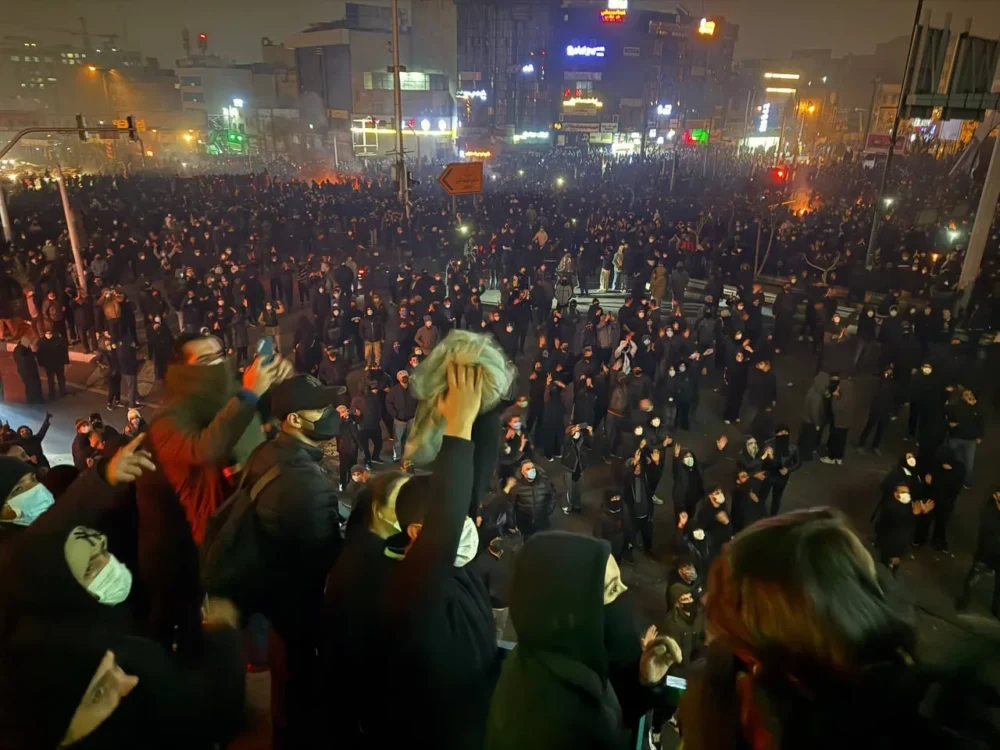
After a year that delivered crushing reversals to its regional sway and deterrence, Iran’s Islamic Republic has begun 2026 besieged by historic internal upheaval. The anti-government demonstrations that began percolating across the country in late December in response to the catastrophic decline in its currency have intensified in recent days into something resembling a revolution. In cities across Iran, thousands have come to the streets despite massive state repression, denouncing regime leaders and smashing its symbols and attacking its infrastructure.
A battle for the future of Iran is being waged on its streets by its citizens, but at present, they are facing steep odds. Tehran’s brutal response—an internet blackout, recalcitrant rhetoric, and a large-scale bloody assault on protesters—has not extinguished the uprising. However, the regime’s immense coercive and surveillance capabilities and its existential determination to prevail offer a decisive advantage. Credible reports of more than 10,000 detained and 6,000 killed over the past several days are likely an underestimate of the atrocities committed while the country was cut off from the world.
As the protests escalated, President Donald Trump took to social media to issue unprecedented White House commitments to intervene on behalf of protesting Iranians, promising that Washington is “locked and loaded” to “rescue” Iranians on the street. The administration is considering a variety of military and non-military options, but as I argue elsewhere, the military option comes with some risks and much more limited prospects of delivering much, if any, near-term relief for Iran’s beleaguered population.
That does not imply American inaction. Trump should rally the world to finally and fully treat the Islamic Republic as the pariah state it is and invest in meaningful support to the revolution underway on Iran’s streets—including efforts to end the internet blackout, tighten sanctions, close embassies, expel Iranian officials, and build capacity for human rights documentation and opposition training.
The Islamic Republic heads toward collapse
Even if it survives this latest upheaval, the theocratic regime is moving steadily closer to its own collapse. Mass violence by Iran’s security forces may succeed in quieting the streets temporarily, but Iran’s leadership has no durable pathway for alleviating the economic hardships that have repeatedly precipitated unrest in recent years or reclaiming its dominance of the regional landscape.
In the midst of this war with its own people, the Iranian regime was already on the cusp of a precarious transition for its 86-year-old supreme leader, Ayatollah Ali Khamenei. He is already receding from public engagement and has no clear or compelling successor thanks to the unexpected death of Iran’s president, Ebrahim Raisi, in a May 2024 helicopter crash and the aging of the revolutionary generation.
After constructing an expansive posture across the wider Middle East over the past four decades, Tehran has recently suffered vast regional setbacks. Its once fearsome proxy militias have been reduced to a shell of their former capabilities; its transnational reach has been disrupted by the demise of Bashar al-Assad’s regime in Syria; and its nuclear program and air defenses have been decimated by Israeli and American attacks.
And at home, each successive volley of unrest over the past 20 years has left its legacy, eroding the regime’s capacity to impose its will on society while deepening popular resistance to the regime and its impositions. The most tangible example is the widespread public disregard for compulsory hijab laws since the 2022-2023 “Women, Life, Freedom” protest movement that emerged after the death of Mahsa Amini.
A crisis long in the making
This should come as no surprise to anyone who has followed Iran closely. Five years ago, in a book of essays reflecting on the legacy of the 1979 Iranian revolution, I anticipated that the regime’s well-practiced playbook for retaining its grip on power would ultimately fail. As I wrote at the time, “The system cannot be reformed sufficiently or successfully. Instead, the nature of the post-revolutionary state and its relationship with the world must be fundamentally transformed. In the Islamic Republic, that is quite literally heresy—a reality that may help to explain the ferocity of the passions on both sides of the debate that is unfolding inside Iran.
“What this heralds for the Islamic Republic in the near term is neither revolution nor collapse, but rather a slow-motion metastasis that is echoing across the political establishment, the economy, and society. The trajectory is uncertain, but the repercussions are expanding the boundaries of Iran’s political imagination beyond the personality politics of the clerical state’s insular elite: Iranians are no longer asking simply who comes next in the forty-year procession of regime troubleshooters; rather, they are increasingly beginning to wonder what might come next.
“This is an episode of monumental importance, a tectonic shift that is unfolding almost entirely beneath the radar of most of the Western media and under a shadow of uncertainty surrounding Iran’s future and its relations with the broader international community. The tumultuous history of Iran’s evolution should check any temptation toward easy optimism: Progress is rarely linear and, given the Islamic Republic’s survival instincts, the political atmosphere within Iran is bound to get worse before it gets better.”
Between unthinkable and inevitable
Six years ago, I wrote that “the prospect of meaningful change in Iran forever lies somewhere between unthinkable and inevitable. At the moment, signs suggest that the pendulum may be swinging toward change.” Iranians have now launched their revolution; with an American-led effort to apply unprecedented pressure on the regime and provide additional support to the opposition, they can prevail.
Source : brookings.edu