








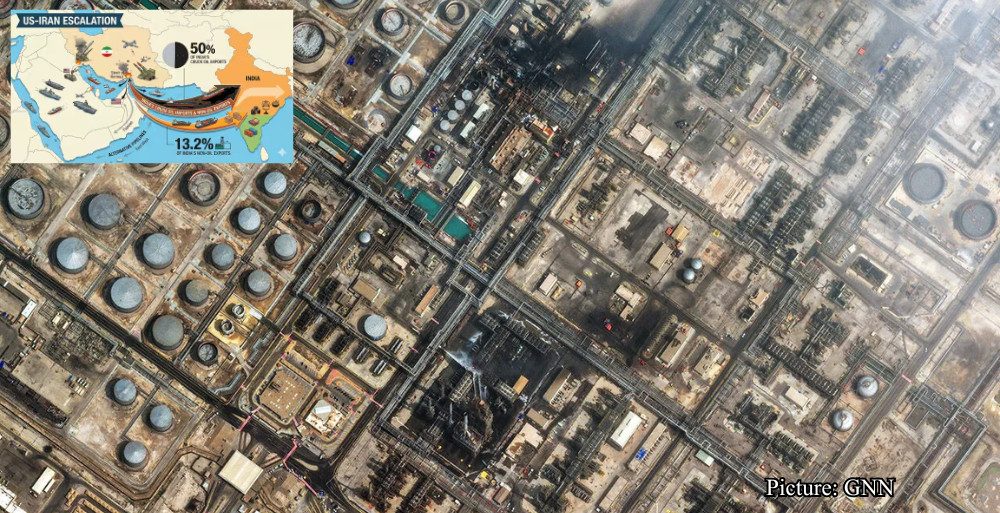
The escalating conflict between a U.S.-Israeli coalition and Iran has triggered the de facto closure of the Strait of Hormuz, paralyzing the world’s most vital energy artery. Analysts warn that the resulting production cuts by major exporters represent the most significant disruption to global oil supplies in history, threatening a systemic collapse of industrial productivity.
The global energy landscape, long defined by its delicate balance of supply and demand, has shifted from a state of volatility into a full-scale unprecedented collapse. As the military confrontation between the U.S.-Israeli alliance and Iran intensifies, the primary concern for global economists is no longer the price of a barrel of crude, but rather its total physical absence from the market. The effective shuttering of the Strait of Hormuz—a narrow waterway through which roughly 21% of the world’s daily petroleum consumption passes—has effectively severed the jugular of the global economy.
Energy historians and market analysts are now describing the current situation as a “nightmare scenario” that dwarfs the oil shocks of 1973 and 1979. Unlike previous crises, which were defined by price hikes or localized embargoes, the current impasse involves the complete structural removal of Middle Eastern supply from the global ledger. With tankers unable to traverse the Persian Gulf due to minefields, drone swarms, and active naval engagements, top oil producers in the region have been forced to take the drastic step of slashing output, as storage facilities reach capacity with nowhere for the product to go.
The economic implications are catastrophic and immediate. In the halls of power from Brussels to Tokyo, the focus has shifted toward emergency rationing and the preservation of critical infrastructure. “We are witnessing the first truly global energy seizure,” says Dr. Elena Vance, a senior energy fellow at the Institute for Strategic Resource Analysis. “This isn’t a matter of paying more at the pump; it is a matter of whether the power stays on for industrial manufacturing and whether the logistical chains that feed the world can remain operational. The math simply does not work without the five core Gulf exporters.”
On the ground, the military reality has outpaced diplomatic efforts to maintain maritime security. The U.S. Fifth Fleet, while maintaining a significant presence, has found it increasingly difficult to guarantee the safety of commercial vessels against Iran’s asymmetric warfare capabilities. The “de facto” closure occurred not through a formal blockade, but through a series of kinetic strikes that have made insurance premiums for tankers non-existent, effectively grounded the fleet by financial and physical risk.
This disruption comes at a time when the global economy was already struggling with inflationary pressures and a fragile post-pandemic recovery. The International Monetary Fund (IMF) has reportedly begun drafting emergency memos warning of a “synchronized global recession” if the Strait remains closed for more than 30 days. For countries like Japan, South Korea, and China, which rely on the Persian Gulf for the vast majority of their energy needs, the crisis is existential. Beijing has already signaled that it views the disruption as a direct threat to its national security, complicating an already fraught geopolitical environment.
Major oil companies, including ExxonMobil and Shell, have issued statements indicating that their upstream operations in the region are being “mothballed” to prevent environmental disasters and to protect personnel. The curtailing of production is a technical necessity; once storage tanks are full and pipelines are backed up, the wells must be capped. However, restarting these wells is not as simple as flipping a switch. The technical degradation that occurs during unplanned shutdowns could mean that even if the war ended tomorrow, global supply would not return to pre-war levels for months, if not years.
Politically, the Biden administration faces a deepening crisis at home and abroad. While the administration maintains that the military action is a necessary response to Iranian aggression, the domestic fallout of spiraling energy costs—with gasoline projected to hit double digits in several U.S. states—is creating a domestic political firestorm. “The strategic oil reserves were meant for short-term disruptions,” notes Marcus Thorne, a veteran political strategist. “They were never intended to mitigate the total loss of the Persian Gulf’s output. We are in uncharted waters, both literally and figuratively.”
The ripple effects are moving through the petrochemical industry, affecting everything from plastic production to fertilizer manufacturing. As the output of natural gas and oil derivatives slows to a trickle, the agricultural sector is bracing for a secondary crisis. Without the energy-intensive processes required to create nitrogen-based fertilizers, global food security is now being linked directly to the naval maneuvers in the Gulf of Oman.
As the sun sets on another day of heightened military activity, the “guru” warnings of a permanent shift in the global order seem less like hyperbole and more like a sober assessment of a crumbling status quo. The world is learning, in real-time, the true cost of its reliance on a single, vulnerable geographic point. The disruption of history is no longer a forecast; it is the current reality.