









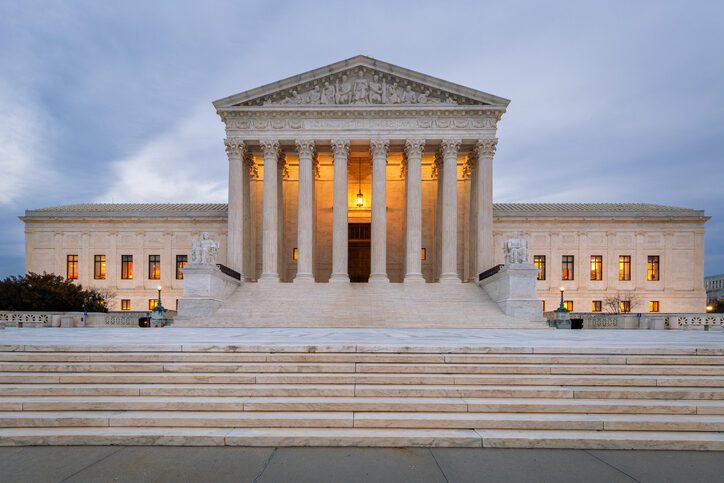
The U.S. Supreme Court appears ready to upend nearly a century of precedent that has limited the president’s authority to remove leaders of independent federal agencies—a move that could dramatically reshape how power is distributed across the federal government.
At the center of this historic case is Rebecca Kelly Slaughter, a Democratic commissioner on the Federal Trade Commission (FTC). Slaughter was originally appointed by President Trump in 2018 and later reappointed by President Biden, with her term set to run through 2029. But in March this year, she received an email from the White House abruptly removing her from office—without any statutory cause.
Slaughter challenged her removal, citing clear legal protections established under longstanding precedent. But during Monday’s arguments, the Supreme Court’s conservative justices showed strong interest in revisiting that precedent and giving presidents far greater control over agency officials.
Court’s Conservative Majority Questions 90-Year Precedent
The key legal foundation under review is Humphrey’s Executor (1935), a ruling that prevents presidents from firing commissioners of independent agencies—like the FTC—unless there is proof of inefficiency, neglect of duty, or malfeasance.
Chief Justice John Roberts questioned whether that decision still makes sense today, arguing that the FTC now holds far more executive authority than when the 1935 ruling was issued.
The liberal justices pushed back forcefully. Justice Sonia Sotomayor warned that overturning the precedent would fundamentally alter the U.S. government’s checks and balances:
“You’re asking us to destroy the structure of government and take away Congress’ power to design agencies that function independently,” she said.
By contrast, conservative justices were more receptive to the administration’s arguments. Solicitor General D. John Sauer insisted the change would not destabilize government:
“The sky will not fall. The government will simply become more accountable to the people.”
Slaughter’s Firing and Legal Challenge
Congress created the FTC in 1914 as a bipartisan body insulated from political pressure. By law, no more than three of the five commissioners can belong to the same political party, and commissioners can only be removed for cause.
Slaughter received no such explanation—only a statement that her continued service conflicted with the administration’s priorities. A federal court found her removal unlawful and ordered her reinstatement. But in September, the Supreme Court—in a 6–3 ideological split—temporarily allowed her removal to remain in effect pending the outcome of the case.
A Case with Major Implications
The legal and political stakes extend far beyond the FTC.
During Trump’s second term, the administration has also removed Democratic members from other independent bodies, such as:
- The Equal Employment Opportunity Commission
- The Merit Systems Protection Board
- The Consumer Product Safety Commission
The administration argues that Humphrey’s Executor was flawed from the start and that agencies like the FTC always exercised executive power. If the Court agrees, presidents would gain sweeping authority to remove officials at will—fundamentally changing how independent agencies operate.
A Trend Already Underway
The Supreme Court has been steadily narrowing Humphrey’s Executor for years. During Trump’s first term, the Court allowed him to fire the director of the Consumer Financial Protection Bureau (CFPB). Chief Justice Roberts described Humphrey’s Executor as applying only to multi-member bodies that do not exercise significant executive power.
Just last week, the D.C. Circuit Court of Appeals echoed that reasoning, ruling that Trump was legally allowed to remove members of the Merit Systems Protection Board and National Labor Relations Board because those agencies hold “significant executive authority.”
A Clash of Constitutional Visions
Slaughter argues that maintaining independence is crucial:
“Americans deserve decisions based on facts—not political pressure.”
But Trump-aligned legal thinkers disagree. Attorney James Burnham said:
“There’s no such thing as a truly independent agency. These removal protections were unconstitutional from the beginning.”
What Comes Next?
The Supreme Court will revisit the broader question of presidential removal power on January 21, when it hears arguments involving Trump’s attempted firing of Federal Reserve Governor Lisa Cook. That case may be even more consequential, given the central bank’s influence over the economy.
The Court’s ruling could redefine the structure of the administrative state—and determine whether presidents can, in effect, reshape regulatory agencies at will.