







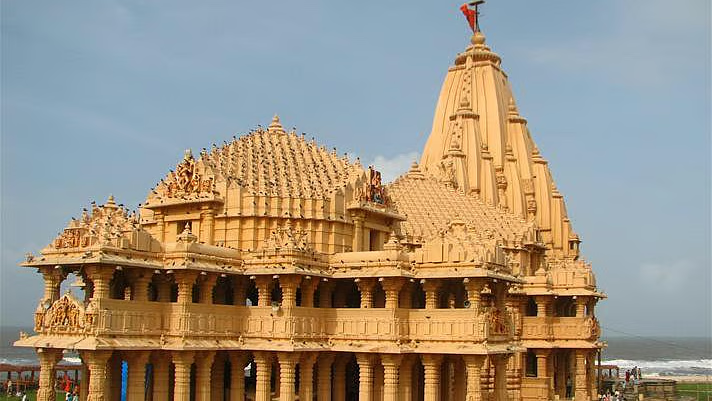
The year 2026 carries a profound historical resonance for India. It marks 1,000 years since the 1026 CE attack on the Somnath Temple by Mahmud of Ghazni, an event often remembered as one of the earliest and most symbolic assaults on India’s civilisational and spiritual heritage. Yet 2026 also marks 75 years since Somnath’s modern reopening, a moment that reflected not destruction, but renewal — and a defining debate about the soul of a newly independent nation.
On May 11, 1951, the restored Somnath Temple was formally opened to devotees in the presence of India’s first President, Dr Rajendra Prasad. The moment was historic, deeply emotional, and politically sensitive. While the event symbolised civilisational continuity for many Indians, it also exposed ideological fault lines at the highest levels of the post-Independence leadership — particularly between Prime Minister Jawaharlal Nehru on one side and leaders like Sardar Vallabhbhai Patel, Rajendra Prasad, and K M Munshi on the other.
A Temple That Refused to Die
Somnath’s story is not merely about a single act of medieval violence. Over centuries, the temple was attacked, destroyed, and rebuilt multiple times — each reconstruction becoming an act of defiance against cultural erasure. From local devotees to rulers like Ahilyabai Holkar, generations ensured that Somnath remained a living shrine, not a relic of defeat.
In the late 19th century, Swami Vivekananda’s visit to Somnath left a lasting impression on him. Speaking later in Chennai, he observed:
“Mark how these temples bear the marks of a hundred attacks and a hundred regenerations, continually destroyed and continually springing up out of the ruins, rejuvenated and strong as ever.”
His words captured Somnath’s essence — a symbol not of victimhood, but of regeneration.
Patel’s Diwali Resolve
After Independence in 1947, the responsibility of restoring Somnath fell upon Sardar Vallabhbhai Patel, India’s Deputy Prime Minister and Home Minister. During a Diwali visit to the ruins of Somnath, Patel was deeply moved. Standing by the Arabian Sea, he announced that the temple would be rebuilt at its original site.
For Patel, rebuilding Somnath was not an act of religious triumphalism but a civilisational necessity. It was about restoring confidence to a people emerging from centuries of subjugation.
Unfortunately, Patel did not live to see the fulfilment of his vision. He passed away in December 1950, months before the temple’s reopening. But his resolve shaped everything that followed.
Nehru’s Reluctance and Rajendra Prasad’s Stand
Prime Minister Jawaharlal Nehru was uneasy with the reconstruction and reopening of Somnath, particularly the involvement of the President and senior ministers. He feared that state participation in the event would project India as a religious nation rather than a secular republic.
Nehru reportedly wrote that such ceremonies could create a “bad impression” internationally and urged that the government distance itself from the event.
But President Rajendra Prasad disagreed.
Despite Nehru’s reservations, Prasad chose to attend and inaugurate the temple. For him, Somnath was not merely a place of worship but a symbol of national self-respect and historical continuity.
His presence on May 11, 1951, sent a powerful message: secularism did not require cultural amnesia.
The Role of K M Munshi
No account of Somnath’s revival is complete without Kanhaiyalal Maneklal Munshi — freedom fighter, scholar, and one of the temple’s most tireless advocates. Munshi worked closely with Patel and later documented Somnath’s saga in his seminal work, “Somanatha: The Shrine Eternal.”
Munshi argued that acknowledging India’s civilisational wounds and healing them was not communalism, but cultural honesty. His writings helped frame Somnath not as a partisan symbol, but as a testament to endurance.
A Thousand Years Later
Today, as Somnath approaches both the millennium of its destruction and the 75th anniversary of its modern reopening, its meaning has only deepened. The waves of the Arabian Sea still crash against its shores, just as they did in 1026 and 1951 alike.
The invaders of history have faded into footnotes. Somnath remains.
As the temple stands radiant once more, it reminds India — and the world — that while hatred and fanaticism may destroy in moments, faith, conviction, and cultural continuity possess the power to create for eternity.