





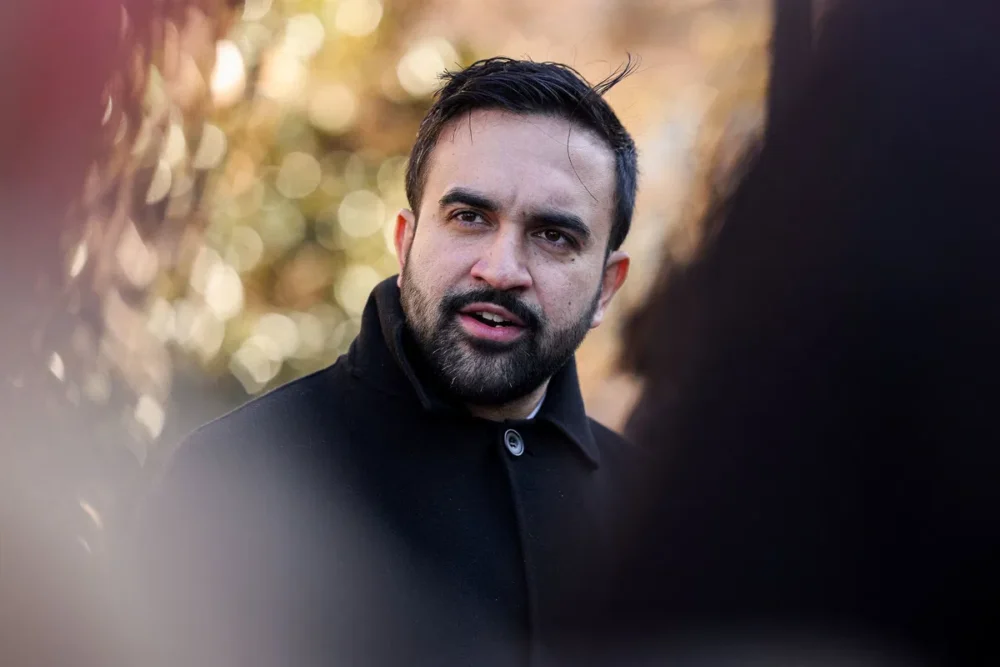
New York City is entering a pivotal political moment as a reform-oriented mayor prepares to take office at a time when the nation’s largest police force is experiencing rare institutional stability and measurable progress on public safety. With New York Police Department reporting sharp declines in shootings and homicides, Mayor-elect Zohran Mamdani is inheriting a police department that, for the first time in years, is operating under consistent leadership and a unified crime-reduction strategy.
Central to that stability is Police Commissioner Jessica Tisch, who will remain at the helm under the incoming administration. Her continuation marks a significant departure from the turbulence of recent years, during which the NYPD cycled through four commissioners amid corruption scandals and internal upheaval under former Mayor Eric Adams.
Continuity at the Top Signals a Strategic Shift
Tisch’s decision to stay on has reassured business leaders, security experts, and rank-and-file officers who feared renewed disruption with a progressive mayor long known for his criticism of the NYPD. Since taking over, Tisch has halted controversial promotions, reinstated respected former executives, and tightened oversight of leadership decisions—moves that have helped restore credibility within the department.
“I’ve had a number of great conversations with the mayor-elect and his team,” Tisch said during a December briefing focused on subway safety. “They are committed to public safety and are very pleased with the results they’re seeing, both below ground and above ground.”
Mamdani echoed that sentiment in a statement announcing Tisch’s retention. “I have admired her work cracking down on corruption in the upper echelons of the police department, driving down crime in New York City, and standing up for New Yorkers,” he said. “Together, we will make sure police focus on serious and violent crime.”
Crime Numbers Show Historic Declines
The NYPD’s latest year-end data underscores why continuity matters. As of late December, shootings were down nearly 24% year-over-year, with 674 incidents compared to 886 at the same point last year. Shooting victims also fell by almost 22%, while homicides dropped nearly 21%, from 375 to 297.
According to the department, the first 11 months of the year recorded the lowest number of shooting incidents and victims since statistics have been kept, surpassing previous lows set in 2018.
“These historic gains are the result of precision policing,” Tisch said. “Our plan is working, and the progress is real.”
Chief of Department Michael LiPetri credited the decline to advanced data analysis and targeted deployments. By using density-based clustering tools to identify violent crime hot spots, the department deployed up to 2,300 officers nightly across 72 high-risk zones, particularly on weekends when violent crime typically spikes.
Quality of Life Policing Returns—With Debate
In August, the NYPD launched its Quality of Life Division, responding to more than 530,000 non-emergency 311 calls and cutting response times by about 20 minutes. While supporters argue the initiative addresses community concerns more efficiently, critics say it resembles a revival of “broken windows” policing.
“They are responding to calls for service from the community,” LiPetri said. “When it takes two hours to respond to disorder complaints, that’s a problem. Now, we’re doing better.”
Staffing Gains, But Retention Remains a Challenge
The department hired over 4,000 new officers in 2025, the largest intake in NYPD history, bringing total strength to approximately 34,700 uniformed members. Still, retirements and resignations—more than 3,400 in the past year—have offset much of that growth, according to the Police Benevolent Association (PBA).
Union leaders say concerns over workload, oversight bodies, and quality-of-life issues continue to affect morale. “The commissioner staying has helped, but morale is still low,” said PBA President Patrick Hendry. “Officers are thinking about their families, pay, and the grind of the job.”
Political Crosscurrents and External Pressure
Mamdani’s past calls to defund the police and harsh critiques of the NYPD have been seized upon by law enforcement agencies nationwide attempting to recruit New York officers. Police unions and departments in states like Texas and Florida have publicly pitched themselves as alternatives, arguing officers may face reduced support under the new mayor.
Mamdani, however, has distanced himself from those earlier statements, visiting the police memorial in Lower Manhattan shortly after the election and reiterating his commitment to enforcing the law.
A Steadying Hand in a Sensitive Transition
For now, Tisch’s continued leadership appears to be a stabilizing force during a politically sensitive transition. A career public servant and former sanitation commissioner, she is widely viewed as an apolitical administrator focused on governance rather than ideology.
As New York balances reform ambitions with public safety realities, the coming months will test whether this alignment between a progressive mayor and a data-driven police leadership can sustain recent gains. For a city long defined by cycles of crime, reform, and backlash, the stakes could hardly be higher.