






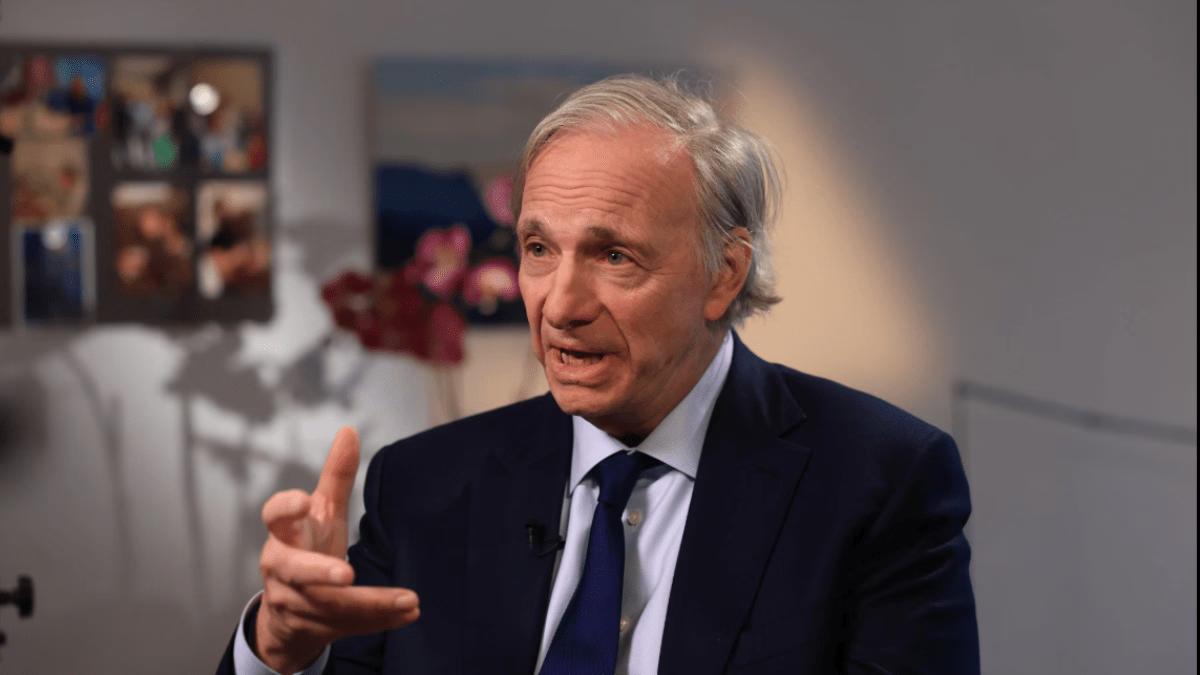
At a time when the global order appears increasingly fragile, billionaire investor Ray Dalio believes India is entering one of the most promising phases in its modern history. Speaking on a podcast with Zerodha co-founder Nikhil Kamath, Dalio laid out a sweeping framework of historical forces that, in his view, explain how nations rise, decline and reposition themselves when old systems break down. Within that framework, India, he argued, stands out as uniquely well placed.
Dalio, the founder of Bridgewater Associates, has long argued that history moves in recurring cycles rather than through random shocks. According to him, the world today is witnessing the collision of several powerful forces that typically signal the end of one global order and the birth of another. Against that unsettled backdrop, India’s trajectory looks unusually favourable.
“India is going to have probably the best fundamentals to have the best growth rate,” Dalio said. “You’re going from not having enough money to having that infrastructure.” In his assessment, India is at a “wonderful arc” in its history — a phase where institutional development, infrastructure expansion and human capital can align to deliver sustained, above-average growth.
Why Dalio Is Bullish on India
Dalio’s optimism rests on a combination of structural factors. India, he noted, carries a relatively low debt burden compared to other major economies. It also has a large, young and increasingly skilled population, alongside rapid progress in both physical infrastructure — roads, ports, logistics — and digital public infrastructure.
These ingredients, Dalio believes, mirror the conditions that powered China’s extraordinary growth over the past several decades. Drawing a provocative comparison, he likened Prime Minister Narendra Modi to Deng Xiaoping, suggesting that Modi is laying the kind of foundational reforms that enabled China’s long economic ascent starting in the late 20th century.
At the same time, Dalio was careful not to oversell India’s current power. “It still has development to do,” he cautioned. “It is more akin to where China was 30 years ago than where China is today.” But that gap, he argued, represents opportunity rather than weakness. India’s relative underdevelopment compared to advanced economies gives it room to grow faster for longer.
The Five Forces Shaping the Global Future
At the core of Dalio’s worldview is a belief that five recurring forces shape both markets and geopolitics.
The first is the debt and money cycle. Credit, Dalio explained, fuels growth but also creates obligations. When debt grows faster than incomes, financial systems become fragile and currencies lose value. “The world is producing too much debt,” he said, a condition that historically favours hard assets over paper money.
The second force is internal political order and disorder. This reflects widening gaps between the rich and the poor and the resulting polarisation between what Dalio broadly describes as the “left” and the “right.” As inequality deepens, compromise erodes and politics becomes a zero-sum contest, undermining effective governance.
The third force is the international world order. Dalio argues that the multilateral system established after 1945 — anchored by institutions such as the UN and WTO — is effectively over. “You come out of a war, and the dominant powers determine how the world order works,” he said. Today, that consensus has fractured.
The fourth force is acts of nature. From pandemics to climate shocks, Dalio stressed that natural events have historically reshaped societies more profoundly than wars, yet remain underestimated in economic planning.
The fifth force is technology and human inventiveness. Dalio described the current era as a “technology war,” arguing that leadership in areas like advanced semiconductors and artificial intelligence will determine future economic and geopolitical dominance. “Whoever wins that,” he said, “wins almost everything.”
From Cooperation to Competition
Taken together, these forces point to a sobering conclusion. The world, Dalio believes, is moving away from cooperation and toward competition. Countries are increasingly mapping their strategic dependencies — in trade, capital and technology — and seeking ways to reduce vulnerabilities while pressuring rivals.
This shift is already visible in trade wars, technology restrictions and geopolitical influence battles — classic precursors, Dalio warned, to more serious conflicts. In such periods, history shows that neutral countries often fare best, while both winners and losers of major conflicts emerge burdened by debt and destruction.
For India, this changing landscape may offer a rare opening. As old rules weaken and new power dynamics emerge, Dalio sees India’s scale, talent base and reform momentum positioning it as one of the strongest contenders in the next phase of global growth.
Whether India fully capitalises on this “wonderful arc” will depend on execution, governance and its ability to navigate an increasingly competitive world. But in Dalio’s long view of history, moments like this — when multiple forces align — do not come often.