







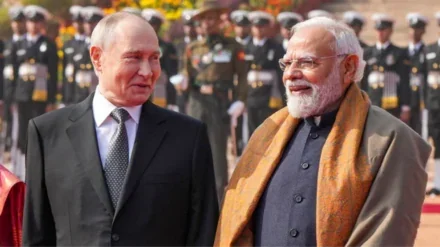
Russian President Vladimir Putin received an exceptionally warm welcome as he arrived in New Delhi for his two-day visit — his first trip to India since the Ukraine invasion nearly four years ago. Prime Minister Narendra Modi personally greeted him at the airport, followed by a limousine ride together, hugs, and a high-profile ceremonial welcome across the capital. Devotional lamps along the Ganges even spelled out “Welcome Putin” during an evening prayer event shared widely online.
The visit served not only as a reaffirmation of India’s longstanding ties with Russia but also as a clear message to Washington. The Trump administration has recently punished India through steep tariffs and public criticism for continuing to purchase discounted Russian oil.
A Diplomatic Message to the U.S.
According to Chietigj Bajpaee of Chatham House, India’s red-carpet treatment of Putin underscores a key point:
“India has options.”
Despite mounting Western pressure to reduce ties with Moscow, New Delhi is signaling that it will not be coerced into abandoning a relationship that has endured for decades — dating back to the Cold War era, when India leaned towards the Soviet Union amid tensions with Pakistan, the United States, and China.
Putin’s visit also carries symbolic weight for Russia. Since the International Criminal Court issued an arrest warrant for him in March 2023, his international travel has been limited. A visit to “the world’s largest democracy,” experts say, grants him considerable global visibility.
Putin Promises Steady Fuel Supplies
Following bilateral talks on Friday, both leaders announced several new agreements, including a program allowing more Indian workers to be employed in Russia.
Putin also emphasized Moscow’s commitment to India’s energy needs, saying through a translator:
“Russia is ready to continue uninterrupted fuel shipments to support India’s fast-growing economy.”
India is now one of the world’s biggest buyers of Russian oil, having sharply increased purchases after the Ukraine invasion.
Russian Oil Under Pressure
However, recent U.S. sanctions and tariff hikes have forced Indian refiners to scale back purchases. Trump’s administration doubled tariffs on India to 50%, imposing penalties on Kremlin-linked producers.
India’s largest buyer of Russian crude, Reliance Industries, halted imports in November to comply with a new European Union ban on refined products made from Russian oil.
Despite these obstacles, experts note that Russian oil is still arriving through a network of sanctions-evading “shadow fleet” vessels that use forged flags and disguises to operate unnoticed.
India has consistently argued that U.S. pressure is “unreasonable,” pointing out that both the EU and the U.S. continue to buy certain Russian energy products themselves.
India Walks a Diplomatic Tightrope
India is carefully balancing its relationships — increasing purchases of American oil and natural gas to ease tensions with Washington while deepening ties with Russia.
Bajpaee notes:
“India is navigating a difficult path — keeping close ties with Moscow while strengthening engagement with the West.”
Modi’s statement referred delicately to the Ukraine war as “the situation in Ukraine,” reiterating India’s support for a peaceful resolution without directly condemning Russia.
Meanwhile, U.S. special envoy Steve Witkoff and Jared Kushner recently held a five-hour meeting with Putin, though the Russian leader dismissed key American proposals.
Key Agreements and Long-Term Outlook
During the summit, India and Russia:
- Finalized a plan to boost bilateral trade to $100 billion by 2030
- Announced more opportunities for Indian workers in Russia
- Reaffirmed defense cooperation, including future joint production of advanced weapon platforms
Although Russia remains India’s largest arms supplier, its share has declined as India diversifies with Western, Israeli, and domestic systems.
Bajpaee argues that despite India’s growing U.S. partnership — including more joint military exercises with the U.S. than any other country — the India–Russia relationship is still seen as dependable in many respects.
From New Delhi’s perspective, he says:
“Recent developments show Russia may be more reliable than the U.S., whose behavior can sometimes be unpredictable.”