



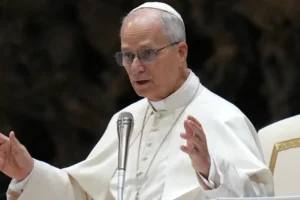


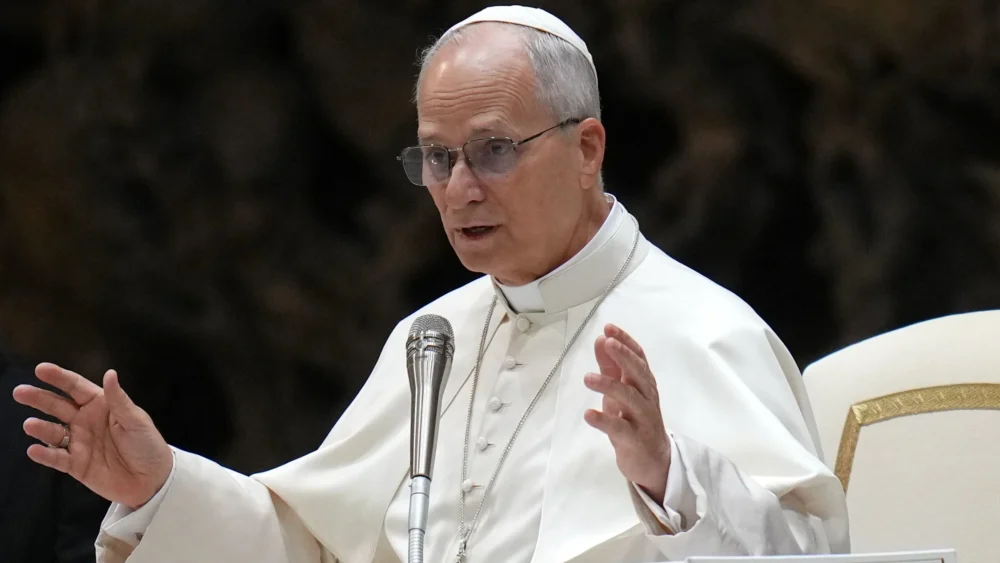
The world is drifting dangerously toward a mindset in which war is no longer seen as a last resort but as an acceptable instrument of policy, Pope Leo XIV warned on Friday, raising alarms over eroding human rights, weakened international law, and a growing reliance on force over dialogue.
Addressing the Diplomatic Corps accredited to the Holy See during the Vatican’s traditional New Year exchange, the Pope delivered a sweeping moral assessment of global affairs, cautioning that the foundations of peaceful coexistence painstakingly built after the Second World War are being steadily dismantled.
“War is back in vogue,” Pope Leo XIV said, warning that peace is increasingly pursued “through weapons rather than justice,” a shift he described as deeply corrosive to international law and human dignity.
A Moral Barometer for the World
The annual address to ambassadors is widely regarded as one of the Vatican’s most significant diplomatic moments — often described as the Pope’s “State of the World” speech. Unlike conventional geopolitical briefings, the address offers a moral diagnosis of global affairs, urging leaders to look beyond national interests and consider the ethical consequences of their decisions.
For Pope Leo XIV, who assumed the papacy only months ago, the occasion also marked his first major diplomatic address. He described the moment as both humbling and urgent, saying the Church’s role in international life is to defend dialogue, protect the vulnerable, and insist that peace must be rooted in truth rather than dominance.
Borders, Power, and the Return of Force
At the heart of the Pope’s warning was the erosion of a key post-war principle: that national borders should never be altered by force.
“The principle established after the Second World War — that nations must not use force to violate the borders of others — has been completely undermined,” he said.
Peace, he added, is increasingly framed as something imposed rather than shared — “a peace pursued through weapons as a means of asserting dominion.” Such thinking, the Pope warned, “gravely threatens the rule of law, which is the foundation of all peaceful civil coexistence.”
Drawing on Saint Augustine’s reflections in The City of God, Pope Leo XIV noted that even those who wage war ultimately seek peace — but often only “the peace they desire,” one shaped by control rather than justice. History, he suggested, has already shown the catastrophic consequences of that illusion.
Civilians, Law, and the Cost of Conflict
Moving from principle to human consequence, the Pope emphasized the centrality of international humanitarian law, insisting it must never be treated as optional.
“Compliance with humanitarian law cannot depend on circumstances or strategic interests,” he said. “It is a commitment states have made, and it must always prevail over the ambitions of belligerents.”
He strongly condemned attacks on civilians and civilian infrastructure, including hospitals, energy systems, and homes, reiterating that the dignity of the human person must outweigh any national or military advantage.
“The protection of the inviolability of human dignity and the sanctity of life always counts for more than any mere national interest,” he said.
Naming Conflicts, Calling for Ceasefires
The Pope applied this moral framework to several active global crises, beginning with Ukraine. He reiterated the need for an immediate ceasefire and renewed dialogue “motivated by a sincere search for peace,” offering the Holy See’s support for any initiative that could end the suffering of civilians.
Turning to the Holy Land, he expressed concern that despite temporary truces, civilians in Gaza continue to face a severe humanitarian crisis. He reaffirmed support for a two-state solution as the only viable political framework capable of addressing the legitimate aspirations of both Palestinians and Israelis and condemned rising violence against Palestinian civilians in the West Bank.
He also referenced tensions in the Caribbean, Venezuela’s political crisis, instability in Haiti, conflicts in Sudan and South Sudan, unrest in the Great Lakes region of Africa, and Myanmar’s worsening humanitarian emergency — calling repeatedly for inclusive dialogue and unhindered humanitarian access.
Nuclear Weapons and the Ethics of Artificial Intelligence
Pope Leo XIV warned that the logic of deterrence continues to fuel arms races, particularly as nuclear arms control agreements weaken. He highlighted the looming expiration of the New START Treaty as a dangerous moment that could accelerate global instability.
He also raised concerns about the militarization of artificial intelligence, arguing that emerging technologies must be governed by ethical frameworks that preserve human responsibility.
“Peace cannot be entrusted to machines,” he cautioned, adding that AI “requires appropriate and ethical management” to prevent catastrophic misuse.
Migrants, Prisoners, and Forgotten Lives
The Pope extended his human rights appeal to migrants and prisoners, groups he said are too often reduced to statistics or security problems.
“Every migrant is a person,” he said, emphasizing that many are forced to flee violence, persecution, conflict, or climate disruption. Efforts to combat trafficking and crime, he warned, must never become excuses for stripping migrants of dignity.
He also spoke about prisoners, insisting that “they can never be reduced to the crimes they have committed.” He renewed his call for humane prison conditions, proportional sentencing, and the abolition of the death penalty, which he described as destroying “all hope of forgiveness and renewal.”
Language, Freedom, and Conscience
In a striking section of the address, Pope Leo XIV warned that language itself is being weaponized — distorted to deceive, silence, or exclude.
“When words lose their meaning, reality itself becomes debatable,” he said, cautioning against what he described as an emerging “Orwellian-style language” that claims to promote inclusion while narrowing the space for genuine freedom of expression.
He also defended freedom of conscience and religious liberty, calling conscientious objection “an act of fidelity to oneself” rather than rebellion. Religious freedom, he noted, remains one of the most violated human rights globally, affecting a majority of the world’s population.
Peace as a Moral Choice
Despite the severity of his diagnosis, Pope Leo XIV closed on a note of cautious hope. Peace, he said, is difficult but attainable when rooted in humility and forgiveness rather than fear.
“Peace is not an illusion,” he said. “It is a demanding but realistic good.”
Invoking Saint Francis of Assisi ahead of the 800th anniversary of his death, the Pope urged world leaders to cultivate “humble and peace-loving hearts,” concluding that history still offers a choice — between repeating old catastrophes or nurturing the fragile seeds of peace already present in the world.